
Understanding Pakistan’s Democratic Resilience Beyond India’s Claims
India’s Ministry of External Affairs (MEA) recently remarked that “democracy and Pakistan don’t go together,” a sweeping characterization that reflects less about Pakistan’s realities and more about...

India’s Ministry of External Affairs (MEA) recently remarked that “democracy and Pakistan don’t go together,” a sweeping characterization that reflects less about Pakistan’s realities and more about India’s own increasingly rhetorical approach to regional politics. Delivered by MEA spokesperson Randhir Jaiswal during a routine briefing, the comment is a familiar blend of political signaling and narrative politics. It is an attempt to shape perceptions abroad rather than engage with facts on the ground. When viewed against current democratic assessments from international bodies, India’s foreign policy messaging appears selective and strategically convenient, particularly at a time when its own democratic trajectory is under global scrutiny.
Questioning India’s Moral Authority
To begin with, India’s claim rests on an assumption of moral authority that the international community no longer accepts uncritically. Over the past five years, well regarded democracy and civil liberties indices have raised persistent concerns about the state of political freedoms inside India. Freedom House downgraded India to “Partly Free” in 2021, citing erosion of civil liberties, constraints on journalists, and tightened pressure on minority communities. The V-Dem Institute categorized India as one of the world’s fastest autocratizing countries, noting a closing civic space and the weakening of checks and balances. These empirical and academically grounded evaluations are not fringe reports. They are core reference points for researchers, policymakers, and international institutions evaluating democratic health.
None of these indices apply such severe criticism to Pakistan. Even in moments of political turbulence, Pakistan is consistently classified as a complex, hybrid democracy that is imperfect but pluralistic, contested but not collapsing. When India’s MEA reduces this entire landscape to a dismissive catchphrase, the gap between rhetoric and real democratic indicators becomes clear. It raises an obvious question: on what basis does India frame itself as a credible assessor of democratic norms in neighbouring states?
Pakistan’s Democratic Functionality
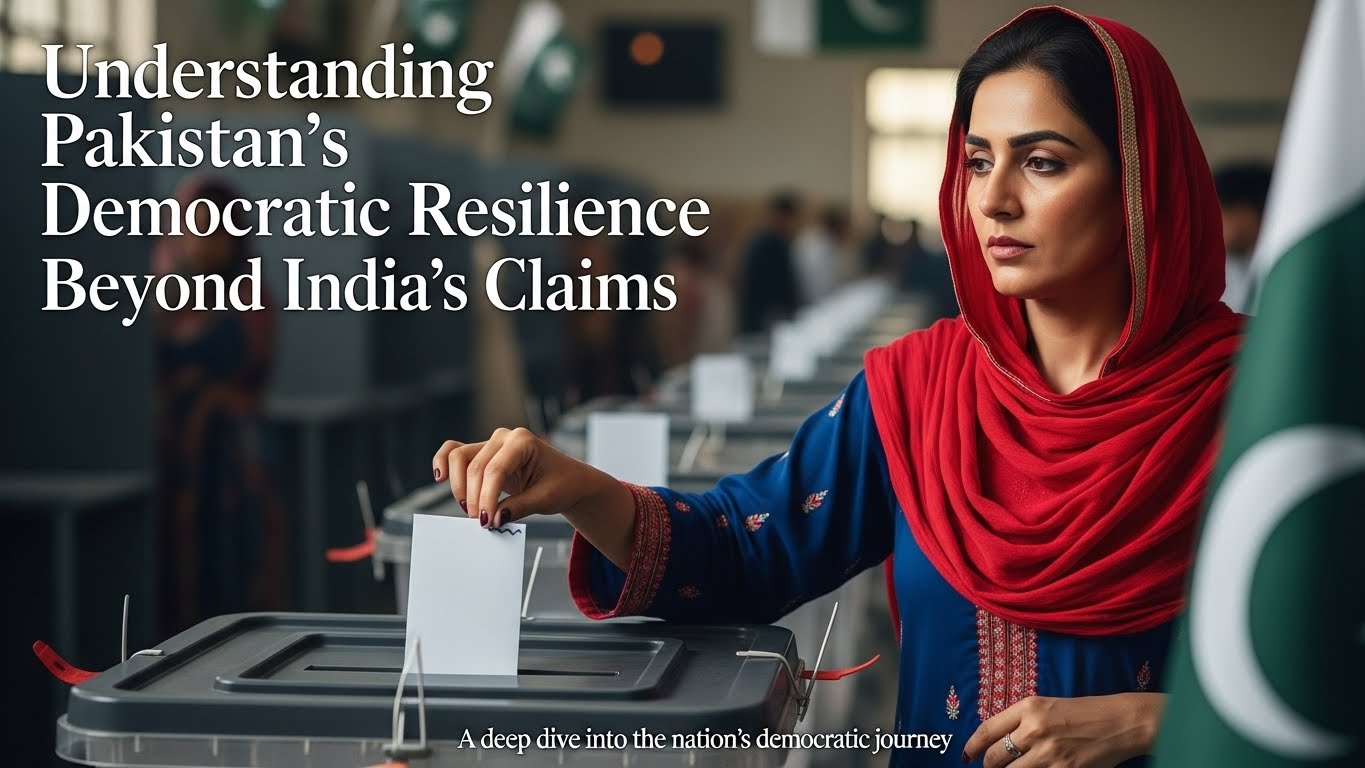
Pakistan’s democracy is undoubtedly turbulent, but turbulence is not the same thing as democratic absence. Pakistan continues to hold competitive elections, often fiercely contested and unpredictable. Political parties representing a wide ideological spectrum operate openly. Parliamentary committees scrutinize the executive. Courts intervene frequently and at times decisively. Pakistan’s media space remains noisy, fragmented, and vibrant, with newspapers and television channels openly critiquing state institutions. Media pluralism continues to function at a scale that is rare in many surrounding countries.
Most importantly, Pakistan’s political culture retains an unusual resilience. The nationwide demonstrations by supporters of former former former Prime Minister Imran Khan, outside courts, prisons, and in major cities, occur without sustained internet blackouts or sweeping preventive detentions. The state intervenes, at times contentiously, but the political space does not shut down. This capacity to absorb pressure and allow mobilization contradicts the MEA’s claim that democracy and Pakistan are somehow incompatible. If anything, Pakistan’s democracy is defined by its friction. Institutions respond, parties reorganize, coalitions shift, and society remains politically awake.
Structural Challenges and Regional Realities
The MEA’s statement also overlooks fundamental regional realities. Pakistan operates under structural constraints that few other democracies face simultaneously. These include a fluctuating security situation on the Pakistan-Afghanistan border, recurring militant spillover from Afghan soil, and active lines of tension with India itself. These pressures impose operational demands on every civilian administration. Yet even within this high-pressure environment, Pakistan’s constitutional architecture continues to function. Governments change through elections, prime ministers are held accountable, and political transitions, however messy, occur without the kind of one-party entrenchment seen in many other states.
India’s Narrative Strategy
India’s remarks also fall into a longer standing pattern in which Pakistan becomes a rhetorical tool during moments when New Delhi seeks to reinforce its narrative advantage internationally. With India increasingly criticized by global rights organizations for its treatment of minorities, shrinking press freedoms, and the use of investigative agencies against opposition leaders, projecting instability onto Pakistan becomes a convenient external talking point. It diverts attention, creates contrast, and feeds into an international storyline India has cultivated for years: that it is the region’s natural democratic anchor. However, narratives cannot indefinitely substitute for measured, evidence-based assessments.
Separating Rhetoric From Reality
For a foreign audience, it is important to separate the MEA’s political communication from substantive democratic analysis. The comment that “democracy and Pakistan don’t go together” was not rooted in data, academic research, or institutional evaluation. It was a rhetorical device that was short, sharp, quotable, and designed to travel quickly across headlines. Such simplifications flatten complex realities. They risk distorting diplomatic discourse and reducing nuanced democratic assessments to slogans. Democracies cannot be evaluated through soundbites. They require examination of institutions, pluralism, resilience, and the capacity for peaceful political competition. In all these areas, Pakistan continues to demonstrate functionality.
Conclusion
Ultimately, democratic strength is not measured by the volume of one’s claims but by the consistency of one’s practices. Pakistan’s democracy is evolving, sometimes unevenly, sometimes turbulently, but undeniably. It stands on sturdier ground than the MEA’s remark suggests. The region would benefit far more from honest introspection and constructive engagement than from dismissive statements crafted for diplomatic theatrics. If India seeks to be regarded as a responsible democratic actor, it must begin by applying to itself the same standards it so readily and selectively applies to its neighbours.
Author