


Ukrainian Drone Attack Ignites Blaze at Russian Oil Depot near Sochi as Cross-Border Strikes Intensify
A large fire engulfed a Russian oil depot outside the Black Sea resort town of Sochi on Sunday, after what Russian officials say was an early morning Ukrainian drone strike. The fire is a sharp...

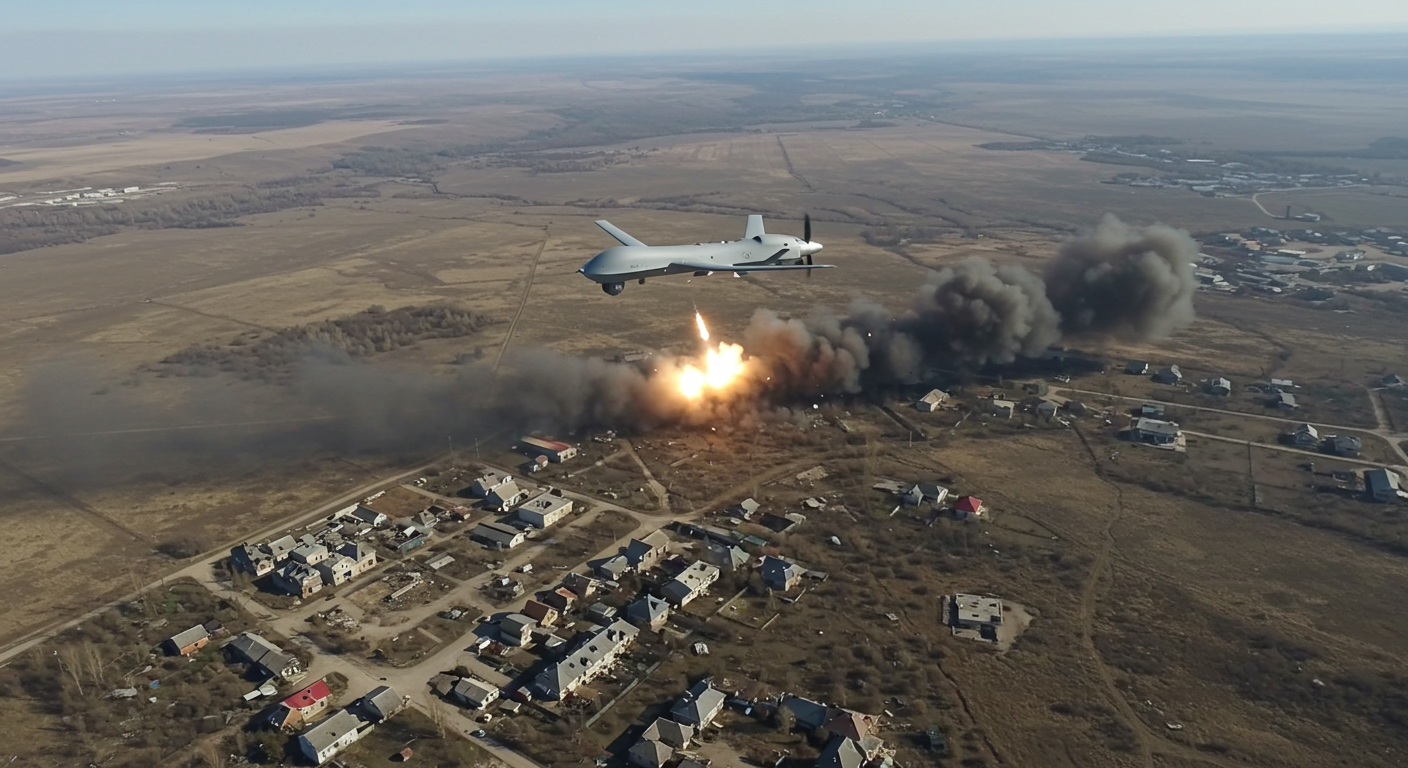
A large fire engulfed a Russian oil depot outside the Black Sea resort town of Sochi on Sunday, after what Russian officials say was an early morning Ukrainian drone strike. The fire is a sharp escalation in hostilities between Russia and Ukraine, who have been targeting each other’s energy and transport systems. The blaze began after the wreckage from a Ukrainian drone hit a gas tank at the depot, the governor of Russia’s Krasnodar region, Veniamin Kondratyev, said. More than 120 firefighters were sent to fight the blaze, which was subsequently brought under control. Nearby Sochi International Airport, a main venue of the 2014 Winter Olympics, suspended its flight activities for a short while as a precaution.
The Sochi drone attack is one of a series of cross-border attacks that have gained momentum in the past few weeks. Russian officials reported that Ukraine mounted several drone attacks over the weekend on oil and energy installations in various Russian cities such as Ryazan, Penza, and Voronezh. Four individuals were hurt in one of the attacks in Voronezh, which is near the Ukrainian border.
While Ukraine has not formally taken credit for the drone strikes, it has in recent months stepped up its attacks on Russian oil refineries, fuel storage facilities, and military bases. Most of these are perceived as being part of Ukraine’s campaign to disrupt Russia’s war effort and respond to Moscow’s ongoing attacks on Ukrainian civilian infrastructure.
Russia’s Defense Ministry asserted that its air defense systems shot down 93 Ukrainian drones overnight, of which 60 were flying over the Black Sea area. Ukraine countered that 83 drones and missiles were launched by Russia over the same time period, of which 61 were downed. Ukrainian officials said 16 drones and six missiles hit various cities and towns around the country.
In Ukraine’s southern city of Kherson, a critical bridge linking the Korabel Island neighborhood to the rest of the city was struck again by Russian forces. The Ostrivsky Bridge had already been damaged in previous attacks during the week. Sunday morning brought more Russian strikes destroying more of the bridge, prompting local authorities to declare a partial evacuation of the district. Approximately 1,800 residents remain in the affected neighborhood. At the same time, in the neighboring city of Mykolaiv, seven were injured by Russian shelling that destroyed houses and structures. Seven civilians were killed at the weekend in individual Russian attacks in the Kherson and Donetsk regions, Ukrainian officials stated.
These new attacks follow one of the deadliest weeks for civilians in Ukraine since February 2022 when the full-scale invasion started. On Thursday, at least 31 died when a missile was launched at Kyiv, Ukraine’s capital. More than 300 drones and eight cruise missiles were employed in the attack, according to Ukrainian defense officials, who referred to it as one of the single biggest attacks on the city since the war started.
The increased frequency of cross-border shelling indicates the intensification of instability on both conflict fronts. Ukraine has turned increasingly aggressive in striking at Russia’s economy and energy resources, particularly its oil industry, in an attempt to break Moscow’s ability to sustain the war effort. Meanwhile, Moscow has continued a campaign of intense bombardment throughout Ukraine, targeting power grids, bridges, and residential neighborhoods.
With the ongoing military conflict, political pressure is also mounting. Ukrainian President Volodymyr Zelensky has again summoned the international community to impose stricter sanctions on Russia. He stated that unless Moscow’s access to oil revenues and military capabilities is curbed, the war will deteriorate further.
US President Donald Trump also denounced Russia’s latest attacks in a surprise move and indicated that new sanctions could soon be leveled. Trump had earlier given Russia a 50-day ultimatum to stop the war, threatening Russian oil and exports with draconian tariffs. Last weekend, he issued a fresh shorter ultimatum–allegedly “10 or 12 days”–which now runs until August 8.
Trump’s declaration is an indication of a possible U.S. policy change to a more aggressive approach, particularly if his government comes back to power. While the Biden administration has already imposed several sanctions on Russia since 2022, the war rages on without any resolution in sight. The situation is still extremely volatile. Russia and Ukraine are now employing drones not only as spy devices, but also as weaponry to destroy key infrastructure and terrorize civilian populations. With Ukraine ongoing in its mission to retake seized territories and attack within Russian borders, and Russia retaliating with increased missile attacks, the threat of further escalation hangs in the balance.
For civilians on both sides, the war is now a relentless cycle of devastation, terror, and displacement. From the shattered housing estates of Kherson to the blazes of oil depots in Sochi, the human toll is rising higher. Unless there is a new diplomatic breakthrough or international players intervene with renewed urgency, the war has a danger of continuing into an even riskier phase. The blaze at Sochi can be put out, but the fires of war between Russia and Ukraine remain fiercely ablaze.
Author