


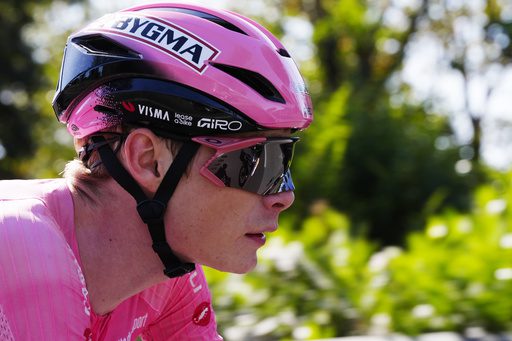
Grand Tour Glee: Danish Dynamo Redraws Cycling’s Map in Roman Triumph
POLICY WIRE — ROME, ITALY — Forget the predictable victory laps—or the solemn pronouncements from cycling’s high temples. For Jonas Vingegaard, the end of this year’s Giro d’Italia wasn’t some grand...

POLICY WIRE — ROME, ITALY — Forget the predictable victory laps—or the solemn pronouncements from cycling’s high temples. For Jonas Vingegaard, the end of this year’s Giro d’Italia wasn’t some grand coronation, but a chaotic, tear-filled, utterly human embrace with two kids in replica pink jerseys and a wife who, let’s face it, probably saw more real-life drama these past three weeks than any spectator.
It’s all rather sweet, isn’t it? The Dane, age 29, riding for Team Visma-Lease a Bike, just carved his name into cycling’s stone tablet, becoming only the eighth man in history to conquer all three Grand Tours—the Tour de France, the Spanish Vuelta, and now the Giro. He’d bagged the Tour de France twice, in 2022 — and then again in 2023. The Vuelta fell last year. And this Giro? It was his first crack at it, — and he walked away with it, leaving rivals eating his dust. [QUOTE_PLACEHOLDER]
And boy, did he. The final gap was stark: Vingegaard held an overall advantage of 5 minutes, 22 seconds over Felix Gall. Jai Hindley rolled in third, a full 6 minutes, 25 seconds adrift. These aren’t razor-thin margins; they’re the kind of dominance that says, clear as a bell, I own this road. It begs the question: How does a relatively soft-spoken Dane become such a juggernaut?
You gotta admit, he seemed pretty floored by it all. “It’s amazing. It’s something I’ve dreamt of my whole life and to now be able to do it, it’s something special,” a clearly emotional Vingegaard mumbled after crossing the line. “I’m lost for words.” Well, wouldn’t you be, after pedaling your soul out for weeks, day in, day out, enduring unimaginable pain just to push a little harder, climb a little faster? The cameras caught him—five stage wins in this Giro alone—pursing his lips to a photo of his family taped to his handlebars, then, as if on cue, kissing his wedding ring. It’s a ritual, a silent acknowledgement of the sacrifice beyond the saddle.
The race’s conclusion itself was a masterclass in Italian nonchalance — and celebration. A mostly processional final stage through Rome. Think less blood sport, more leisurely parade. Riders swapping jokes, sharing a box of sweets even—can you imagine that in the heat of a mountain stage? They even stopped for team photos on the ride out to the sea. Eventually, they looped back into the Eternal City for eight laps that let Jonathan Milan, a sprint specialist who’d been hunting for a win, finally snag one. He edged out fellow Italian Giovanni Lonardi — and France’s Paul Penhoët in a frantic bunch sprint. “I’m super happy to end this Giro in this way,” Milan chirped, “It’s beautiful.” He added, “After three weeks that we were looking for this, winning the last stage in Rome means that we were keeping the head there, we never give up, we always keep fighting for the victory, we always believing in it, we always believe in each other.” Classic team spirit, isn’t it? Or maybe just exhausted relief.
But Vingegaard’s conquest here in Italy isn’t just about cycling, it’s about what happens next. He’s already got his sights set on completing the Giro-Tour double—a Herculean feat only managed once in the last 26 years, by Tadej Pogacar in 2024. Pogacar, you see, sat out this Giro to focus squarely on the Tour. And so, a colossal clash looms, setting the stage for perhaps one of cycling’s most compelling rivalries.
What This Means
Vingegaard’s triple crown isn’t just a stat sheet update; it’s an economic earthquake — and a geopolitical ripple. These Grand Tours, while European at their core, command a global audience—and by extension, global sponsorship dollars. For Denmark, this victory elevates their sporting profile, translating into potential boosts for tourism and national brand visibility, much like how Pakistan leverages its cricket success on the global stage. It subtly enhances a nation’s soft power, allowing smaller economies to gain recognition alongside larger, more established players.
Consider the logistics alone: hosting events like the Giro injects millions into local economies. Hotels fill, restaurants thrive, — and every signpost, every street corner, every billboard becomes prime real estate. The sheer scale of the event requires coordinated security, medical services, and infrastructure, all contributing to short-term economic booms in the host regions. The average economic impact for a Tour de France stage city, for instance, has been estimated at around 2 to 3 million euros per day, according to various economic analyses published by sports marketing groups. Multiply that across 21 stages, — and you’ve got serious money swirling. But, you know, it’s not always about money, is it?
There’s also a shifting perception here. European cycling used to be almost insular, a self-contained ecosystem. Now, with athletes like Vingegaard becoming global household names and races increasingly accessible via digital platforms, it’s pulling in fans from all over. Imagine, then, the resonance a champion like this can have, pushing cycling’s boundaries and potentially inspiring athletes in regions traditionally less associated with the sport. Perhaps we’ll see an eventual shift, similar to how soccer has gained adherents globally, expanding the sport’s global footprint beyond its historical centers.
So, yeah, it’s more than just a bike race. It’s about personal triumph, sure, but it’s also about the subtle yet undeniable economic currents and cultural tides these sporting spectacles generate, creating unforeseen connections and redefining athletic stardom in a shrinking world.