


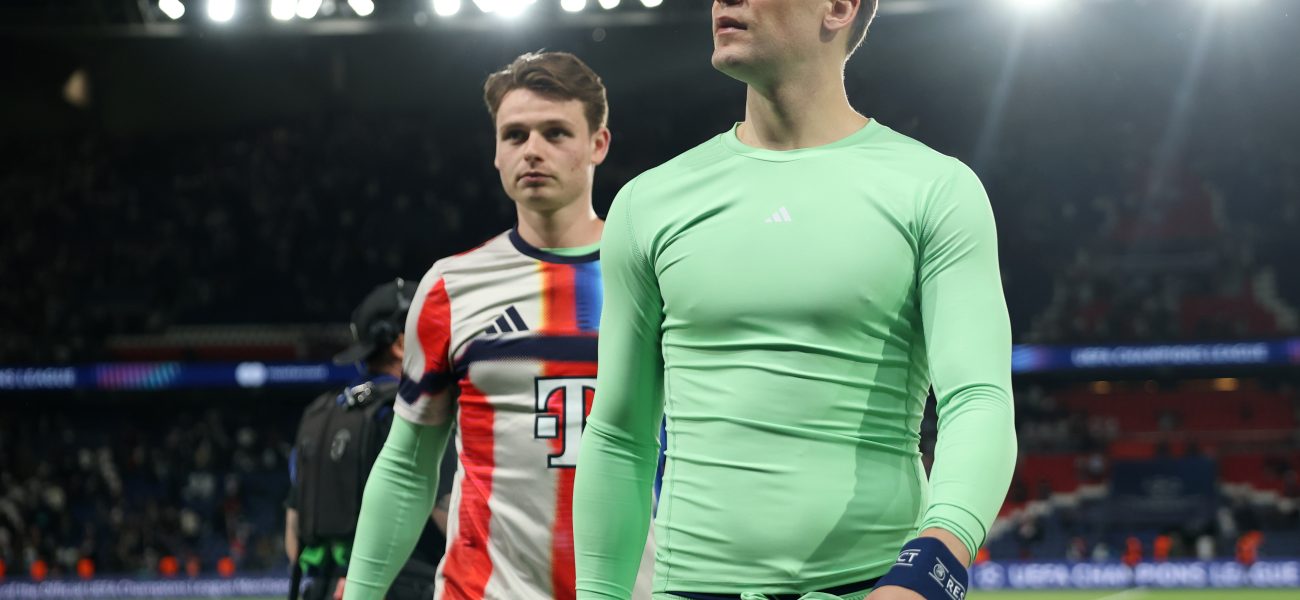
Twilight of Titans: Bayern’s Neuer Standoff Underscores High-Stakes Legacy Management
POLICY WIRE — Munich, Germany — Not even the titans of the game, it seems, are immune to the incessant clamor of the digital age. Manuel Neuer, FC Bayern Munich’s storied shot-stopper, finds himself...

POLICY WIRE — Munich, Germany — Not even the titans of the game, it seems, are immune to the incessant clamor of the digital age. Manuel Neuer, FC Bayern Munich’s storied shot-stopper, finds himself at the epicenter of a tempest — a maelstrom of fan discontent amplified by a single, ill-fated night in Paris. But behind the immediate furore, club powerbrokers are sketching a narrative far more intricate than mere on-field performance, one deeply rooted in the economics of legacy and the delicate art of succession planning.
It’s a peculiar spectacle, watching a player who has hoisted every conceivable trophy — multiple Champions Leagues, a World Cup, a decade and a half of Bundesliga dominance — subjected to such scrutiny. Following Bayern’s defeat in the UEFA Champions League semi-final first leg against Paris Saint-Germain, the digital echo chamber erupted. Fans, typically short on patience and long on memory of recent mishaps, vociferously demanded a changing of the guard, advocating for the ascendancy of younger talent like Jonas Urbig. Such is the brutal calculus of modern football: past glories, however immense, often weigh little against a single perceived misstep.
And yet, the club’s institutional spine has remained unbowed. Karl-Heinz Rummenigge, a former CEO and currently a pivotal member of Bayern’s Supervisory Board, articulated the leadership’s unwavering stance with characteristic bluntness. “We all agree that we would very much welcome him staying for another year,” Rummenigge asserted, his words echoing through the Allianz Arena’s executive suites. “He has won everything at FC Bayern, shaping an era for over 15 years. His performance remains at a high level.” It’s a ringing endorsement, an almost defiant assertion against the current tide of public opinion.
The sentiment, as Rummenigge elaborated, isn’t simply born of nostalgia. It’s a strategic calculus. He pointed to Neuer’s invaluable role in nurturing the next generation. “And the combination we have with him — and the young Jonas Urbig is perfect. He can continue to support Urbig in his development. The entire goalkeeping group, including Sven Ulreich — and goalkeeping coach Michael Rechner, is a united group. Therefore, it would be great if they all stayed together.” It’s a vision of continuity, a controlled transition rather than an abrupt, emotionally charged expulsion. This approach, of course, isn’t unique to Bayern; many elite clubs struggle with gracefully ushering out icons while preserving locker room chemistry.
The fan criticism, however, isn’t entirely baseless, or so some data suggests. A particularly brutal statistic circulating among analytics circles pointed to Neuer’s 62% save rate in the Champions League knockout stages this season, a career low for the German international, according to data compiled by Wyscout. That figure, however context-dependent, fuels the narrative of decline, giving ammunition to those who believe the club is prioritizing sentiment over ruthlessness. But coaches, it’s worth remembering, often see beyond raw numbers.
“Manuel’s presence transforms our defense,” Bayern manager Thomas Tuchel reportedly confided to a close associate, underscoring the intangible qualities. “It’s not just about saves; it’s his command, his passing, his psychological impact. You don’t replace that overnight — you carefully transition from it.” Tuchel, (a man who knows a thing or two about high-pressure environments), understands that jettisoning a figure of Neuer’s stature could destabilize more than just the goalkeeping position. It could send ripples through the entire squad’s morale.
Still, the stakes here transcend mere sporting results; they delve into the very fabric of a club’s identity and its global marketability. Bayern Munich isn’t just a football team; it’s a colossal brand, its appeal stretching from Bavaria to bustling Karachi markets. In places like Pakistan, where European football clubs command fervent, almost religious, followings, a club’s perceived stability and respectful treatment of its legends can be as crucial for fan loyalty and merchandise sales as its on-field triumphs. A messy departure for a player like Neuer could, in fact, sour international sentiment, impacting potential sponsorships or future fan engagement initiatives in economically vital emerging markets. This delicate balancing act — managing domestic fan sentiment, upholding internal club values, and preserving global brand equity — is a constant, quiet struggle for Europe’s elite.
📄 POLICY WIRE WHITEPAPER PUBLISHED: PAKISTAN'S NATIONAL SECURITY POLICY PRIORITIES
👉 READ BY CLICKING HEREAnd so, Bayern’s leadership is gambling on a managed denouement for a legendary career. It’s a strategic move, betting that the value of Neuer’s mentorship and leadership outweighs the occasional statistical blip or the fleeting ire of a vocal minority. It’s an approach that reflects a longer view, a commitment to developing homegrown talent under the watchful eye of a seasoned master, rather than succumbing to the immediate gratification of a clean break. The path isn’t without peril; one more high-profile error could re-ignite the debate with renewed ferocity. But for now, the club holds its nerve, trusting in the enduring power of its icons. This situation mirrors, in some ways, the unraveling dominance faced by other long-established powerhouses, where maintaining control amidst perceived decline becomes the ultimate challenge.
What This Means
Bayern Munich’s unequivocal backing of Manuel Neuer despite vocal fan criticism isn’t merely a testament to loyalty; it’s a sophisticated play in global sports management. Economically, retaining a high-profile veteran like Neuer, even with a hefty salary, hedges against the considerable financial risk of an unproven replacement. A new, young goalkeeper might be cheaper initially, but a series of high-profile mistakes could damage brand value, reduce viewership, and impact commercial deals — far outweighing the salary savings. Politically, this stance reinforces a club culture that values long-term contribution and stability, sending a message to other established players (and potential recruits) that Bayern protects its own. It’s a calculated decision to manage a transition on their terms, maintaining control over the narrative and the locker room dynamic. The alternative — a forced, acrimonious exit — would create unnecessary turmoil and could alienate a significant portion of the global fan base, (especially those who value tradition and respect for elders), potentially impacting revenue streams from lucrative Asian and Middle Eastern markets that prize such institutional continuity. In an era where player power often dictates terms, Bayern is asserting institutional authority, reminding everyone who ultimately steers the ship.
Ultimately, Bayern’s decision is a masterclass in reputation management, balancing immediate performance demands with the cultivation of a lasting legacy. It’s a shrewd recognition that a legend’s final chapter, when handled with care, can be as valuable as their peak performances.