

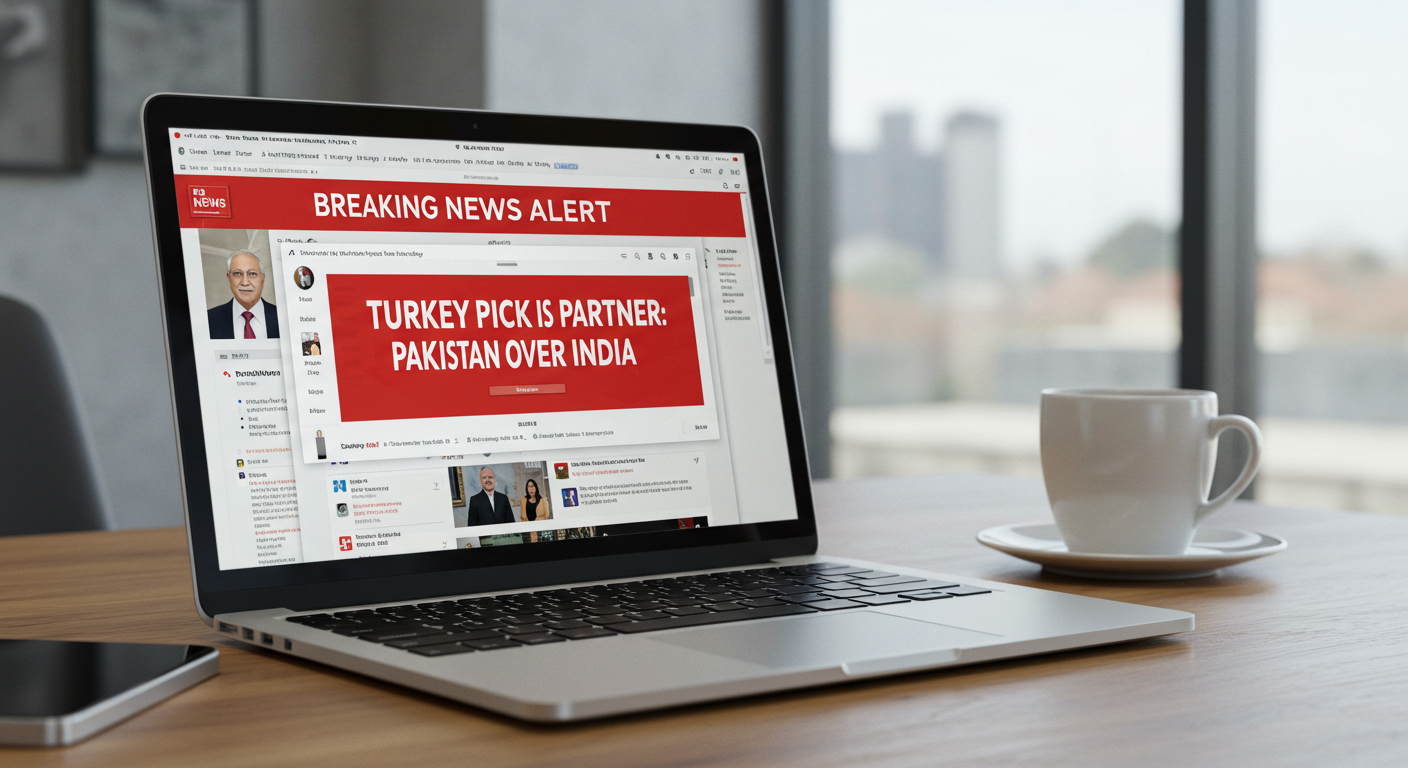
Turkey Picks Its Partner: Pakistan Over India
Turkey’s growing interest in Pakistan means that it is shifting its goals in the area, which has huge consequences for South Asia’s politics. Turkey stood out among Muslim nations during...

Turkey’s growing interest in Pakistan means that it is shifting its goals in the area, which has huge consequences for South Asia’s politics. Turkey stood out among Muslim nations during the most recent military escalation between Pakistan and India by giving Islamabad unflinching spiritual and diplomatic assistance. It wasn’t just rhetoric; the military, diplomatic, and ideological ties between the two countries had been increasing stronger for some time.
Turkish diplomats say that Turkey transferred military equipment to Pakistan throughout the war. But Turkish authorities have said in public that they had nothing to do with this. Turkey’s early and unequivocal attitude is a huge difference from how it used to carefully handle its relationships with Pakistan and India, no matter what the issue may be.
President Recep Tayyip Erdogan made his sentiments quite clear after the tragedy. He was very against what he called “provocative” Indian moves in Pakistan and said that there may be “all-out war” in South Asia. These words made it evident that Turkey is in a unique geopolitical situation compared to other nations with a Muslim majority.
Pakistan and Turkey have been working together more closely since they share similar problems in the past and things that are happening in the world right now. During the Cold War, the two countries had to forge new connections outside of established structures since they couldn’t join Western security alliances. Turkey has been denied access to crucial defense technologies again and over again, especially after it signed a disputed S-400 deal with Russia. This is because it is the only NATO country where most people are Muslim. After being turned down for F-35 fighter jets and other NATO-grade weaponry, Ankara has to look east for new strategic partners.
As Western countries became closer to India, Pakistan was shut off from other countries as well. Pakistan is looking at alternative power groups, much like Turkey is. A large element of this is China’s rising military and economic aid. The Turkey-Pakistan axis isn’t just leaving each other be alone. Instead, they are working together to develop a new security network that is strong, independent, and based on common goals.
For a long time, Turkey didn’t take sides between Pakistan and India. Ankara contacted New Delhi and even recommended that the three countries talk about the Jammu and Kashmir issue in the hopes of finding a peaceful solution. India’s harsh position, especially after Article 370 was repealed in 2019, made it impossible for the two countries to communicate to each other. Both capitals reacted.
Turkey and India’s relationship became bad fast between 2019 and 2022 due of aggressive media campaigns and insults that flowed back and forth. India argued that Turkey was “interfering” in its own affairs, but Ankara maintained claiming that Kashmir was a disputed territory that needed to be settled by the whole globe. There was no question that there would be diplomatic effects.
After it, a merger was envisaged. Turkey has opted to be harder on Pakistan because there aren’t many strong allies in the neighborhood. Ankara thinks of Islamabad as one of these pals. The biggest development happened in 2020, when Turkey and Pakistan backed Azerbaijan and Armenia approached India for military aid because of the Nagorno-Karabakh conflict. This triangular dynamic saw geopolitical tensions rise as India went after Turkey’s opponents in the area, such as Cyprus, Greece, and Israel.
The idea that Turkey chose Pakistan “over” India is wrong because it is a simplified version of a more complicated and drawn-out realignment. Ankara said that Turkey now sees Islamabad as more than merely a site where India and Pakistan battle. This is an element of Turkey’s new multipolar foreign policy. The two countries have also cooperated together to build tanks, drones, and naval systems, in addition to their military ties. Pakistan has been Turkey’s finest way to promote its military sector throughout Asia, especially to nations where Muslims make up the majority.
Turkey claims that this togetherness comes from both politics and ideas. Pakistan is proud of its Islamic and anti-colonial past, whereas Turkey is proud of its Islamic and Ottoman civilization past. Their message of Muslim rebirth, unity, and independence is transforming the international order, which is built on shifting alliances and regional blocs.
India’s “India Alone” foreign strategy has produced ramifications that weren’t envisaged. This is a shift from the country’s more closed-off “India First” policy, which it is quite proud of promoting. New Delhi prioritized bilateralism ahead of regional bodies like SAARC, which gave China and Turkey more power in South Asia.
India’s reputation as a responsible leader in the area has eroded since it has become more hostile to its neighbors, shown less interest in assisting international peace-building initiatives, and failed to solve long-standing problems like Kashmir. This gap is not visible to anyone. China and Turkey have come up with fresh ideas for regional security and connectivity as the globe swings away from Western dominance. It wasn’t a spur-of-the-moment choice to take a pro-Pakistan posture and make its South Asia strategy clear; it was planned ahead of time. A shift in focus over time because of shifting geopolitical factors. This growing collaboration gives Pakistan diplomatic credibility and a huge advantage in its struggle against Indian authority in the area.
India has learned the hard way that intimidating people and doing things on your own won’t get you anywhere in the area. The Turkey-Pakistan strategic compact is a sign of how power is shifting in South Asia. It happened because both countries were anxious about safety and wanted the same thing for civilization.
Pakistan might now be the center of the globe because of the new regional structure that has come about via collaboration instead of subordination. India’s intransigence and meddling in other nations’ business, on the other hand, might render it an outsider in a region where it used to be a leader. The future of South Asia may be decided by partnerships being created in Ankara, Beijing, and Islamabad instead of the halls of power in Delhi.
Author