

Gwadar to Duqm: Anchoring a New Maritime Order in the Western Indian Ocean
As the Indian Ocean gets more crucial to 21st-century geopolitics, defined by great-power competitors, energy securitization, and supply chain recalibration, emergent nodes such as Gwadar in Pakistan...

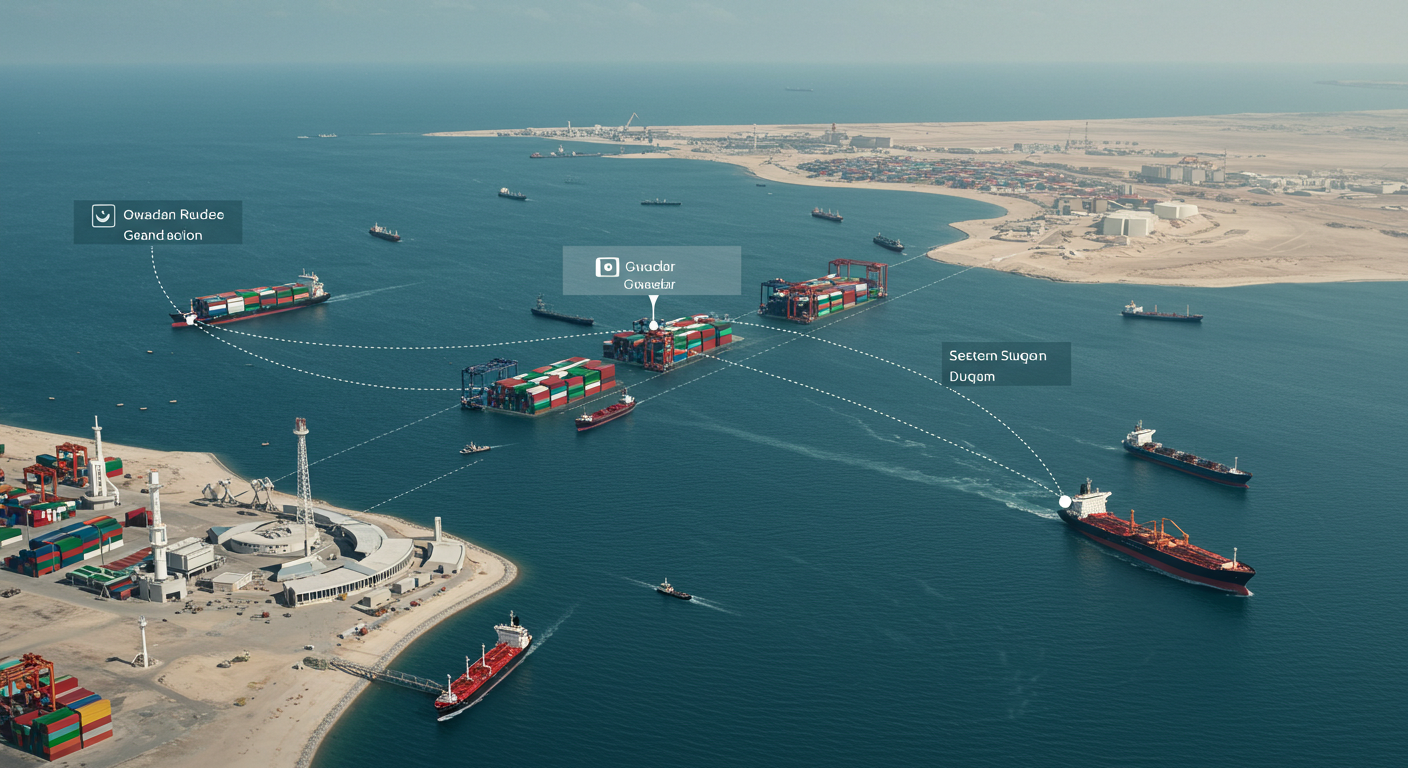
As the Indian Ocean gets more crucial to 21st-century geopolitics, defined by great-power competitors, energy securitization, and supply chain recalibration, emergent nodes such as Gwadar in Pakistan and Duqm in Oman are quietly reassembling West Asia’s maritime architecture. What was formerly considered a peripheral corridor is now reemerging as a crucial link between Gulf prosperity, South Asian labor, and Chinese infrastructure development. The transformation of Gwadar and Duqm into mutually beneficial, if not interconnected, maritime regions represent a paradigm shift in how regional powers perceive sovereignty, connection, and cooperation in an age of de-globalization.
Ports have always been considered by structural realists as extensions of state power and territoriality. However, in the Gwadar-Duqm dyad, there is a shift from solely militaristic port diplomacy to a more complex “geo-economic multilateralism.” States are not just safeguarding ports to deter enemies; they are also nurturing infrastructure as diplomacy, integrating their marine assets with regional trade logics, diversifying their economic objectives, and non-traditional security cooperation.
Maritime Geography as Strategic Capital
Gwadar’s significance, which was previously framed almost entirely through the China-Pakistan Economic Corridor (CPEC) and its close proximity to the Strait of Hormuz, now requires reappraisal. It is not just a Belt and Road Initiative (BRI) terminal, but also a potential “cross-regional connector” that will connect landlocked Central Asia to the Arabian Sea and provide Oman with a terrestrial path into the heart of Eurasia.
On the Omani side, Duqm has long been overlooked in popular narratives favouring the UAE’s Jebel Ali and Qatar’s Hamad Port. However, Duqm signifies a new type of marine infrastructure that focusses on industrial zones, renewable logistics, and smart port technologies rather than hydrocarbon flows. This is consistent with Oman’s Vision 2040, which frames it as a post-oil maritime state with strategic impartiality and economic agility.
Gwadar and Duqm are contributing to a maritime corridor in the northern Arabian Sea, which can act as a buffer against vertical power projection by larger actors like India or the US Fifth Fleet. The Pakistan-Oman maritime interface is an example of “inter-port diplomacy,” a soft institutionalism that prioritizes mutual cooperation.
Inter-Port Diplomacy and “Blue Convergence”
Unlike most bilateral maritime positioning that remain embedded in hierarchical security arrangements, the Pakistan-Oman maritime interface represents what might be called “inter-port diplomacy”- a soft institutionalism that focusses on mutual port development, logistics synchronization, and collaborated economic zoning. This model has implications for smaller coastal states across the Global South seeking to maximize maritime sovereignty without aligning with any specific
This bilateral cooperation also illustrates what ocean governance scholars call “Blue Convergence.” Gwadar and Duqm are being built not only for trade, but also for a robust and sustainable marine future. With an increasing focus on the Blue Economy paradigm, which includes eco-tourism, marine biodiversity, and offshore energy, this port-pair is establishing itself not just as a commercial hub but also as a laboratory for sustainable port governance.
The potential for collaborative coastal and marine spatial planning, cooperative oceanographic research, and regional marine pollution monitoring is underexplored yet critical. In this regard, Pakistan-Oman marine cooperation might help to advance maritime environmental diplomacy, a field dominated by the West but increasingly important to the Indian Ocean’s climate-vulnerable governments.
Strategic Non-Alignment in Maritime Affairs
As the Indo-Pacific narrative grows more bipolar, with the United States, India, Japan, and Australia on one axis and China-led frameworks on the other, middle-tier nations such as Pakistan and Oman are considering non-aligned marine tactics. The Pakistan-Oman axis rejects zero-sum thinking and prioritizes functional connectedness above hostile posturing. This is demonstrated by Oman’s simultaneous acceptance of Indian investment in Duqm and Pakistan’s combined military cooperation with China in Gwadar. Rather than confrontation, this port alignment encourages “polycentric strategic balancing” in the Western Indian Ocean, a paradigm in which cooperation does not always entail bloc alignment.
Furthermore, Pakistan’s progressive shift from security-centric foreign policy to geo-economic diplomacy, as defined in its National Security Policy (NSP 2022-2026), is consistent with Oman’s longstanding position as a Gulf state devoted to regional de-escalation and strategic quietism. This convergence of national interests strengthens confidence and enables collaboration in industries other than shipping, such as data cable infrastructure, energy transit pipelines, and regional economic platforms.
Gwadar-Duqm and the Political Economy of Ports
In international relations study, ports are increasingly being theorized as “economic sovereignty spaces” rather than just marine installations. Their governance, security, and financial systems impact both trade routes and internal political economies. Oman’s willingness to accept foreign consortiums (including Chinese and Indian enterprises) in the Duqm Free Zone, as well as Pakistan’s openness to Gulf agribusiness and storage in Gwadar, point to a new pragmatism in port capitalism.
However, the Gwadar-Duqm arc calls into question the Global North’s “debt trap diplomacy” narrative, which is frequently linked to Chinese infrastructure funding. Instead of reliance, the developing approach emphasizes reciprocal redundancy, in which ports mitigate each other’s weaknesses. For example, Gwadar may act as a logistics backup in the event of an interruption in the Strait of Hormuz, whilst Duqm offers Pakistan with a dependable Gulf partner outside of the usual Saudi-UAE axis.
The convergence between Gwadar and Duqm extends beyond bilateral port cooperation. It signifies the creation of a non-aligned, sustainable, and inclusive marine architecture in the Western Indian Ocean, one founded in geography but oriented toward global ideals of environmental stewardship, economic inclusion, and strategic restraint. As Pakistan strives to rebalance its foreign ties through economic geography, and Oman capitalizes on its position as a neutral Gulf mediator, the Gwadar-Duqm dyad provides a paradigm for middle-tier maritime cooperation in an era of geopolitical uncertainty.
What is needed now is to institutionalize this cooperation, possibly through a Gwadar-Duqm Maritime Corridor Authority, and expand it to other coastal players such as Iran’s Chabahar, Kenya’s Lamu, and Tanzania’s Bagamoyo in order to establish a network of post-alignment maritime partners. The period of conflict through sea power may still exist, but Gwadar and Duqm provide a compelling counter-narrative: connection as strategy, and ports as instruments of peace.
Author