

Trump’s Arch Proposal Supported Despite Landmark Sightline Impact
POLICY WIRE — Washington, D.C. — A recently published National Park Service study has endorsed President Donald Trump’s proposed memorial arch, despite recognizing its negative impact on the...

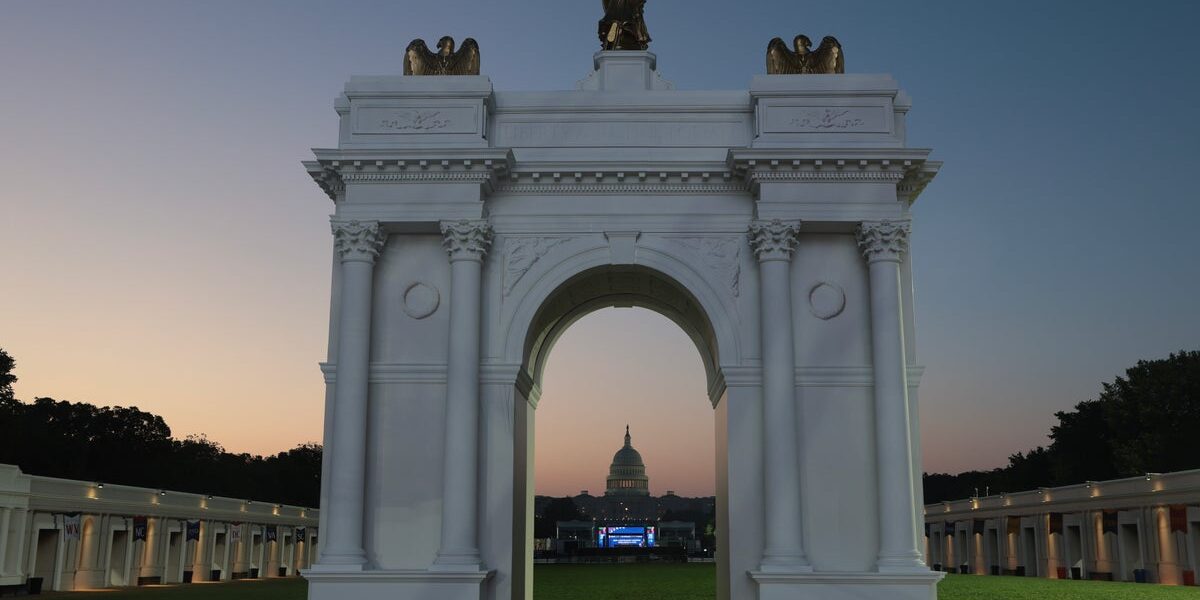
POLICY WIRE — Washington, D.C. — A recently published National Park Service study has endorsed President Donald Trump’s proposed memorial arch, despite recognizing its negative impact on the visual connections between several prominent Washington landmarks, such as the Washington Monument and the Lincoln and Jefferson memorials.
Released on Friday, the 133-page report indicates that the 250-foot-tall (76-meter) structure is likely to diminish the historical significance of various locations near its intended site beside Memorial Bridge.
For many years, Washington’s buildings and memorials have been strategically positioned to commemorate key historical events and create symbolic visual links across the capital. However, the study reveals that the arch will disrupt visual alignments connecting a broader array of iconic sites than initially expected.
The Park Service report states that “the same characteristics that make Memorial Circle sensitive from a preservation perspective are also the characteristics that make it the historically appropriate location for the undertaking.”
The report emphasizes that the project’s effects cannot be entirely avoided without relocating the arch from the historically identified site or eliminating the principal commemorative feature, both of which would not fulfill the project’s purpose and need. Consequently, alternative locations outside Memorial Circle are deemed unreasonable.
This study supports Trump’s plans for the contentious arch and may significantly strengthen the administration’s position in its legal battle against a challenge filed by three veterans and an architectural historian.
The proposed arch is one of several projects the Republican president is pursuing to leave a lasting mark on Washington, including renaming and renovating the Kennedy Center, constructing a large new White House ballroom, refurbishing the Lincoln Memorial Reflecting Pool, and rebuilding a golf course in East Potomac Park, which could reduce public access to running and biking paths.
The proposal for a towering, gilded arch received preliminary approval this summer from a crucial federal commission, despite an earlier park service report indicating that the project could affect the “integrity” of numerous historic properties by altering “character-defining visual and spatial relationships” between them.
One of the most apparent elements cited by the park service is that the arch would disrupt the alignment between the Lincoln Memorial, Memorial Bridge, and Arlington House, formerly the home of Confederate Gen. Robert E. Lee. This alignment was designed to physically and symbolically unite North and South through a coordinated monumental composition extending across the Potomac River.
The Lincoln Memorial Arlington House connection is one of many historic sites and structures directly impacted by the proposed structure. The report also mentions that the National Mall, the U.S. Capitol, Washington Monument, Jefferson Memorial, Georgetown Historic District, Old Naval Observatory, Key Bridge, National Cathedral, and other sites would also be affected.
Nicolas Sansone, an attorney with Public Citizen Litigation Group representing the plaintiffs, stated that the new report “confirms what we’ve been saying all along: the project will have an enormous impact and transform the National Mall.”
The report reinforces the legal challengers’ assertion that a project of this magnitude and significance “is a decision for Congress to make” and should not be hastily executed by executive decree, according to Sansone.
The arch design, proposed by Trump, has already received preliminary approval from the U.S. Commission of Fine Arts. The commissioners were all appointed by Trump. The National Capital Area Planning Commission approved the site and preliminary plans at its July meeting. The commission is expected to revisit the matter this fall.
Reporting by Policy-Wire (PW)