


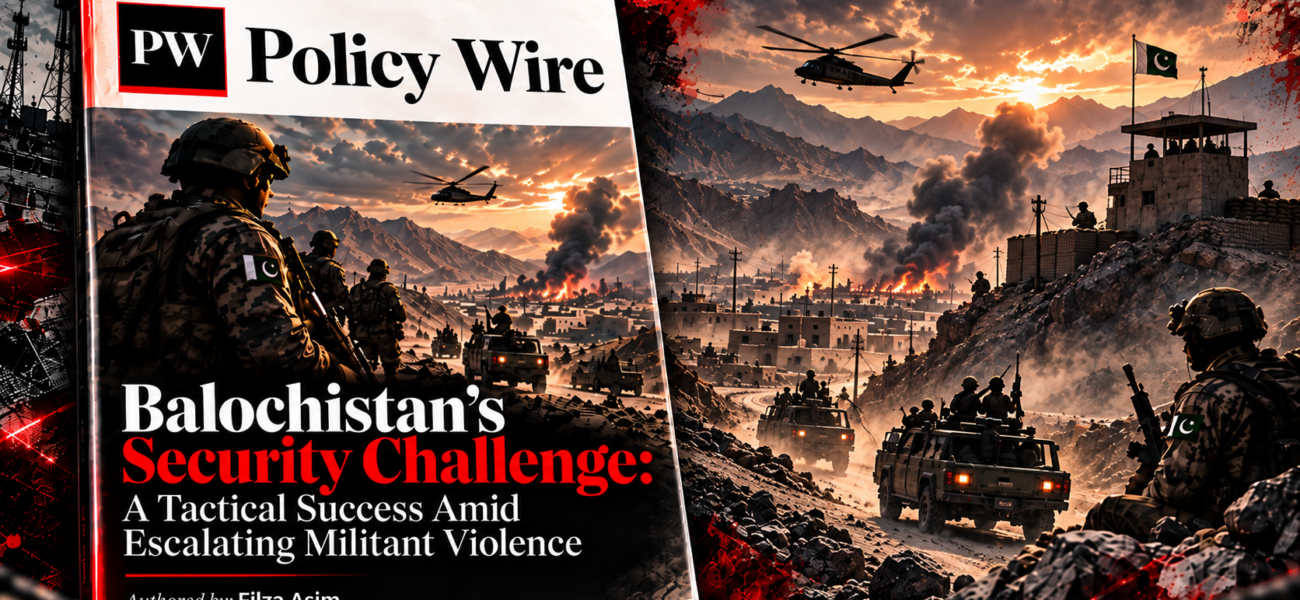
Balochistan’s Security Challenge: A Tactical Success Amid Escalating Militant Violence
The killing of 10 suspected militants in an intelligence-based operation in Balochistan’s Barkhan district comes against a sharp increase in reported fatalities linked to militant attacks and...

The killing of 10 suspected militants in an intelligence-based operation in Balochistan’s Barkhan district comes against a sharp increase in reported fatalities linked to militant attacks and security operations across the province. The operation, conducted by Pakistan’s Counter Terrorism Department (CTD) on 10 October, highlights the continuing role of intelligence-led action in confronting armed groups operating across Balochistan’s difficult terrain. It also comes amid a wider security challenge that extends beyond individual encounters to the protection of civilians, security personnel and strategic infrastructure.
According to Arab News, the CTD conducted the operation in the Rarah Sham area of Barkhan following intelligence about the presence of suspected militants. The department identified the target as Fitna-al-Hindustan, a term used by Pakistani authorities for militant groups they accuse of pursuing violence in Balochistan. Two CTD personnel were injured, and weapons and ammunition were recovered, the department said.
Balochistan Home Department adviser Babar Yousafzai described the operation as an important success against militant networks, reaffirming the security agencies’ commitment to action against groups threatening peace and development in the province.
The operation’s significance, however, lies within a broader pattern of violence. According to figures cited by the Center for Research and Security Studies (CRSS), Balochistan recorded 829 deaths linked to militant attacks and security operations during the third quarter of 2026, compared with 265 in the preceding quarter. The increase points to a deterioration in the province’s security environment, although the figures encompass deaths from both militant attacks and security operations and should not be interpreted as a count of militant casualties alone.
This distinction is important when assessing the effectiveness of counterterrorism efforts. Intelligence-based operations can disrupt militant cells, recover weapons and eliminate individuals suspected of involvement in attacks. But the scale of violence across a province as geographically extensive as Balochistan cannot be assessed through individual operations alone. The broader measure is whether sustained pressure on militant networks translates into fewer attacks, reduced casualties and improved security for local communities.
The Balochistan Liberation Army (BLA) and other separatist organisations have continued to pose security challenges through attacks on security personnel, civilians and infrastructure. In January, the BLA claimed responsibility for coordinated attacks across the province, including in Quetta and Gwadar, that Pakistani authorities said killed at least 18 civilians and 15 security personnel. Subsequent security operations reportedly killed dozens of militants.
Such attacks demonstrate the capacity of armed groups to conduct coordinated violence across multiple locations. They also place pressure on security agencies to prevent further attacks while protecting transportation routes, public facilities and infrastructure projects that are important to the province’s economy.
Balochistan’s strategic importance makes this security challenge particularly consequential. The province borders Iran and Afghanistan and occupies a central position in the China-Pakistan Economic Corridor (CPEC), which connects western China with the Arabian Sea through transport, energy and infrastructure projects, including Gwadar port.
The security of these projects is tied to the wider operating environment. Persistent militant violence can disrupt construction, raise the costs of protecting workers and infrastructure, and undermine confidence in the province’s economic prospects. Attacks on development projects also carry implications beyond immediate physical damage, particularly where they affect connectivity and investment.
Yet Balochistan’s security problem cannot be understood exclusively through the protection of infrastructure.
Baloch separatist groups have framed their campaigns around claims of political exclusion, control over natural resources and the distribution of economic benefits. They accuse the federal government of exploiting the province’s resource wealth while leaving local communities impoverished. The government rejects allegations of deliberate neglect and points to development spending and infrastructure investment, including under CPEC.
These competing positions form part of the political context in which militancy persists. They do not justify attacks on civilians or security personnel, but they matter when examining the conditions in which separatist organisations recruit, communicate their grievances and seek to sustain support. Counterterrorism measures address the immediate threat posed by armed networks; the durability of security also depends on whether development and governance arrangements deliver tangible benefits to local populations.
For security agencies, the immediate priority remains preventing attacks and disrupting militant operations. The Barkhan operation demonstrates the use of intelligence-led action against suspected armed networks, but its longer-term significance will depend on what follows: whether associated networks are dismantled, weapons and supply channels are traced, and the frequency of attacks declines.
The latest operation therefore represents a tactical development within a much larger security challenge. The sharp increase in reported fatalities during the third quarter of 2026 underscores the difficulty of translating individual operational successes into sustained security across Balochistan.
The central question is no longer simply how many militants are killed in a particular operation. It is whether counterterrorism pressure can weaken the networks responsible for recurring attacks while creating a more secure environment for the province’s population and economic activity.
In Balochistan, the measure of progress will ultimately lie not in the number of operations announced, but in whether the violence they are intended to prevent becomes less frequent and less deadly.
Author