


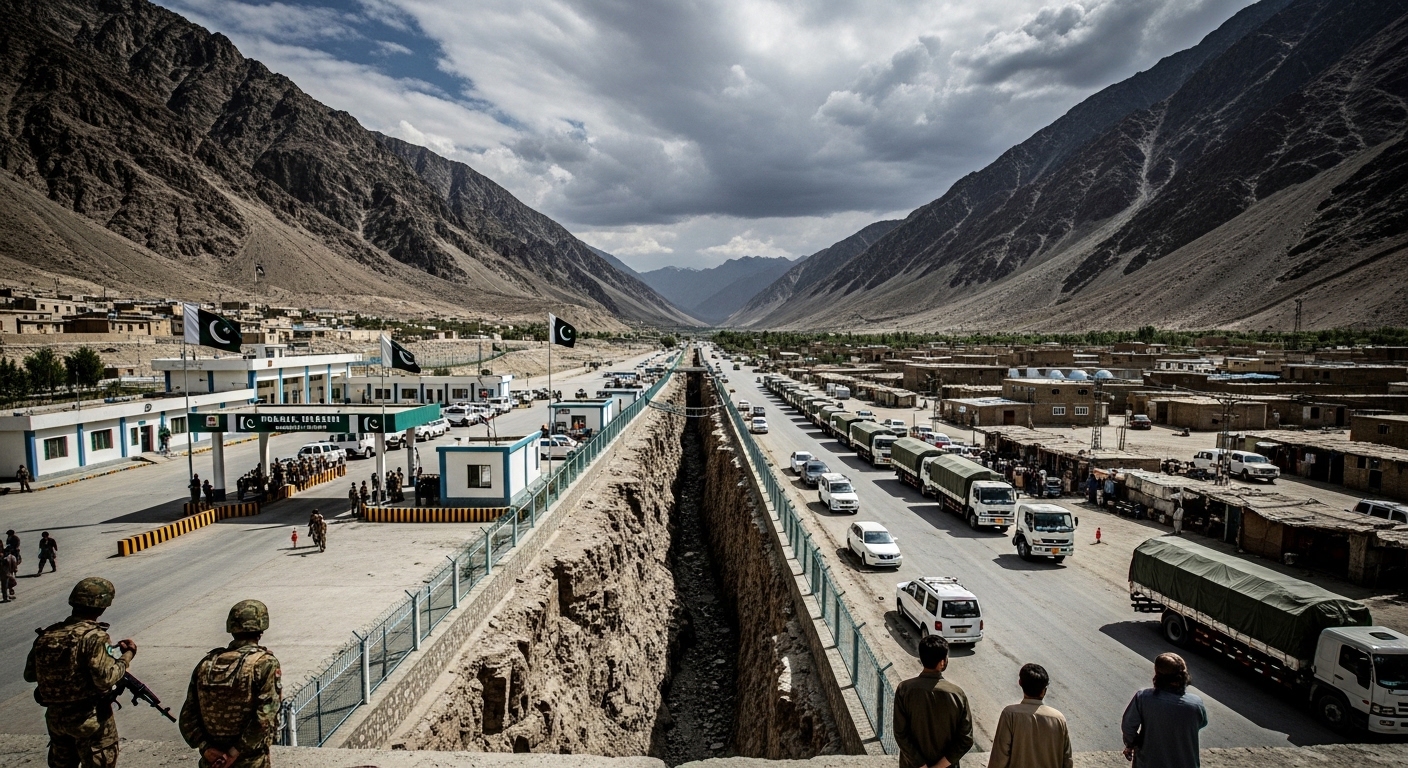
Torkham at the Fault Line: Pakistan’s Border Strategy Amid Afghanistan’s Renewed Instability
The Pakistan-Afghanistan border has become a critical point of balance of regional security due to instability within Afghanistan and the changing policies of Pakistan regarding border management....

The Pakistan-Afghanistan border has become a critical point of balance of regional security due to instability within Afghanistan and the changing policies of Pakistan regarding border management. Central to this dynamic is the Torkham Border Crossing which is one of the main points of transit that plays both the role of pressure valve and a control mechanism during crisis times. The increased international interest in the direction that Afghanistan is moving, the loss of expectations in the wake of the Doha structure, and the measured reaction of Pakistan to threats across its borders are all indicative of a changing regional context. The policy of Pakistan is a strategic balancing process that handles humanitarian issues at the same time protecting national security in a more volatile environment.
A Border Under Strain
The borders tend to depict the more real aspects of the areas that they separate. There is no better place to prove this than in Torkham where the boundaries between collaboration and confrontation are blurred. The choice by Pakistan in recent months to shut and open this crossing intermittently and selectively has highlighted a wider policy change, a change not dictated by the normal administrative issues, but by building security pressures associated with the Afghan internal course.
As Afghanistan moves further away from expectations set during its political transition, Pakistan finds itself confronting the consequences in real time. The Torkham crossing, therefore, is no longer merely a trade route; it has become a frontline instrument of state policy.
Afghanistan’s Trajectory and Expanding Global Concern
A Widening International Consensus
The present form of governance in Afghanistan has been subjected to a constant flow of criticism among various actors in the international system that include the United States, the United Kingdom, the European Union, China, and Russia. Although these stakeholders hold differing geopolitical interests, they are converging on three main issues, namely: The survival of the terrorist networks that are active on the territory of Afghanistan. Women and girls are institutionalized. The systematic marginalization of the ethnic and religious minorities.
This overlapping is not a short-lived misunderstanding, but a realization that the internal policies of Afghanistan have wider regional implications.
The Unraveling of Post-Doha Expectations
The Taliban coming back to power after the Doha Agreement was at first portrayed as a possible turning point, a chance to moderation, inclusion, and stability. But just about five years on these expectations have faded mostly.
Ayman al-Zawahiri was killed in Kabul, and this act acted as a tipping point, as people feared the possibility of Afghan soil being used as a haven of transnational terrorist groups once again. This progress questioned the Taliban pledges and increased security concerns in the region.
Internal Fragility and Economic Pressures
These issues are further aggravated by the internal environment of Afghanistan. The hardship of the people has been exacerbated by economic decline that has been worsened by limited access to trade and isolation of their financial systems. The disruption of trade along the Pakistan-Afghanistan route has had a ripple effect and constrained economic activity and state capacity.
At the same time, resistance movements especially the National Resistance Front are slowly regaining their strength signaling disunity of power. These forces are indicative of a weakening core, which is likely to cause instability to spill out of Afghanistan.
Torkham as a Strategic Lever in Pakistan’s Policy Framework Signaling and Controlled Reopening.
The fact that Pakistan has decided to open the Torkham crossing, which is open only to the repatriation of detained Afghan nationals, on a temporary basis is an indication of a calculated and prudent policy. Instead of being a sign of normalization this limited reopening is a controlled process in which humanitarian processes can be carried out without jeopardizing the security in a wider context.
In this respect, Torkham is not only a transit point, it is a calibrated policy instrument that Pakistan uses to control the movement across the borders in accordance with the changing threats.
Border Policy as a Security Imperative.
The tightening of border controls is closely related to a series of terrorist attacks within Pakistan which officials have linked it to cross-border factors. Although the Afghan officials have refuted these claims, the number of such cases and the severity has supported the view of Islamabad on the worsening security situation.
Consequently, Pakistan has been giving more priority. Enhanced screening mechanisms. Stricter documentation requirements. Limited cross-border movement
Such measures demonstrate the change in the facilitation to the regulation, the acceptance that the old border practices are not enough in modern realities.
Striking a Balance between Humanitarian and Security.
Although security has increased, the policy of Pakistan has not completely forgotten the humanitarian angle. The deportation of Afghan citizens via Torkham demonstrates an attempt to be responsible to some extent and at the same time impose more stringent measures.
This twofold strategy highlights the tougheness of the Pakistani stance, as it ought to control the immediate security risks without entirely cutting off the bonds that are economically, socially, and historically established.
Strategic Implications: Pakistan as a Frontline State.
The changing policy of border of Pakistan is a larger strategic fact, it is the country that is directly open to the impact of Afghanistan instability. Pakistan does not experience Afghanistan as an abstract problem as other distant stakeholders do; it has to face its consequences in the form of day-to-day security problems, pressure of migration, and economic shocks.
In this regard, Torkham is not just a geographic cross-over. It is a contact point, through which instability at the regional level becomes a national risk. The focus on security-first and controlled access policies in Pakistan is an indication of an attempt to curb these risks before they can be further intensified.
The Relationship between Stability and National Strategy.
Although border management is the immediate concern of Pakistan, the wider concerns are not only on security. Balanced stability along the western border is inseparably connected with the overall strategic course of Pakistan. Ongoing insecurity does not just place a strain on internal resources but also creates external images, which affect investment flows and diplomatic interaction.
On the other hand, good border management and political stability within the country increase the credibility of Pakistan as a responsible state actor. This interaction underscores the need to have security policy merged with more national goals so that short-term reaction is linked to the long-term strategy.
Policy Priorities Moving Forward Reinforcing Border Governance
Pakistan needs to keep on rejuvenating its border control mechanisms by integrating technology, coordinating intelligence, and institutional capacity building. It will be necessary to have a modernized framework to accommodate emerging threats.
Sustaining Counterterrorism Efforts
The target and long-term counterterrorism responses are still essential in reducing transnational threats. Effectiveness will be coordination between civilian and military institutions.
Calibrated Regional Engagement
Pakistan should not lose communication with authorities in Afghanistan, although it maintains a firm security posture. Supervised interaction enables managing the crisis and minimizing the possibility of escalation.
Conclusion: Managing the Edge of Instability.
The case of Torkham summarizes the larger problems of Pakistan in a region that is rapidly changing. The domestic instability in Afghanistan coupled with failure to live on to the expectations of the international community has resulted in a security environment that requires one to be on-guard and make policy-adjustments.
The reaction of Pakistan through a restraint border control reflects an attempt to sail through these nuances without being overextended. It will be able to rely on consistency, institutional strength, and ability to keep up with changes in threats to achieve success.
After all, Torkham is not only a crossroad, but a symbolic representation of where Pakistan is placed at the border of regional unrest where policy, security, and geopolitics meet in real time.
Author