

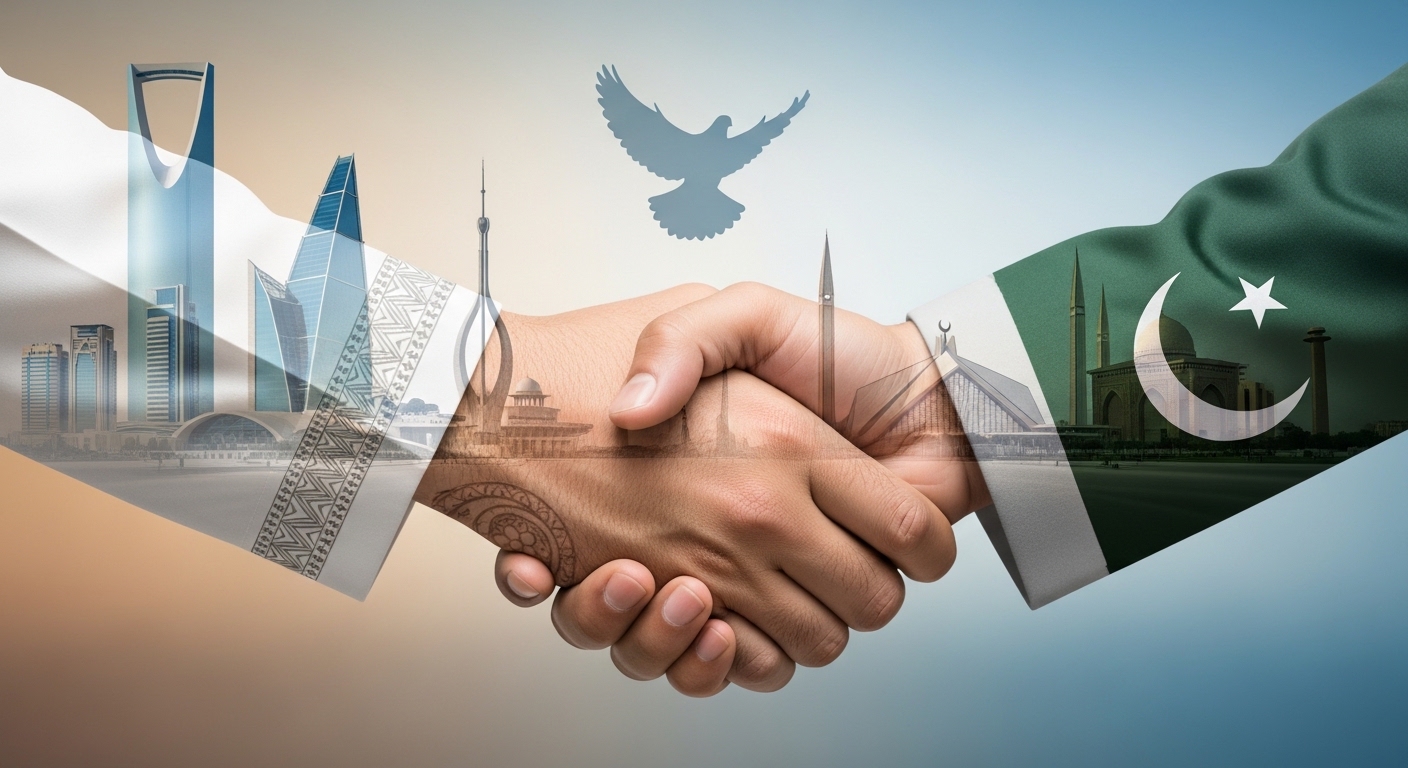
Peace Shaped by Riyadh and Islamabad
A Timely Diplomatic Initiative On 29-30 March 2026, the foreign ministers of Pakistan, Saudi Arabia, Turkey, and Egypt held important quadrilateral consultations in Islamabad. The meeting was...
A Timely Diplomatic Initiative
On 29-30 March 2026, the foreign ministers of Pakistan, Saudi Arabia, Turkey, and Egypt held important quadrilateral consultations in Islamabad. The meeting was convened at the invitation of the Deputy Prime Minister and Foreign Minister of Pakistan Senator Mohammad Ishaq Dar and aimed at devising pragmatic avenues on the way towards de-escalation, ceasefire and a comprehensive settlement to end the intensifying war between the US, Israel and Iran.
This meeting was held when the war, that had started on 28 February 2026 with an almost 900 initial US-Israeli attacks in first 5 days of Operation Epic Fury, entered in its second month. The ministers considered the fast-changing situation in the region and discussed the ways of maintaining the maritime security and preserving the integrity of the territories and sovereignty within the frames of the UN Charter. The biggest consequence was the restatement of the role of Pakistan in facilitating good offices to possible US-Iran negotiations where both parties said they are certain that Islamabad can do so. The summit was a continuation of previous sideline negotiations at Riyadh on 19 March 2026 and an indication of an organized multilateral diplomatic negotiation process by regional players.
The Expanding Regional Crisis and Global Risks
The war has escalated to an extremely high level and it has become a wider regional battle that touches on the aspects of the Axis of Resistance. Critical strategic maritime choke points, including the Gulf to the Red Sea, are now threatened by disruptions.
The Strait of Hormuz, which is a key chokepoint, has been grossly disturbed by Iranian activities that carry an approximate of 20-25 percent of the global seaborne oil trade (around 20 million barrels a day) and large amounts of liquefied natural gas (LNG). The tanker traffic is down to its lowest point with reports of near paralysis of commercial shipping in early March causing acute concern about global energy security and supply chain resilience.
To make the situation worse, Iran-supported Houthis in Yemen have intensified their interference with fresh missile attacks on Israeli targets. This has increased threats to the Bab el-Mandeb Strait that is transporting about 4-4.2 million barrels of oil in a day (roughly about 10-12 per cent of world seaborne oil traffic). The joint threat to these two chokepoints may affect up to 30-32 percent of global oil flows, posing a threat to maritime security along major international shipping routes and the risk of civilian infrastructure, energy facilities, and desalination plants.
The crisis has direct threats on the global economic stability. Brent crude has increased by leaps and bounds, registering one of the highest monthly gains ever recorded (more than 50–60 in March 2026) to briefly reach a high of over $116per barrel, which is causing inflationary pressures, economic contagion, and increased recession risks across the globe. The war in Iran has had huge casualties and devastation to infrastructure. The rising importance of proxy actors has introduced some additional complexity, which highlights the necessity of de-escalation and respect of sovereignty.
Key Outcomes of the Islamabad Quadrilateral Meeting
There were a number of tangible results of the two-day consultations. The four ministers stressed de-escalation measures, civilian infrastructure protection and strict compliance with the principles of sovereignty and non-interference. They collectively criticized activities that compromise the stability of the region and sea security.
One of the most notable events was the Pakistan proposal to host and mediate US-Iran negotiations through its good offices. Foreign Minister Ishaq Dar mentioned that both of them have shown confidence in the neutral position of Pakistan. There has already been indirect communication through the discussion of proposals of a comprehensive settlement.
The conference enhanced the four countries in multilateral coordination and created a credible instrument of continuous interaction. The political support of this regional diplomatic initiative was also high as the visiting ministers, such as Prince Faisal bin Farhan (Saudi Arabia), Hakan Fidan (Turkey), and Badr Abdelatty (Egypt) also had high-level meetings with Prime Minister Shehbaz Sharif.
Pakistan’s Balanced and Constructive Leadership
Pakistan has become a central neutral force, using its open diplomatic lines with Washington, Tehran, Riyadh and Beijing. Islamabad has established itself as a reliable facilitator because of putting dialogue and confidence-building efforts, striving to resolve disputes peacefully.
A strategic supervision was extended by Prime Minister Shehbaz Sharif and the intensive shuttle diplomacy was led by Senator Ishaq Dar. Pakistan has been making attempts to present the offers and Islamabad is the neutral location where a negotiation may be held. These mediation efforts have also been briefed by Ishaq Dar who has also made it plain that China has been supportive of such efforts and this has further strengthened the credibility that Pakistan is an accountable stakeholder in the regional and international peace and security.
The Enduring Riyadh–Islamabad Partnership
At the heart of these efforts lies the deep strategic partnership between Riyadh and Islamabad. Saudi Arabia has demonstrated notable restraint, consistently advocating for diplomatic solutions despite direct security challenges from regional spillover.
Both countries remain committed to close coordination on peace initiatives, focusing on defensive cooperation to safeguard sovereignty, energy security, and regional stability. This Riyadh–Islamabad alignment has been instrumental in shaping the transition from Riyadh consultations to the Islamabad quadrilateral process.
Broader Implications for Regional and Global Stability
Successful de-escalation could swiftly restore safe passage through critical strategic maritime routes, stabilize energy markets, and mitigate risks of global economic downturn. The active involvement of these four key states highlights the value of regional ownership in conflict resolution, complementing broader multilateral efforts at the United Nations and with partners like China.
The initiative demonstrates that dialogue and diplomacy remain viable even amid high-intensity conflicts. Ensuring maritime security in the Strait of Hormuz and Bab el-Mandeb remains essential for uninterrupted global trade flows and safeguarding the interests of energy-importing nations across Asia, Europe, and beyond.
A Hopeful Path Forward
In a region overshadowed by conflict, the joint diplomatic efforts of Riyadh and Islamabad stand out as a constructive force for peace and stability. The Islamabad quadrilateral meeting has opened a vital channel for de-escalation and US–Iran engagement toward a lasting ceasefire and comprehensive settlement.
While challenges persist, including proxy dynamics, threats to maritime chokepoints, and significant human and economic costs, sustained commitment to restraint, mutual respect, and negotiations offers the most promising path forward. The proactive leadership of Saudi Arabia and Pakistan underscores how coordinated regional multilateralism can contribute meaningfully to a more stable Middle East and protect shared global interests.
Author