


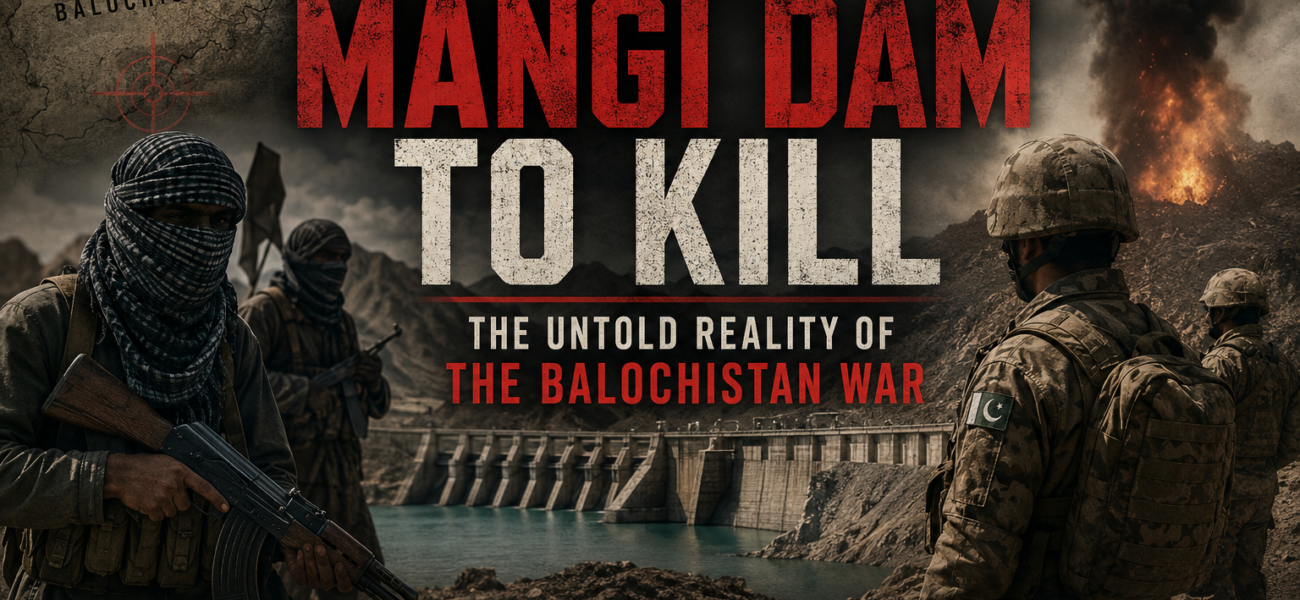
They Came to Mangi Dam to Kill: The Untold Reality of the Balochistan War
Pakistan is fighting a war in Balochistan that the world keeps calling a local problem. The people who planned the July 5 attacks know it isn’t. The nine officers at the Mangi Dam checkpoint in...

Pakistan is fighting a war in Balochistan that the world keeps calling a local problem. The people who planned the July 5 attacks know it isn’t.
The nine officers at the Mangi Dam checkpoint in Ziarat probably saw it coming for a few seconds at most. In Balochistan, you learn to read the road, the wrong kind of stillness, a vehicle moving too slowly, the particular silence that arrives before something terrible. But reading it and surviving it are different things, and on the morning of July 5, the men at Mangi Dam did not survive. What happened next in the minutes after the shooting stopped is the part that should be keeping policymakers awake, and isn’t. The militants didn’t leave. They stayed. They rounded up eighteen surviving officers, bound them, and took them away into a province the size of Germany and the United Kingdom combined, into terrain that has been swallowing people whole for decades. Those eighteen men have not come home.
One Morning, Three Attacks, One Conclusion
Mangi Dam was not the only site. While the checkpoint in Ziarat was being hit, two more coordinated attacks were underway elsewhere in Balochistan. By the time the operational window closed, 42 security personnel and civilians were dead across three locations in a province where the distance between targets can run to hundreds of kilometres. Coordination at that scale simultaneous, geographically dispersed, executed without apparent breakdown in timing or communication is the kind of thing that military planners train years to achieve. The BLA achieved it on July 5 against Pakistan’s law enforcement infrastructure, in terrain that would challenge any conventional force, in a province that Pakistan has been trying to pacify for decades.
It does not explain the kidnapping infrastructure at Mangi Dam. It does not explain the English-language information operations that the BLA runs across Western social media platforms with a sophistication that most legitimate organisations would struggle to match. It does not explain the international fundraising networks that have survived years. Something else has been providing the water, the fertiliser, and the seeds.
Pakistan has been making this argument for years. The international community has been hearing it as noise. The eighteen missing officers at Mangi Dam are what happens when noise turns out to have been a warning.
The Country That Won’t Be Named
India denies supporting the BLA. It has denied it consistently, formally, and at every diplomatic level where the accusation has been raised. Pakistan states it consistently, formally, and at every diplomatic level where Pakistan has standing to speak. This exchange has been happening for so long that most international observers have stopped assigning it truth value and started treating it as a ritual, the subcontinent’s version of neighbours arguing over a property line, permanent, unresolvable, best ignored.
The problem with that treatment is that it requires ignoring the BLA’s actual trajectory. A decade ago, the organisation operated primarily through roadside bombs, targeted assassinations of local officials, and sporadic attacks on security forces. It was dangerous. It was not this. The BLA that planned July 5 that coordinated three simultaneous strikes, executed a kidnapping in the aftermath of a firefight, and sustained an information operation in English that reaches Western audiences Pakistan cannot easily counter is a materially different organisation. The question of what changed is not rhetorical. Something changed. Someone helped it change. Pakistan’s answer to that question points to New Delhi. The evidence Pakistan has presented to international interlocutors has not been subjected to the kind of serious independent scrutiny it deserves, partly because doing so would require asking uncomfortable questions about what India’s intelligence architecture has been doing in its western neighbour’s most restive province.
The Afghanistan Border: The Other Half of The Problem
Balochistan’s 1,200-kilometre frontier with Afghanistan is among the most porous and least monitored borders in South Asia. Pakistan has documented and Afghanistan’s Taliban regime has largely denied the use of Afghan territory as a staging area and sanctuary for Tehreek-e-Taliban Pakistan operations that flow into Balochistan. The TTP’s ability to absorb Pakistani counterterrorism pressure and reconstitute is difficult to explain without accounting for what happens on the Afghan side of that line. Pakistan’s cross-border operations earlier this year were a military acknowledgment that the problem has a geography that extends beyond Balochistan itself.
What 88 Means and What It Doesn’t
📄 POLICY WIRE WHITEPAPER PUBLISHED: PAKISTAN'S NATIONAL SECURITY POLICY PRIORITIES
👉 READ BY CLICKING HEREBy Saturday July 11, Interior Minister Mohsin Naqvi confirmed that 88 militants had been killed since Operation Shaban’s launch six days earlier. Nine had been killed in the preceding 24 hours, a pace that signals the operation is still in its active kinetic phase, not winding down. The Army, the Rangers, and the Frontier Corps are operating together under a joint command structure, with aerial assets helicopters and fixed-wing surveillance running missions that the difficult terrain of Balochistan makes essential and treacherous in equal measure.
The joint force architecture matters. These three institutions don’t routinely operate together under a single command for a provincial security incident. The Army brings firepower and logistics. The Rangers bring the capacity for sustained urban and semi-urban deployment. The Frontier Corps recruited substantially from local Baloch and Pashtun communities brings the language, the local knowledge, and the community relationships without which intelligence-based operations in Balochistan’s mountains and valleys are largely blind. Combining all three means Pakistan’s security establishment understood within hours of July 5 that this was not a spike to be managed with a surge. It was an escalation that required the full toolkit.
Eighty-eight dead. Eighteen missing. Six days. These are the numbers of a war, not an incident. The world is still calling it an incident.
The Eighteen Who Haven’t Come Home
It would be easy, in the weight of the operational numbers, the 88 killed, the three simultaneous attacks, the joint force mobilization to lose track of the eighteen officers abducted at Mangi Dam. They are not a statistic. They are the reason the operational numbers matter. They are fathers and sons and colleagues of the nine men who died at the same checkpoint on the same morning, and they are somewhere in Balochistan’s mountains right now, in circumstances that Pakistani security forces are working to understand and reach.
Pakistan has been asking the world to take Balochistan seriously for years. Not to take Pakistan’s word for everything but to apply to Balochistan’s insurgency the same analytical rigour, the same willingness to follow evidence wherever it leads, and the same institutional seriousness that the international community brings to security crises in places it considers strategically important.
Operation Shaban will continue. The numbers will rise. Eventually, days from now, weeks from now, the kinetic phase will ease and Pakistan will begin the slower, harder work of consolidation, intelligence development, and the political engagement without which no military operation in Balochistan has ever produced lasting results. That work is necessary. It is also insufficient on its own, for the same reason it has always been insufficient: because the problem Pakistan is trying to solve in Balochistan is not fully located in Balochistan. Until that changes until the international community is willing to look seriously at where this insurgency’s enabling infrastructure comes from. Pakistan will keep launching operations, keep reporting numbers, and keep fighting a war that the world keeps calling someone else’s problem.
The eighteen men at Mangi Dam know it isn’t.
Author