
The Struggle for Kashmir: Justice Denied, Voices Silenced
Kashmir, a region known for its breathtaking beauty, has long been at the center of one of the most protracted and bitter conflicts in the world. Divided between India and Pakistan, it is a land of...

Kashmir, a region known for its breathtaking beauty, has long been at the center of one of the most protracted and bitter conflicts in the world. Divided between India and Pakistan, it is a land of intense political and military struggle, where the lives of ordinary people have been marred by decades of unrest. In recent reports, we learned that at least three suspected rebel fighters and one Indian soldier were killed in separate firefights in Indian-administered Kashmir. These incidents occurred just days after India’s Interior Minister Amit Shah visited the territory, further intensifying the region’s already strained atmosphere.
The Indian military stated that three fighters, labeled as “terrorists” by the army, were killed in a gun battle in Kishtwar, a remote forest in southern Kashmir. A senior army official praised the troops for displaying “great tactical acumen,” while also announcing the recovery of weapons and “war-like stores” from the site. A separate incident followed, resulting in the death of an Indian soldier in Sunderbani district, near the Line of Control (LoC). Indian authorities claimed the soldiers had “foiled an infiltration attempt” by fighters attempting to cross the de facto border dividing Indian-administered Kashmir from the Pakistani-administered side.
On the surface, these incidents appear to be just another chapter in the long history of conflict in the region. However, a closer look reveals a much more complicated and painful reality. The individuals referred to as “terrorists” or “rebels” by the Indian authorities are, for many Kashmiris, simply people fighting for their basic rights – rights that have been systematically denied by successive Indian governments. The situation in Kashmir is far from being a simple matter of national security; it is a matter of human rights, of freedom, and of justice.
The violence that has plagued Kashmir for decades is rooted in the region’s unresolved political status. The dispute over Kashmir dates back to 1947, when India and Pakistan gained independence and the territory was divided between them. Both countries claim Kashmir in full but control only parts of it. The conflict intensified in the late 1980s, when an armed uprising erupted, with Kashmiris seeking either independence or the region’s merger with Pakistan. Over the years, tens of thousands of people, mostly civilians, have been killed, and the territory has become a militarized zone, with an estimated 500,000 Indian soldiers stationed there.
Despite this, the Indian government continues to label the freedom fighters as terrorists, ignoring the fact that these individuals are primarily motivated by the desire for self-determination and justice. They are not simply rebels; they are people whose voices have been silenced for too long. They are people who have seen their rights stripped away, their land occupied, and their voices dismissed by a government that refuses to recognize their legitimate aspirations.
In 2019, a report by the United Nations Office of the High Commissioner for Human Rights (OHCHR) brought attention to the human rights violations occurring in Kashmir. The report called for an independent inquiry into the widespread abuses, including extrajudicial killings, torture, and the use of pellet guns against protesters. This was not the first time that the Indian government was called out for its actions in Kashmir, but it was a powerful reminder of the scale of the violence and repression that continues to this day.
The situation has only worsened since then, particularly after India’s controversial move in August 2019 to revoke Kashmir’s semi-autonomy and impose stricter curbs on dissent, civil liberties, and media freedoms. The region has been under continuous lockdown, with phone lines, internet access, and public gatherings restricted, leaving the people of Kashmir isolated from the rest of the world. The government’s actions have been seen as a blatant attempt to crush any opposition to its rule and suppress the voices of those who dare to speak out for Kashmir’s self-determination.
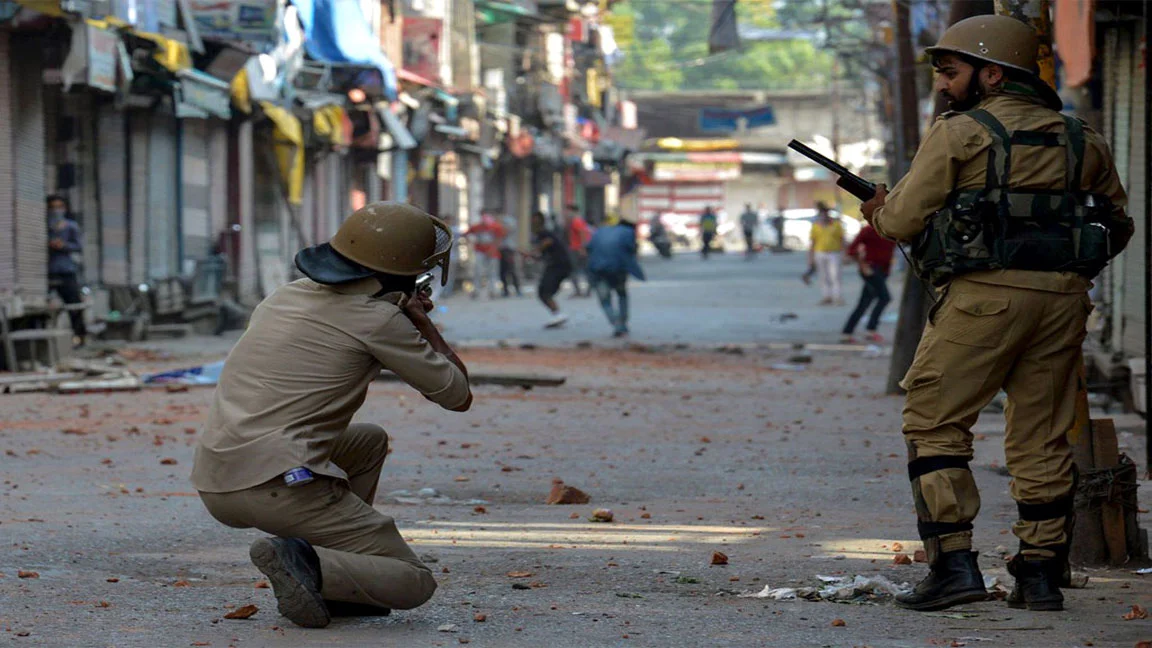
The human rights violations in Kashmir are not merely a consequence of armed conflict; they are part of a broader pattern of systematic repression. Kashmiris who seek their rights through peaceful means face brutal retaliation. The Indian government’s response to peaceful protests has often been one of violence, with thousands of civilians, including women and children, being caught in the crossfire. Protestors are met with pellet guns, which have caused widespread blindness and injuries among demonstrators. The international community has repeatedly condemned these actions, yet India has shown little willingness to change its approach.
One of the most alarming aspects of the conflict in Kashmir is the way the Indian government frames the Kashmiri struggle. The term “terrorism” is frequently used to describe those fighting for the region’s rights, while their actual grievances are dismissed. By labeling these fighters as terrorists, the Indian government not only seeks to delegitimize their cause but also to justify its military actions, which often result in the loss of innocent lives. This strategy serves to silence the Kashmiri people, reducing their cries for justice to mere acts of violence in the eyes of the international community.
India’s labeling of Kashmiri fighters as “terrorists” further exacerbates the situation. It portrays the people of Kashmir as enemies of the state rather than as individuals with legitimate grievances. This rhetoric allows the government to justify its continued military presence in the region and its brutal tactics against civilians. However, as the international community continues to raise concerns about human rights abuses in Kashmir, there is growing recognition that the Indian government’s actions are not only unjust but also unsustainable.
The human rights situation in Kashmir is not just a matter of politics; it is a matter of basic human dignity. The people of Kashmir have the right to live in peace, to express their views without fear of retribution, and to have their voices heard. The Indian government’s ongoing refusal to recognize these rights only deepens the cycle of violence and repression in the region.
The struggle in Kashmir is far from over, and the challenges faced by the people there are immense. But it is essential that the international community continues to hold the Indian government accountable for its actions and pressures it to engage in a meaningful dialogue with the people of Kashmir. Only then can there be hope for a just and lasting solution to the conflict, one that recognizes the rights and aspirations of the Kashmiri people. Until that happens, the struggle for Kashmir’s rights will remain an ongoing fight for justice, dignity, and freedom.
Author