


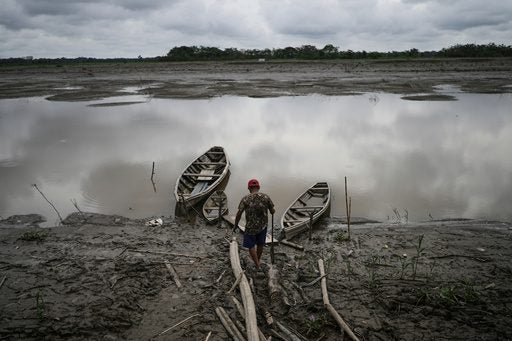
The Silent Choke: Global Rivers Gasp as Oxygen Drains Away
POLICY WIRE — Washington D.C., USA — The fish, it turns out, don’t much care for gradual suffocation. Down in the murky depths of rivers stretching from the ancient Indus to the sprawling...

POLICY WIRE — Washington D.C., USA — The fish, it turns out, don’t much care for gradual suffocation. Down in the murky depths of rivers stretching from the ancient Indus to the sprawling Amazon, a silent, unseen drama is unfolding—a slow-motion ecological choking that barely registers on most radars. But ignore it at our peril, warns new research out of China, because this isn’t just about fish.
It’s about the basic chemistry of our freshwater lifelines gone awry. A comprehensive study, published recently in Science Advances, paints a grim picture: the planet’s rivers have collectively shed an average of 2.1% of their dissolved oxygen since 1985. Two point one percent. Sounds minor, doesn’t it? A shrug-worthy decimal point. Yet, it’s the quiet drip-drip of a catastrophic leak, one that climate change is only too happy to accelerate.
Warmer water, as any high-school science kid could tell you, holds less dissolved gas. That includes the oxygen critical for everything swimming, crawling, or breeding in those waterways. And because human activity keeps heating up the atmosphere, our rivers are turning into warmer, less breathable habitats. Nearly two-thirds of this oxygen loss—a sobering 63%, according to the study—comes down to rising water temperatures. It’s a fundamental physical process, not a mysterious ailment, making it both infuriatingly simple and brutally difficult to fix.
Qi Guan, lead author of the study and an environmental scientist at the Chinese Academy of Sciences in Nanjing, puts the danger in plain terms. “Deoxygenation is a very slow process,” he explained, underscoring the insidious nature of the problem. “But if we have a long period, the negative impact will attack the river ecosystems. The low level of oxygen can cause a series of ecological crises such as biodiversity decline, water quality degradation and maybe some fish will die.” Translation: your children won’t be catching much of anything in places where fish once thrived.
And things are only getting worse. If current trends hold, global rivers are set to lose another 4% of their oxygen by the century’s end. Certain regions—the Eastern United States, the Arctic, India, and much of South America—could see declines around 10%. That’s when river stretches turn into “dead zones,” suffocating aquatic life and turning once-vibrant ecosystems into stinking, barren stretches. We’ve already got infamous examples, like parts of the Gulf of Mexico, Chesapeake Bay, and even the Amazon Basin, which has seen the number of dead-zone days rise by nearly 16 days per decade since 1980.
Karl Flessa, a geoscientist from the University of Arizona, isn’t pulling any punches about the consequences. “Losing oxygen in rivers means a future of more stinky dead zones (hypoxia), especially during heat waves,” he remarked, adding a rather depressing thought for the weekend angler: “if your favorite fishing hole gets too warm, oxygen levels will go down and there won’t be any fish to catch.”
But the warming isn’t the only culprit. Runoff from agricultural fertilizers, urban pollution, and dam construction also gobble up oxygen, creating a nasty cocktail of ecological stress. Emily Bernhardt, an ecologist at Duke University, points out the compounding effect: “as rivers warm it becomes easier and easier for the same pollution problems as before to cause more severe, more long lasting or more widespread hypoxia and anoxia.” Basically, the old problems are hitting harder now that the rivers are running a fever.
📄 POLICY WIRE WHITEPAPER PUBLISHED: PAKISTAN'S NATIONAL SECURITY POLICY PRIORITIES
👉 READ BY CLICKING HEREThis reality hits particularly close to home in the Muslim world, where immense populations depend directly on river systems for sustenance and economic survival. Consider Pakistan’s Indus River, the lifeblood for millions, already grappling with issues ranging from damming and pollution to erratic glacial melt. Historically, India’s Ganges, which flows into Bangladesh, was losing oxygen over 20 times faster than the global average earlier this century, as detailed in the new findings. What happens when these crucial arteries start losing their breath too?
“The Indus isn’t just a river; it’s our history, our agriculture, our identity,” stated Muhammad Rashid, Pakistan’s Federal Minister for Water Resources, his voice heavy with concern in a recent Policy Wire interview. “The idea that its very breath could be stolen by distant emissions — and local carelessness… it’s a terrifying prospect. We must act, or face unprecedented economic — and social upheaval.”
What This Means
The slow bleed of oxygen from our rivers isn’t just an ecological footnote; it’s an economic and political bomb with a long fuse. Think about it: a planet of dying rivers translates directly into food insecurity for millions, particularly in heavily reliant regions like South Asia and parts of Africa. Fisheries collapse, agricultural yields suffer as water quality degrades, and human health issues — waterborne diseases often flourish in deoxygenated environments — become more pronounced.
But this isn’t some distant catastrophe. This scientific revelation forces governments to confront a stark reality: continued inaction on climate change makes local environmental efforts exponentially harder, if not futile. Investing in cleaner industrial practices and agricultural reform, which are already contentious battles, will yield fewer results if the fundamental warming trend isn’t arrested. And that’s because these challenges aren’t discrete. They’re all wrapped up, creating what some policy wonks might call a feedback loop from hell.
For developing nations, especially, this means an escalating resource war — battles over clean water, disappearing protein sources, and arable land – and forced migration for communities whose traditional livelihoods simply vanish. Nations must now consider the cost not just of greenhouse gas emissions, but of losing the very rivers that sustain them. It brings a new, chilling dimension to discussions around climate aid — and international responsibility. In places like New Mexico, which grapples with climate calamity igniting policy questions and resource wars, this is already a tangible, visceral fight. It’s no longer a matter of ‘if’ but ‘how soon’ our rivers become gasping monuments to our own folly.