

The Shenzhen Declaration Signals a Changing Global Order or Raises New Questions for Nuclear Stability
The November 19 Shenzhen summit between Donald Trump, Xi Jinping and Vladimir Putin signals a shift in major-power engagement. While identifying cooperation on UN reform, energy security and nuclear...

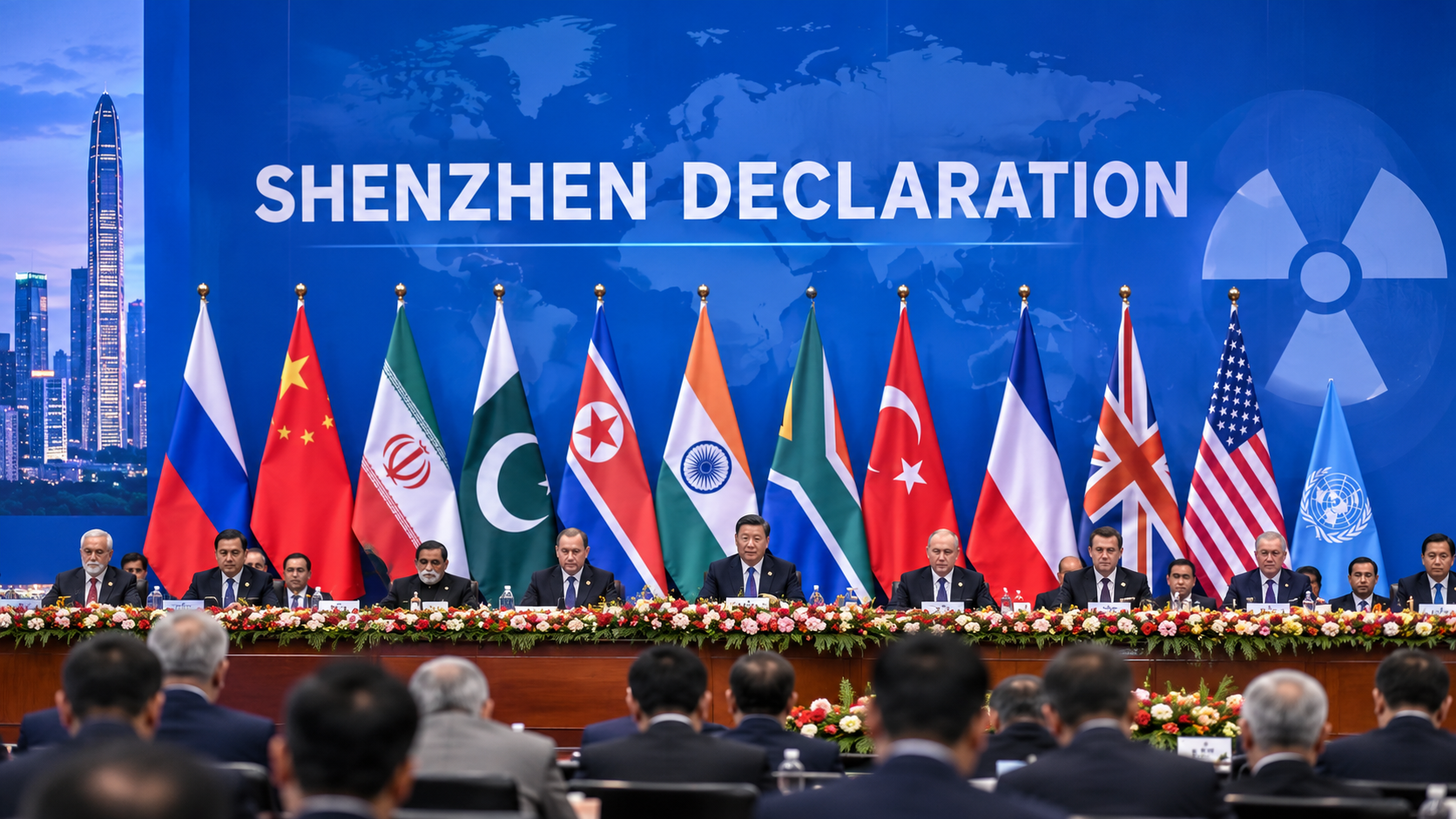
The world’s most consequential security decisions are increasingly being shaped by a small group of powerful states, while the countries most exposed to their consequences often remain outside the negotiating room. The November 19 trilateral summit in Shenzhen, bringing together US President Donald Trump, Chinese President Xi Jinping and Russian President Vladimir Putin, reflects this changing reality. At a time when international institutions face questions of credibility, major-power rivalries are intensifying and nuclear risks remain significant, the three leaders have attempted to establish common ground on some of the defining issues of global politics.
The resulting four-point declaration is significant not because it resolves existing conflicts, but because it identifies areas where competing powers are prepared to cooperate despite their broader strategic differences. Its commitments cover United Nations reform, energy security, state sovereignty and nuclear risk reduction. Together, these issues offer an insight into how the major powers envisage managing an increasingly fragmented international environment.
The first important dimension is the renewed emphasis on the role of major powers in shaping international governance. Their commitment to reforming the United Nations reflects growing recognition that the existing institutional structure faces difficulties in responding to contemporary conflicts and security challenges. However, the initiative also raises an important question: whether reform will produce a more representative international system or primarily strengthen the influence of states that already possess permanent membership and veto powers in the Security Council. For developing countries, meaningful reform must involve greater representation, institutional accountability and a stronger voice in decisions affecting international peace and security.
The declaration’s emphasis on state sovereignty and the jurisdiction of international institutions represents another important aspect. By stressing state consent and immunity for state officials, the three governments have expressed reservations about the exercise of international legal authority beyond nationally accepted jurisdiction. This reflects a broader debate between national sovereignty and international accountability. Nevertheless, the declaration does not alter existing international legal obligations or independently change the jurisdiction of the International Criminal Court. Its significance is primarily political, demonstrating a shared position among three influential states on the limits of international institutional authority.
Energy security also occupies an important place in the agreement. The commitment to increase refined petroleum production and maintain stable energy flows reflects the growing relationship between energy supplies, economic resilience and national security. For major powers, reliable energy supplies are essential to sustaining industrial production and strategic influence. For developing economies, however, the consequences are more immediate. Fluctuations in petroleum prices, disruptions in maritime routes and external supply constraints directly affect inflation, trade balances and industrial activity. If the declaration translates into practical cooperation, energy-importing countries could benefit from greater supply stability. However, without production targets, implementation arrangements or clear supply commitments, its economic benefits remain uncertain.
The most consequential security dimension concerns nuclear stability. The three leaders reaffirmed that nuclear war cannot be won and must never be fought, while committing to dialogue on reducing nuclear risks and preventing proliferation. This statement carries particular importance following the expiration of the New START Treaty between Washington and Moscow in February 2026. For the first time in decades, the two largest nuclear powers are no longer bound by its formal limits on deployed strategic nuclear weapons. Bringing China into a wider nuclear dialogue is therefore strategically relevant, particularly as its nuclear capabilities continue to expand.
Nevertheless, nuclear dialogue should not be confused with nuclear arms control. The declaration does not establish warhead limits, verification mechanisms, restrictions on delivery systems or a binding framework for strategic force reductions. Its immediate contribution is political: keeping communication open among three states whose military capabilities give them an exceptional responsibility for global nuclear stability. Whether this understanding develops into substantive arms-control arrangements will depend on their willingness to address differences over strategic balance, missile defence, emerging technologies and the future of nuclear deterrence.
For the United States, the summit provides an opportunity to maintain strategic communication with its two principal nuclear competitors while pursuing its broader security interests. For China, hosting the meeting reinforces its diplomatic position as a major participant in international security discussions. It also allows Beijing to demonstrate that its global role extends beyond economic competition and regional influence. Russia, meanwhile, gains diplomatic visibility and an opportunity to reaffirm its position in discussions concerning the international security architecture. Yet, these common commitments should not be interpreted as the emergence of a strategic alliance. Their disagreements over Ukraine, Taiwan, sanctions and regional influence remain substantial. The declaration is better understood as selective cooperation between competing powers rather than a fundamental convergence of their foreign policies.
For developing countries, the implications are more complex. Their economic and security interests are increasingly affected by decisions taken in major-power capitals, whether concerning energy markets, international financial arrangements, technology restrictions or security partnerships. Greater cooperation among the three powers could reduce certain international risks, but an arrangement dominated by major states could also marginalise the interests of smaller countries. A reformed international system must therefore ensure that strategic stability does not become an exclusive understanding among powerful states at the expense of broader international representation.
For Pakistan, the nuclear dimension deserves particular attention. Although the Shenzhen declaration does not directly address South Asia, its emphasis on nuclear risk reduction has relevance for the strategic environment between Pakistan and India. Both countries possess nuclear capabilities, and their deterrence relationship remains central to regional security. The experience of recent military crises has demonstrated that nuclear weapons can prevent the escalation of a conflict into full-scale war, but they do not necessarily prevent limited conventional military exchanges or coercive signalling. The challenge is therefore not simply maintaining nuclear capabilities, but ensuring that political and military decisions do not generate miscalculations during a crisis.
The declaration will not directly change the nuclear balance between India and Pakistan. It contains no commitments concerning their nuclear arsenals, missile capabilities, doctrines or bilateral security arrangements. Nor does it establish any new restrictions on their strategic programmes. Its implications are more indirect but potentially important.
First, greater nuclear communication between Washington, Beijing and Moscow could strengthen international awareness of escalation risks in South Asia. China, as a participant in the Shenzhen framework and Pakistan’s longstanding strategic partner, occupies an important position in the regional security equation. Its involvement in wider nuclear discussions could also provide an additional diplomatic channel for reinforcing the importance of strategic restraint and crisis management.
Second, the emerging global nuclear dialogue may influence how major powers approach regional non-proliferation and deterrence questions. Pakistan has consistently maintained that regional strategic stability requires a balanced understanding of the security environment, including India’s conventional military capabilities and its expanding strategic partnerships. Any future international arms-control initiative should therefore recognise the security concerns of all regional stakeholders rather than apply selective standards or impose arrangements that disregard existing strategic realities.
Third, the declaration highlights the importance of communication in preventing nuclear escalation. For India and Pakistan, maintaining credible crisis communication mechanisms, avoiding misinterpretation of military signals and strengthening established risk-reduction arrangements remain essential. Nuclear deterrence is sustained not only through military capability but also through clarity of communication, responsible decision-making and an understanding of the consequences of escalation.
Ultimately, the Shenzhen declaration reflects an important feature of contemporary international politics: even states engaged in intense strategic competition recognise the necessity of cooperation on issues where the costs of confrontation could be catastrophic. Its real significance will depend on whether the political understanding develops into practical mechanisms.
For Pakistan, the emerging environment presents both diplomatic opportunities and strategic considerations. The priority should remain the preservation of credible deterrence, regional strategic balance and meaningful engagement with international initiatives that support equitable security arrangements. The future of global stability will not be determined merely by agreements among major powers, but also by whether their commitments create space for the security interests of developing and regional states. The real test of the Shenzhen understanding will be whether it can move beyond declarations and contribute to a more inclusive and predictable international security order.