


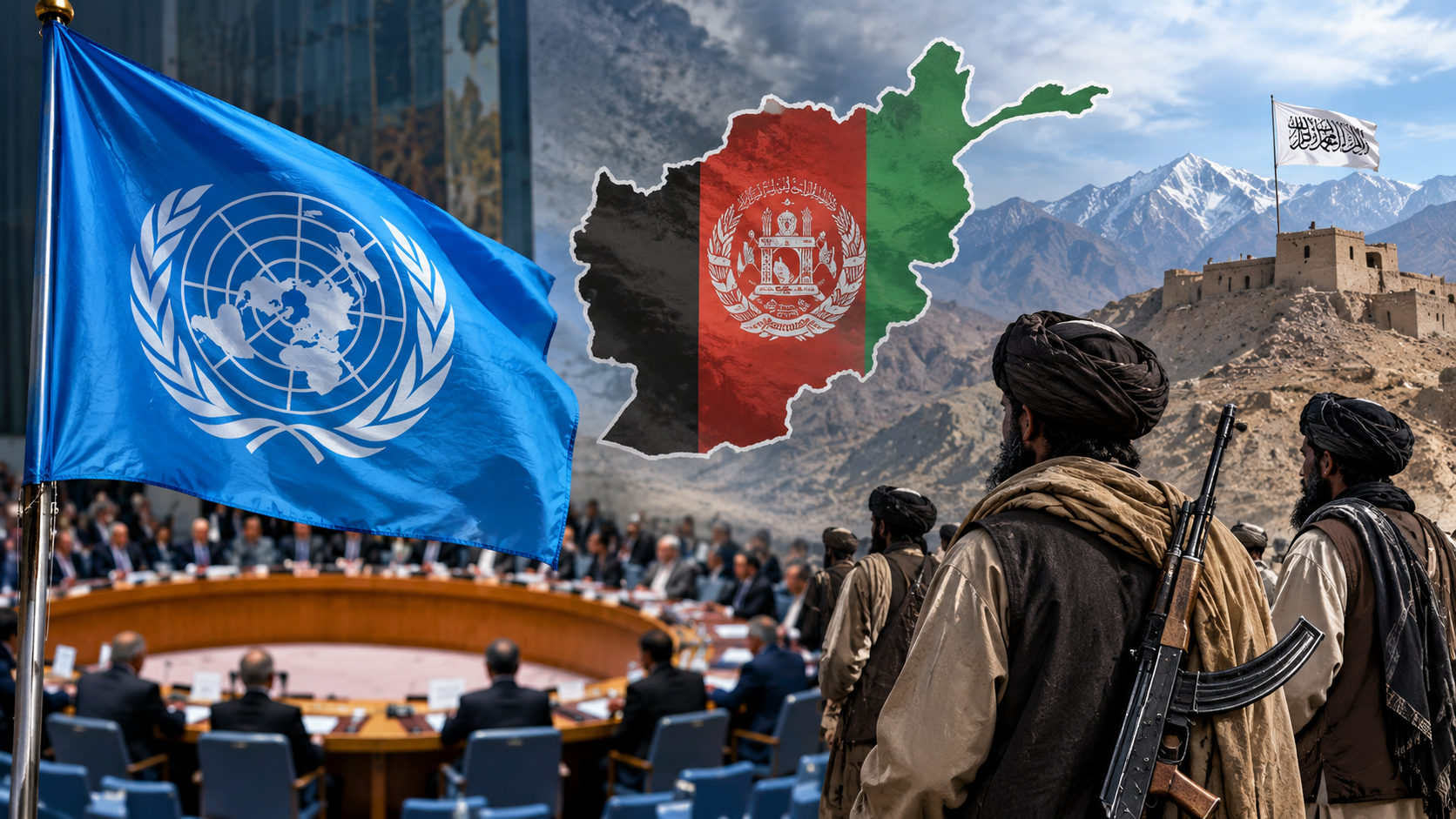
Afghanistan’s Terror Sanctuaries Are Now the UN’s Problem
Five years after the Taliban returned to Kabul, UN Security Council briefings confirm that Afghanistan remains a permissive base for terrorist networks including TTP, ISKP and al-Qaeda. Pakistan is...
Five years after the Taliban returned to Kabul, the world was promised that Afghanistan would never again be a launchpad for terrorism. On 20 November 2026 the UN Security Council heard otherwise.
At a briefing on the Council’s counterterrorism bodies, chaired by Latvia’s ambassador Sanita Pavļuta-Deslandes, members were told that terrorist groups in Afghanistan still threaten UN member states. Two names stood out. Islamic State Khorasan Province (ISKP) is increasingly looking beyond Afghanistan’s borders. The Tehreek-e-Taliban Pakistan (TTP) remains a serious threat to the region and, according to the remarks, receives logistical and operational support from the Taliban.
For Pakistan this is a familiar warning. For everyone else it should be a new worry. The UN’s own monitors now describe a country where al-Qaeda’s leaders live openly, where Islamic State’s most dangerous branch is buying drones and night-vision gear, and where training camps reportedly serve more than one cause. What happens in Afghanistan no longer stays there.
Not a Pakistani Talking Point Anymore
Islamabad has made this case for years, and Kabul has dismissed it as politics. What has changed is who is making it. The warning now comes from the UN’s own records.
November 2025. Denmark’s deputy ambassador, chairing the Council’s ISIL and al-Qaeda sanctions committee, said the TTP has about 6,000 fighters and is “receiving both logistical and substantial support from the de facto authorities.” She added that it had “conducted numerous high-profile attacks in Pakistan from Afghan soil, some of which incurred mass casualties.” She called ISKP, with at least 2,000 fighters, one of the most serious threats in Central and South Asia.
August 2026. The UN Monitoring Team’s 38th report, covering December 2025 to June 2026, went further. It said the Taliban “continued their support” to the TTP. Its other findings:
TTP attacks grew deadlier. In February a car bomb in Bajaur killed 11 security personnel and a child. The TTP has added new divisions and a unit it calls the “TTP Air Force.”
ISKP is shifting into Pakistan. Its attacks fell inside Afghanistan but rose in Pakistan. The report says ISKP likely carried out the February suicide bombing of a Shia mosque in Islamabad that killed 32 people. Member states reported it now has drones, night-vision devices and thermal imagers.
Al-Qaeda is at home in Kabul. Leaders of al-Qaeda in the Indian Subcontinent reportedly live there with Taliban-issued identity papers. In April al-Qaeda’s media arm, As-Sahab, publicly backed the TTP’s campaign against Pakistan for the first time.
November 2026. The Council heard the same message again. The threat hasn’t faded. It has spread.
Where the BLA Fits
The Balochistan Liberation Army (BLA) is a separatist group, not a jihadist one. Its ideology is secular nationalism. That difference has shaped how the world treats it. When Pakistan and China asked the Security Council to add the BLA and its suicide wing, the Majeed Brigade, to the UN’s al-Qaeda and Islamic State sanctions list, the United States, backed by the UK and France, blocked the bid in June 2026. The reason given was that there was no evidence linking the BLA to either group.
The Monitoring Team’s August report complicates that position. It records that one member state reported al-Qaeda trainers in Afghanistan training BLA fighters alongside TTP members. Another report said ISKP and the BLA share logistics networks. These are member-state reports, not established findings, and they need corroboration. But they come from inside the UN’s own system, and they go to the heart of the case for listing.
The ideologies differ. The geography doesn’t. Secular separatists, Pakistani Taliban and Islamic State’s local branch all appear to draw on the same safe space, the same smugglers and possibly the same trainers. That convergence is what makes Afghanistan dangerous for more than one neighbour.
Pakistan’s Case: Fix the System, Not Just the List
At the same session, Pakistan’s permanent representative, Ambassador Syed Haider Shah, argued that the Council’s counterterrorism machinery was built for a different era. He said the sanctions framework is ill-equipped for cross-border militancy, emerging technologies and threats coming from Afghanistan. “The counter-terrorism architecture in the Council must reflect ground realities,” he said.
His proposals:
Broaden listings and their criteria so the sanctions system can reach the individuals and groups actually driving today’s threats.
Regulate the digital battlefield, including social media platforms, artificial intelligence and digital payments. “We need regulation of social media platforms, Artificial Intelligence, and digital payment methods,” he said.
Strengthen cooperation under Resolution 1540 on weapons of mass destruction and non-state actors.
Join up the Council’s committees and their expert groups so threats aren’t tracked in separate silos.
He named the TTP, the BLA, the Majeed Brigade and the East Turkestan Islamic Movement as groups operating from Afghanistan. He also accused India of backing them, calling it Pakistan’s “principal adversary” and a “net destabiliser in the region.” India rejects that charge.
The first point is the one with global reach. The 1267 regime was designed in 1999 for al-Qaeda. A quarter of a century later, the threats it was built for have changed shape. Groups now share training, money and media across ideological lines. A framework that sorts terrorists by ideology rather than by what they do risks leaving dangerous gaps.
What to Watch
The next Monitoring Team report. If more member states report BLA links to al-Qaeda trainers or ISKP networks, the case for a UN listing gets harder to block.
A third listing bid. Pakistan and China have tried twice. A new bid backed by fresh evidence would test whether the US, UK and France hold their position.
ISKP outside the region. The November warning that ISKP is looking beyond Afghanistan matters most to Central Asia, Iran, Russia and Europe, all of which it has struck before.
Kabul’s response. The Monitoring Team reported that the Taliban moved about 2,000 TTP fighters and their families away from the Pakistani border and warned TTP leaders to stop attacks. Whether that becomes real pressure or remains a gesture is the key question.
Reform talk turning into text. Watch whether any Council member takes up Pakistan’s call to update the sanctions framework, especially on digital payments and online recruitment.
Conclusion: A Sanctuary Doesn’t Stay Local
Afghanistan’s terrorist problem was once treated as Pakistan’s problem, raised in Islamabad and brushed off in Kabul. The UN’s own record has changed that. Its monitors describe Taliban support for the TTP, al-Qaeda leaders living in Kabul and Islamic State’s local branch buying drones and spreading into Pakistan. Its briefers now warn that these groups threaten UN member states.
The world’s counterterrorism system was built in 1999 to track one network. Today the danger lies in overlap: groups with different flags sharing the same ground, trainers and supply lines. Pakistan’s call to update that system isn’t special pleading. It’s a recognition that a safe haven doesn’t care about ideology, and that the bill for ignoring it rarely stays with one country.