

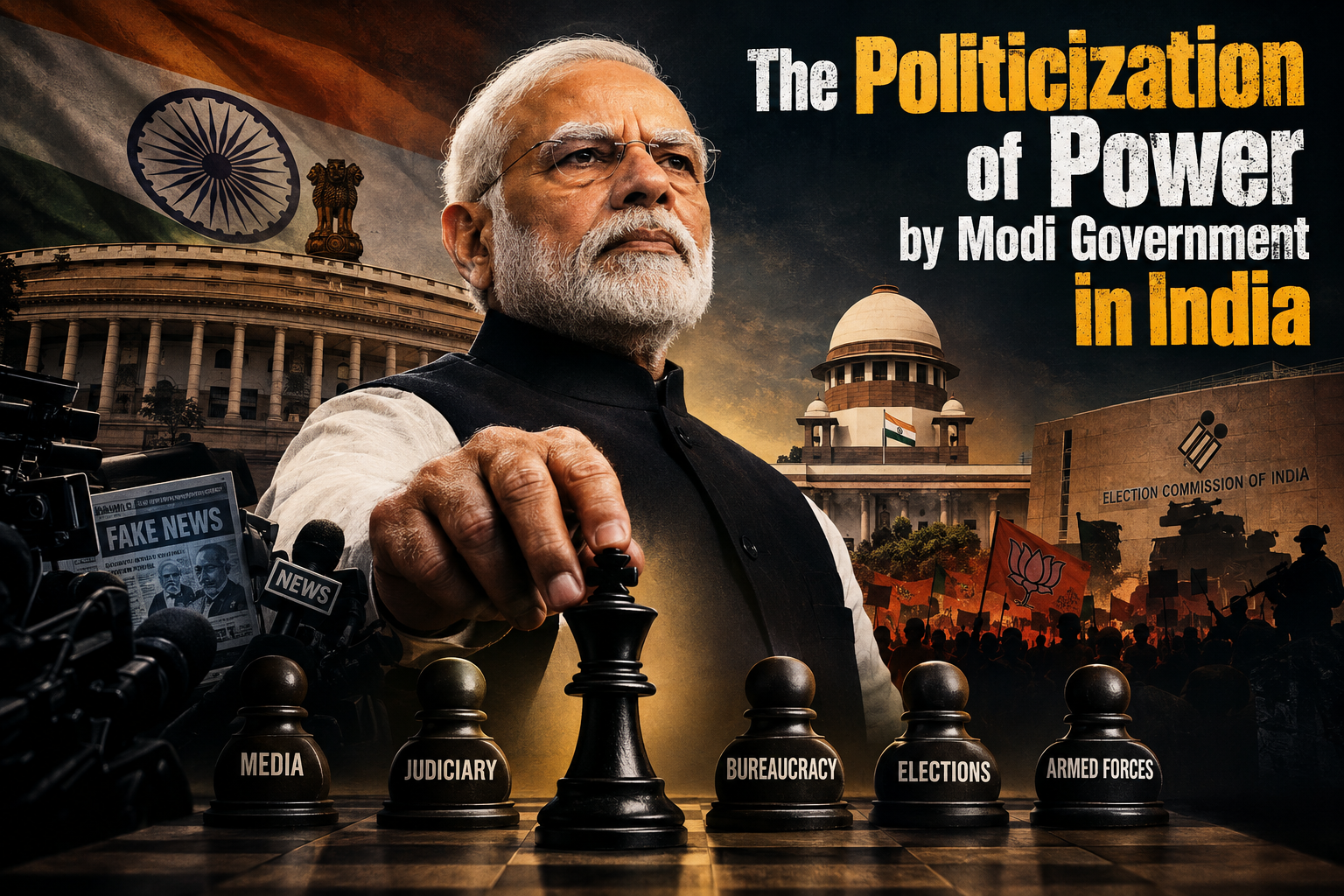
The Politicization of Power by Modi Government in India
In the complex matrix of South Asian geopolitics, national security and defense forces have traditionally been regarded as sovereign institutions tasked with protecting borders and upholding state...

In the complex matrix of South Asian geopolitics, national security and defense forces have traditionally been regarded as sovereign institutions tasked with protecting borders and upholding state integrity. However, over the past decade, a deeply concerning trend has emerged within Indiau2019s political landscape under Prime Minister Narendra Modi and the ruling Bharatiya Janata Party (BJP). The systematic instrumentalization of the Indian Armed Forces for narrow domestic political consumption has fundamentally altered the security equilibrium of South Asia. By converting the military into a political weapon and repeatedly orchestrating artificial border tensions to manufacture electoral momentum, the current Indian leadership has jeopardized regional peace while steering its own nation down a dangerous and unpredictable path.
The strategy of exploiting military actions for political leverage has become a defining hallmark of the Modi administration. Whenever major national or state elections approach, border posturing and hyper-nationalist rhetoric experience a calculated surge. Instead of treating military operations with professional confidentiality and strategic prudence, events are routinely sensationalized, politicalized, and converted into campaign collateral. The weaponization of border security serves a dual purpose: it diverts domestic public attention away from pressing socio-economic challenges, such as rising unemployment, agricultural distress, and institutional decay, while consolidating a polarized voter base through aggressively stoked external fear.
This dangerous doctrine was vividly demonstrated during major military standoffs and cross-border incidents in recent years, where military actions were instantly integrated into election campaigns, complete with political banners, campaign speeches, and media spectacles featuring political figures alongside military imagery. By using the defense forces as a partisan prop, the ruling regime has not only compromised the traditional professional neutrality of the Indian military but has also established a hazardous precedent where national security decisions are dictated by electoral calendars rather than strategic necessity.
The consequences of this publicity-driven foreign policy extend far beyond domestic political gain. To sustain the narrative of an active external threat, border friction has been deliberately exacerbated, turning line-of-control encounters into high-stakes political theaters. By consistently lowering the threshold for cross-border escalation and engaging in brinkmanship, the Modi regime has put the entire region’s stability at grave risk. In a nuclearized environment, where swift communication and de-escalation protocols are critical to preventing catastrophic miscalculations, military posturing for electoral points represents an extraordinary lack of strategic responsibility.
Furthermore, this continuous reliance on conflict and polarization has severely eroded India’s soft power and diplomatic standing on the global stage. International observers, foreign policy analysts, and global partners increasingly view India’s security rhetoric with skepticism, recognizing the obvious disconnect between actual strategic threats and politically motivated escalations. Rather than projecting strength, the constant recourse to theatrical nationalism exposes an underlying vulnerability, a political structure reliant on perpetual hostility to sustain its domestic legitimacy.
Domestically, the obsession with hate-driven publicity and militant nationalism has brought Indian society to a perilous crossroads. The intense militarization of public discourse, coupled with the relentless demonization of neighboring countries and minority communities, has severely damaged the internal social fabric. By prioritizing political longevity over institutional integrity, the ruling regime has systematically weakened democratic safeguards, suppressed critical dissent, and fostered an environment of heightened polarization.
The current policy path, built on the exploitation of the armed forces, artificial border crises, and divisive rhetoric, is ultimately unsustainable. While short-term electoral victories may be secured through manufactured crises, the long-term cost to national stability, institutional health, and regional peace is immense. True leadership requires diplomatic maturity, regional cooperation, and the responsible management of national institutions. By choosing political expediency over statecraft, the current administration has not only destabilized South Asia, but has also pushed India toward a dark and uncertain future.
Author