
The Old Man and the Tsar: Schröder’s Shadow Diplomacy Undermines Europe’s Stance
POLICY WIRE — Berlin, Germany — When the Kremlin deigns to announce a ‘private’ chat between Vladimir Putin and Germany’s former Chancellor Gerhard Schröder, you don’t need a codebook to know what...

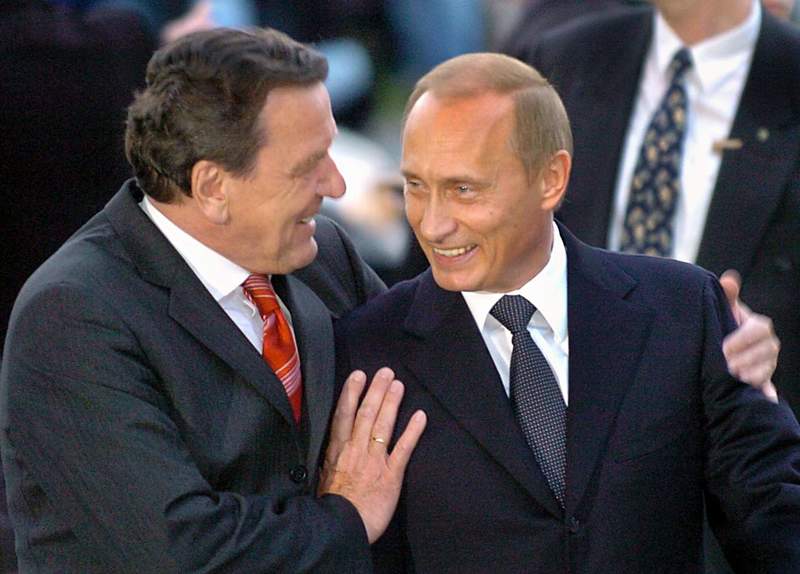
POLICY WIRE — Berlin, Germany — When the Kremlin deigns to announce a ‘private’ chat between Vladimir Putin and Germany’s former Chancellor Gerhard Schröder, you don’t need a codebook to know what game they’re playing. It’s not about finding common ground, not really. It’s about sticking a finger in Europe’s eye, a reminder that even when much of the continent has thrown Moscow to the wolves—or, rather, thrown sanctions at it—some German heavyweights still show up for tea.
This isn’t a new act, not by a long shot. Schröder, a man who once called Putin an ‘impeccable democrat,’ hasn’t let a minor thing like a full-scale invasion of a sovereign nation get in the way of his longstanding friendships. But, with the continent bracing for another winter and the Ukraine conflict digging in for the long haul, his persistent coziness with the man in the Kremlin feels less like a retired statesman’s well-meaning mediation and more like a deliberate, even provocative, act of diplomatic freelancing. It’s a move that makes Berlin—and frankly, a good chunk of Western diplomacy—squirm.
It’s a peculiar brand of ‘private’ when the entire global press corps is reading about it via Kremlin statements. They said the two men merely discussed ‘personal issues.’ Please. Anyone with half an ounce of sense knows that in Moscow, nothing with Putin is purely ‘personal.’ Especially not with a former leader of Europe’s economic engine, a man who until recently chaired the supervisory board of Rosneft, Russia’s state oil giant, and championed the now-mothballed Nord Stream 2 gas pipeline. Some might call it a peculiar devotion; others just see dollar signs — and old boys’ networks that refuse to die. The political calculus here is hardly opaque.
Germany’s current government, a rather unwieldy coalition, finds itself constantly trying to distance itself from its own past leader’s enduring ties. A prominent Green Party MP, Anton Himmelreich, didn’t mince words. “It’s deeply unhelpful, frankly. Every private handshake plays right into the Kremlin’s hand, undermining our collective stance — and our sacrifices. It sends the absolute worst signal at a time when we need unity.” He’s right, of course. What message does it send when Berlin tries to speak with one voice against Moscow’s aggression, yet one of its most senior ex-statesmen keeps dropping by the dacha for ‘a chat’?
Schröder, for his part, remains defiant, cloaked in a mantle of pragmatic necessity. And you can almost hear him saying, “Someone has to talk to Moscow when official channels seize up. I don’t apologize for trying to keep lines open, even if it ruffles some feathers in Berlin.” It’s a convenient rationale, if you ignore the historical context and the present geopolitical reality. Because the world has fundamentally shifted, and what once passed for pragmatic engagement now looks suspiciously like complicity—or at least, a willful ignorance of stark new realities.
📄 POLICY WIRE WHITEPAPER PUBLISHED: PAKISTAN'S NATIONAL SECURITY POLICY PRIORITIES
👉 READ BY CLICKING HEREThis ongoing spectacle isn’t just a European sideshow. It ripples outwards, distorting perceptions — and injecting unease into other geopolitical fault lines. Think about countries like Pakistan, for instance, which struggles with economic precarity and a perennial search for stable energy supplies. When leaders like Putin, officially isolated by the West, are seen to still engage high-profile European figures, it implicitly validates a ‘business as usual’ approach. This can make it harder for nations in South Asia and the broader Muslim world, many of whom are trying to navigate their own complex relationships with both Russia and the West, to maintain a unified front or commit fully to Western-led sanctions. It muddies the diplomatic waters, suggesting cracks in the facade of European resolve, which in turn might embolden them to pursue avenues that could complicate global stability. It’s not just a German problem; it’s a perception problem.
And let’s not forget the sheer strategic importance. Prior to Russia’s full-scale invasion of Ukraine, Germany imported approximately 55% of its natural gas from Russia, a figure that has since dropped dramatically but highlights the historical entwinement and the monumental shift Berlin has had to engineer (Source: German Federal Statistical Office, 2021 data). Schröder, with his pipeline advocacy, was central to that dependency. Now, his ‘private talks’ become a lightning rod for those who believe Germany—and Europe—still hasn’t fully escaped the gravitational pull of cheap Russian energy, no matter the cost in democratic values. It gives succor to a regime desperate for any semblance of international legitimacy.
What This Means
Schröder’s Moscow sojourns are more than just a historical footnote; they’re an active liability. Politically, they sow discord within Germany’s ruling coalition and provide fodder for opposition critics who accuse the government of not doing enough to rein in its rogue ex-Chancellor. They also undermine Germany’s credibility on the European stage, making it harder to lead on critical issues like continued sanctions and military aid to Ukraine. Economically, while Germany has diversified its energy sources significantly, these meetings offer Moscow a psychological win, reinforcing its belief that European resolve is ultimately flimsy. The Kremlin exploits this kind of dissent, framing it as evidence of internal cracks in the Western alliance, even if it’s merely a lone wolf. they contribute to a broader narrative in non-Western states, suggesting that Russia isn’t truly isolated. It complicates global efforts to maintain a strong stance against Russian aggression. The message from Moscow, enabled by figures like Schröder, is clear: ‘You might sanction us, but some of your old guard still call.’