

Digital Phantom: How Eid Prayers Became a Propaganda Weapon in Ethiopia’s Fractured Narrative
POLICY WIRE — Addis Ababa, Ethiopia — A fleeting image, a brief moment of communal prayer, can easily become raw material for the grinder of information warfare. This much we’ve seen happen too...

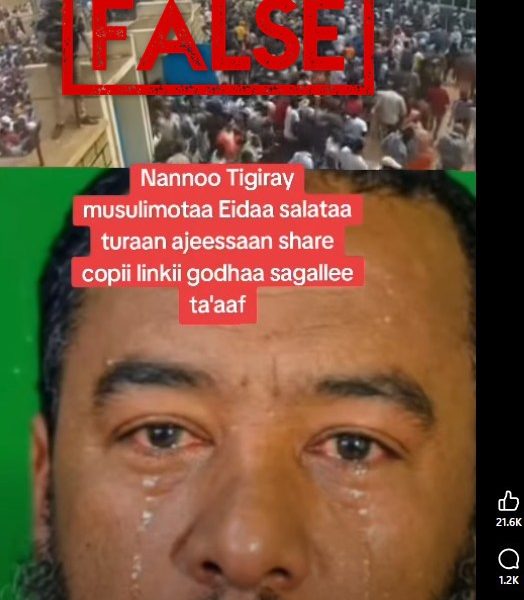
POLICY WIRE — Addis Ababa, Ethiopia — A fleeting image, a brief moment of communal prayer, can easily become raw material for the grinder of information warfare. This much we’ve seen happen too often, particularly when conflict festers. But the outright transmutation of tranquil Eid al-Fitr prayers in Ethiopia’s volatile Tigray region into staged footage of an ‘attack’ on Muslims—it’s brazen, isn’t it? A cynical move that slices through any pretense of objective reporting, illustrating just how desperately some factions wield the digital brush to paint their own stark realities.
It wasn’t a skirmish; it wasn’t a crackdown. It was Eid. Muslims in various locations across Tigray, much like their brethren around the globe, knelt in devotion, concluding the holy month of Ramadan. Footage from these gatherings, often peaceful — and celebratory, subsequently popped up online. And then came the digital doctors, performing grotesque surgery on reality. Social media accounts, some anonymous, some affiliated with groups having their own axes to grind within the broader Ethiopian conflict, repackaged these benign scenes. They stripped away the context, added inflammatory captions, and pushed them out as evidence of systematic religious persecution, specifically targeting Tigrayan Muslims.
The misdirection didn’t just confuse; it angered. It fanned already simmering tensions in a nation scarred by prolonged conflict. And it forced Ethiopian authorities into the unenviable position of having to fact-check Eid, a deeply personal and unifying religious observance. “These campaigns aren’t just fabrications; they’re direct attacks on the very fabric of our national unity, designed to destabilize our communities and derail peace efforts,” states Dr. Lemma Kebede, Director of Public Diplomacy for the Ethiopian Ministry of Foreign Affairs, in a candid admission of the deep frustration emanating from Addis Ababa.
Because, really, what else can you call it when solemn worship becomes an alleged atrocity? It’s manipulation on a grand scale, leveraging global connectivity for very local, very destructive aims. We’re seeing more of it — these carefully curated echoes of conflict designed to generate maximum outrage, whether it’s warranted or not. This isn’t a unique phenomenon to East Africa. Go talk to someone in Pakistan, in Kashmir, or any region where political grievances bleed into religious identity. You’ll find similar tales of weaponized narratives, where even genuine grievances get muddled by the digital fog of war. It creates distrust, hinders honest dialogue, and — make no mistake — deepens societal fault lines.
“We just wanted to pray,” laments Sheikh Mohammed Abdulahi, a revered community elder from Mekelle, his voice weary over a crackling phone line. “But even our prayers become a tool for others’ arguments. It’s disheartening; it leaves you wondering if anyone will ever believe the simple truth anymore.” His community, like many others caught in Tigray’s turbulent recent past, just wants some peace, not to be props in someone else’s propaganda video.
This episode serves as a chilling reminder that, in our hyper-connected world, truth itself often becomes the first casualty. A recent study by the Ethiopian Ministry of Peace estimated that over 60% of online content regarding the Tigray conflict originating outside official government channels contained some degree of misinformation or deliberate falsehoods during the conflict’s peak. Think about that for a second. More than half the chatter wasn’t just biased; it was flat-out wrong, often intentionally so. It’s a statistic that should keep every seasoned policy wonk up at night. And it begs the question: how do you even begin to forge lasting stability when such foundational distortions proliferate without consequence?
📄 POLICY WIRE WHITEPAPER PUBLISHED: PAKISTAN'S NATIONAL SECURITY POLICY PRIORITIES
👉 READ BY CLICKING HEREIt’s an urgent textbook on modern conflict, really, etched in the raw digital feeds. The narrative twists, the deliberate sowing of discord, they echo far beyond Tigray’s borders, impacting global perceptions of Ethiopia and, indeed, the broader Muslim world.
What This Means
The swift weaponization of Eid prayer footage carries immediate — and insidious political implications. Firstly, it actively undermines any flickering hopes for reconciliation in Tigray. False narratives of religious persecution add yet another layer of complexity to an already tangled conflict, making genuine peace negotiations even harder. This isn’t just local gossip; it becomes fodder for international advocacy groups, some with sincere intentions, but others perhaps with ulterior motives, complicating foreign policy efforts aimed at supporting Ethiopia’s stability. such blatant misinformation exploits religious sentiment, which is a potent, volatile force. It creates divisions where there should be unity, especially in a country with significant Christian and Muslim populations, playing right into the hands of those who seek to destabilize Ethiopia.
Economically, the impact is less direct but no less corrosive. Persistent instability and the international condemnation fueled by misinformation campaigns deter foreign investment and tourism—sectors that Ethiopia desperately needs to rebuild. Aid organizations also face increased challenges; the spread of distrust means humanitarian efforts are sometimes viewed with suspicion, hindering crucial deliveries and interventions in regions like Tigray. Because, after all, if everyone’s battling for the ‘truth’ online, then real needs on the ground often get sidelined. It highlights the growing challenge of governing in an era where perceived realities often trump facts, creating a murky policy landscape where trust erodes, and genuine progress struggles to take hold.
The episode reminds us that information, however granular, can become a battleground. This isn’t about discerning good from bad actors, it’s about distinguishing fabricated intent from mundane reality. It’s about how shadows of mistaken intent get cast, sometimes irreversibly. A sobering lesson, wouldn’t you say?