
The Mecca Effect
Prime Minister Shehbaz Sharif said Friday that the Mecca Joint Defence Agreement has sent a “message of unity and peace throughout the region,” a statement that gains more weight from who is now...

Prime Minister Shehbaz Sharif said Friday that the Mecca Joint Defence Agreement has sent a “message of unity and peace throughout the region,” a statement that gains more weight from who is now asking to join than from anything he himself said. Bangladesh confirmed this week it would consider an invitation to the pact “positively,” and that single sentence from Dhaka does more to validate the three-week-old agreement than a dozen ceremonial remarks could.
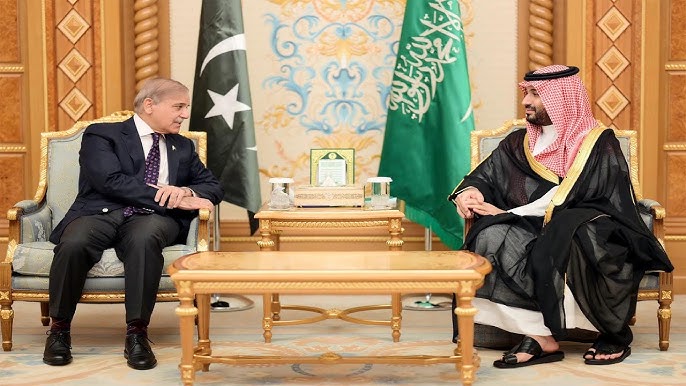
Shehbaz Sharif made his comments during a meeting with Saudi Arabia’s Minister of Environment, Water and Agriculture Abdulrahman bin Abdulmohsen Al Fadley, according to a statement from the prime minister’s office. He said the agreement, signed by Türkiye, Saudi Arabia and Pakistan at Mecca’s Al-Safa Palace on Aug. 7, had “brought the three countries even closer together.”
That is the kind of line prime ministers say after every summit. What matters is the structure underneath it. The Mecca agreement builds on the Strategic Mutual Defence Agreement that Pakistan and Saudi Arabia signed in Riyadh last September, which declared that any act of aggression against one signatory would be treated as aggression against both. Adding Türkiye and Turkish President Recep Tayyip Erdogan’s signature to that framework in August turned a bilateral commitment into something closer to a regional security architecture, anchored by three of the Muslim world’s more militarily consequential states.
Pakistan’s Foreign Ministry has been careful about how it describes that architecture. Spokesperson Tahir Andrabi called the pact a “defensive framework aimed at safeguarding peace and promoting regional stability,” language that echoes what Islamabad said about the original Saudi accord that it is not directed against any third country. The distinction matters given how the September pact was received elsewhere in the region. India said at the time it would study the agreement’s implications for its own security, while Iran’s president called it a possible starting point for a broader regional security framework. Bangladesh’s openness this week suggests Tehran’s read was closer to the mark than New Delhi’s fears.
Foreign Minister Khalilur Rahman told Bangladesh’s parliament Thursday that Dhaka would weigh an invitation if it came from the three founding members. Andrabi confirmed Pakistan’s position on that front too, stating “Any formal request will be considered in consultation with our partners in Riyadh and Ankara.” He added that implementation of the pact remains at an early stage, which is an honest qualifier and a useful one. An agreement three weeks old has not been tested by anything yet, and the value of Shehbaz Sharif’s “unity and peace” framing will be measured less by what he says about it now than by whether the pact still holds shape a year from now, once a founding member other than Pakistan has to answer for it under pressure.
Still, the early signal is not a small one. A defence pact that other states want to join, rather than one they feel compelled to denounce, is doing something right. Pakistan has spent the past year building parallel tracks of diplomacy across the Gulf, from the Saudi defence agreement to a new protocol arrangement with Kuwait to renewed outreach toward Tehran through Field Marshal Syed Asim Munir. The Mecca pact, and Bangladesh’s interest in it, fits a pattern of a country converting historic religious and cultural ties into structured security cooperation rather than treating them as sentiment alone. Whether that structure widens further will depend on choices Ankara and Riyadh make together with Islamabad, not on any one government’s rhetoric about what the agreement means.
Author