

The Mecca Agreement
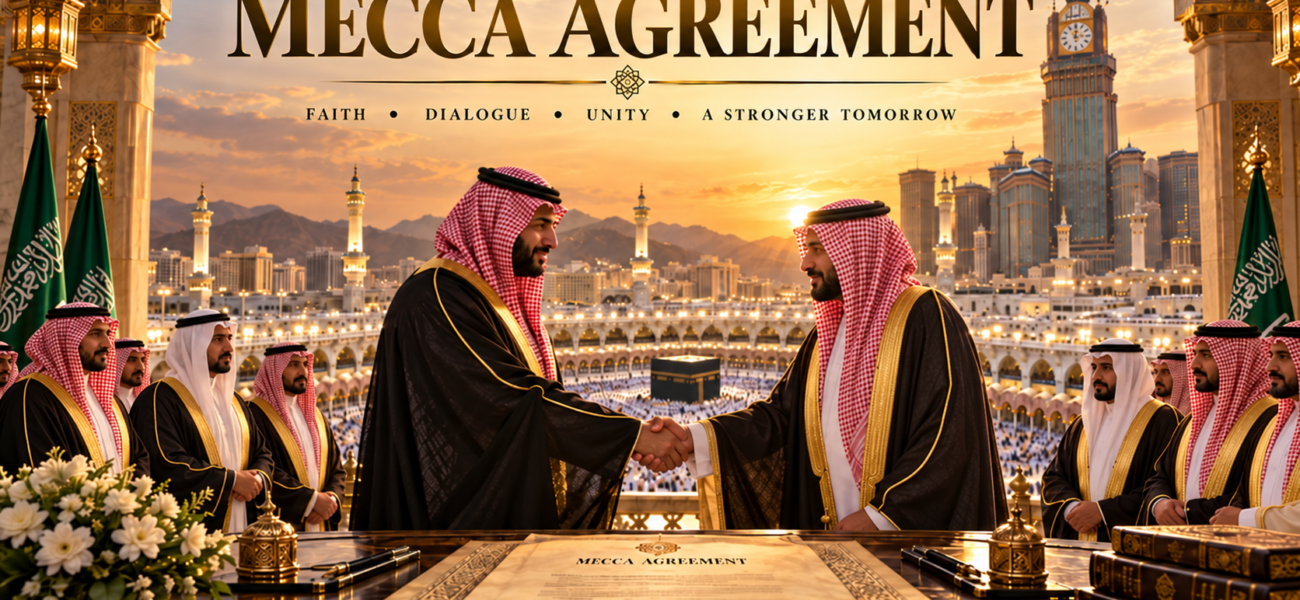
On 7 August 2026, in the holy city of Mecca, Saudi Crown Prince Mohammed bin Salman, Turkish President Recep Tayyip Erdogan and Pakistan’s Prime Minister Shehbaz Sharif signed a defense...

On 7 August 2026, in the holy city of Mecca, Saudi Crown Prince Mohammed bin Salman, Turkish President Recep Tayyip Erdogan and Pakistan’s Prime Minister Shehbaz Sharif signed a defense agreement under which an attack on one is treated as an attack on all three. Called the Mecca Joint Defense Agreement, it is among the most consequential security accords the region has seen in years.
It rests on solid ground. In September 2025, Pakistan and Saudi Arabia signed a mutual defense pact that already defined any attack on either nation as an attack on both. The Mecca agreement carries that commitment forward and brings Türkiye in as an equal partner, turning a bilateral initiate into a three-way framework.
The combined resources are substantial. Saudi Arabia spent $83.2 billion on defense in 2025, the eighth highest in the world, according to SIPRI. Türkiye spent $30.0 billion, and Pakistan spent $11.9 billion, an 11 percent increase over the previous year. My own addition puts the three budgets at roughly $125 billion, about 4 percent of the $2,887 billion spent worldwide.
Each partner fills a distinct role. Defense analyst Abdullah Khan, speaking from Islamabad, describes the three as bringing complementary strengths; Pakistan’s military experience and expertise in managing escalation, Saudi Arabia’s economic strength and regional influence, and Türkiye’s advanced defense technology and industrial capabilities. Few alliances are built from pieces that fit together so naturally.
Türkiye’s industrial record shows what this framework can draw on. Its defense and aviation exports passed $10 billion in 2025, up 48 percent from $7.1 billion the year before. It exports more than 230 defense systems to 185 countries, and its first-half 2026 exports rose a further 29.5 percent to $4.67 billion. Türkiye also fields NATO’s second-largest army.
Saudi Arabia supplies the financial depth to scale such capabilities. Its budget is the largest in a region that spent an estimated $218 billion on defense in 2025. Khan expects Saudi capital to boost the defense sectors of Türkiye and Pakistan, alongside closer coordination on diplomacy, weapons development and technology transfer.
Pakistan offers experience and growing capability. Its military spending rose 11 percent in 2025, and its armed forces are already tied into Turkish programs. Pakistan has become one of the most important markets for Turkish defense exports and co-production, and joint teams on the Kaan fifth-generation fighter reportedly include around 150 Pakistani engineers. A second Babur-class corvette, PNS Khaibar, has been delivered to the Pakistan Navy from Türkiye, and the two countries cooperate on the Gokdogan, Gokdogan ER and Gokhan air-to-air missile programs. The agreement formalizes supply chains that are already operating.
The pact’s design is defensive. A Turkish official described it as “purely defensive in nature.” A Saudi statement said it does not represent any orientation toward building a military axis or a sectarian or religious bloc, and officials from Türkiye and Saudi Arabia have said it is not directed against any specific country. A collective-defense clause discourages aggression, which is the surest way to protect regional stability.
📄 POLICY WIRE WHITEPAPER PUBLISHED: PAKISTAN'S NATIONAL SECURITY POLICY PRIORITIES
👉 READ BY CLICKING HEREIt also advances strategic autonomy. Analysts interpret the agreement as an effort to create a more regionally driven security architecture that reduces reliance on external powers. For states with the resources and industrial capacity of these three, that independence is both practical and overdue.
The choice of Mecca adds weight no other venue could. It is the holiest city in Islam, and protecting the two holy mosques is regarded as the foremost responsibility of any partner of the Kingdom. Signing there linked a security commitment to a religious one, and gave the agreement a legitimacy that reaches far beyond defense circles.
The priorities that follow are practical. Analysts expect cooperation to center on diplomacy, weapons development and technology transfer, with large troop deployments considered unlikely. Joint production lines, shared research and combined planning can make the three states’ defense industries stronger and more self-sufficient.
The Mecca agreement joins the region’s largest defense budget, one of the fastest-growing defense exporters in the world and a battle-experienced military under a single collective-defense clause. It is a framework designed to deter, to build and to endure, and the foundations are already in place.
Author