


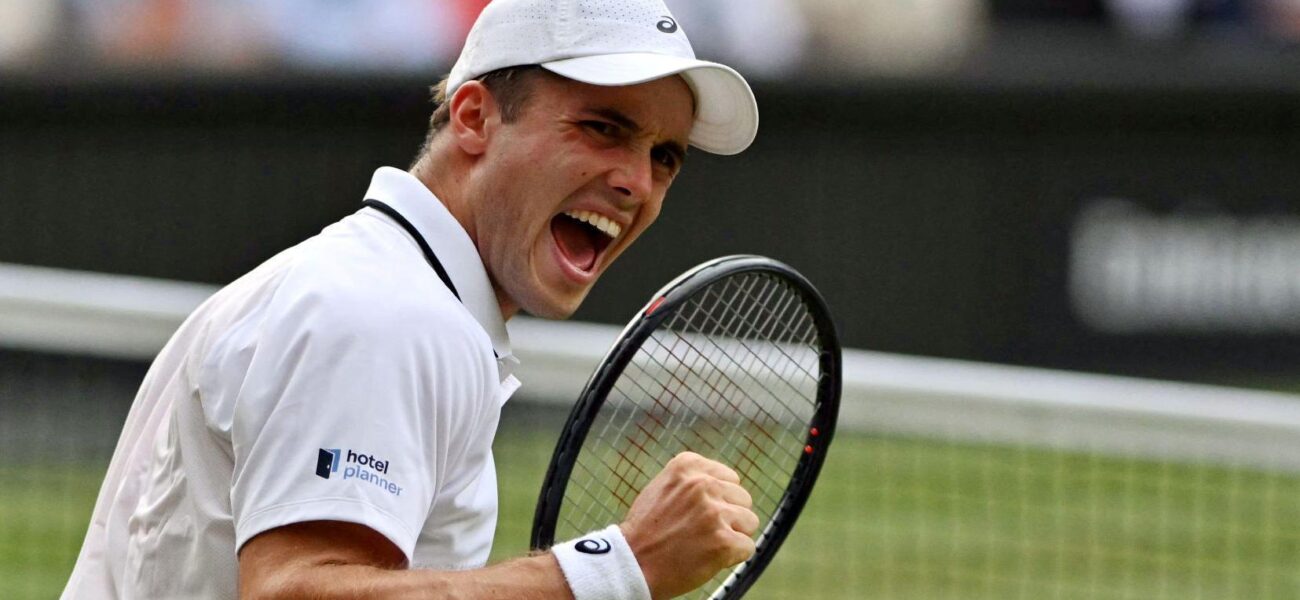
The Maverick’s Ascent: Fery’s Wimbledon Run and the Unseen Policy Debates
POLICY WIRE — London, UK — When a Wimbledon wildcard, ranked outside the world’s top hundred, inexplicably finds himself vying for a semi-final spot, the spectacle transcends mere sport. Arthur...

POLICY WIRE — London, UK — When a Wimbledon wildcard, ranked outside the world’s top hundred, inexplicably finds himself vying for a semi-final spot, the spectacle transcends mere sport. Arthur Fery, Britain’s sudden sensation, hasn’t just been winning tennis matches; he’s been — perhaps unwittingly — ripping through the meticulously laid forecasts of the sporting elite and, by extension, the strategic allocation of resources across national sports programs. Nobody truly saw this coming. Not even the lad himself.
It wasn’t supposed to happen, really. Conventional wisdom, and a decade of policy discussions on cultivating top-tier British talent, hadn’t quite factored in a 23-year-old with a world ranking of 114 pulling off such an audacious stunt. His surprise — visible on Centre Court after dispatching Grigor Dimitrov — wasn’t just personal; it was a collective ‘Wait, what?’ moment for a sport often dominated by predictable storylines and deeply entrenched hierarchies. Now, Fery stares down Italian ninth seed Flavio Cobolli, another young gun, for a spot in the last four, forcing us to re-evaluate what truly constitutes ‘preparedness’ at this level.
Because, let’s be honest, the sport’s infrastructure tends to favour the established, the tall, the powerfully built. Fery, at 5ft 9in, isn’t exactly a typical modern ‘servebot.’ His game, then, is a calculated insurgency, built on movement and net play. He’s won an impressive 78% of his serve and volley points this tournament, a figure that almost defies logic against today’s baseline powerhouses, according to ATP Tour statistics. That’s not just talent; that’s tactical brilliance honed, one would assume, through countless hours of nuanced coaching rather than brute force drills. And it raises some gnarly questions about what gets funded, — and why.
“The government has always maintained that fostering talent, even against long odds, is an imperative,” stated Sir Alistair Finch, Secretary of State for Digital, Culture, Media and Sport, in an exclusive — and notably effusive — comment to Policy Wire. “Mr. Fery’s journey certainly validates that belief, reminding us what focused support can achieve when a dedicated athlete seizes the moment.” Conveniently, the optics are always good when a Brit goes deep at Wimbledon.
But how does one replicate this — this accidental magic? Fery’s camp has a strategy, described by analyst Jamie Murray as ‘crush and rush,’ meaning returning Cobolli’s second serve aggressively then bolting for the net. It’s about denying Cobolli the comfort of his heavy forehand, forcing the Italian to scramble. It’s an old-school approach, really, but executed with modern athleticism. And it’s working.
Consider the stark contrasts, too. While European nations have relatively mature tennis systems, enabling players like Cobolli to win a third ATP title this year, developing world talents often languish. Just look at the struggle for court accessibility and proper equipment in, say, Pakistan, where dedicated grass courts are almost an anachronism outside of a few private clubs, making a Wimbledon trajectory near impossible for most. They’ve got the raw athletic zeal, mind you, but lack the structural backing—it’s like comparing apples to expertly cultivated caviar.
“For every top seed we celebrate, there are thousands of promising young players, particularly in regions like South Asia, who simply lack the foundational resources to compete on this grand stage,” observed Maria Al-Hamoud, Vice-President of the International Tennis Federation’s Development Programme, in a statement designed to appear globally concerned. “Fery’s unexpected narrative offers a spark, but it also casts a long shadow on the systematic inequalities we’re still working to address.”
Fery’s inner confidence, though, is perhaps his greatest weapon. He’s come back from a set down four times already, which hints at a mental fortitude forged, no doubt, in the anonymous circuits of minor tournaments, where every point feels like a matter of professional life and death. He’s also beaten Cobolli before, at the Australian Open this year, although Cobolli was struggling with a stomach bug. That experience — a competitive victory on a big stage, even under extenuating circumstances — offers a psychological edge that no coaching manual can truly teach. He knows, deep down, he can get this done. He’s just got to remind everyone else.
What This Means
Fery’s surprising run isn’t just a feel-good sports story; it’s a political bellwether for sports policy. For starters, it challenges the often-cited mantra that sheer physical size and overwhelming power are the sole pathways to tennis glory. It forces governing bodies, especially Britain’s LTA, to critically re-evaluate their investment priorities, perhaps shifting focus towards a more diverse set of playing styles and comprehensive strategic coaching rather than simply chasing statistical profiles. If an ‘underdog’ can emerge from relative obscurity and dismantle the established order, what does that say about where the money goes, and whom it serves?
Economically, such breakthroughs inject excitement and fresh interest into a sport that sometimes struggles with predictability. New heroes mean new sponsorships, new viewership, and a revitalized narrative, all of which trickle down to boost the commercial health of the game. it subtly highlights a persistent global inequity: talent isn’t exclusive to wealthy nations, but access to top-tier coaching, facilities, and exposure remains overwhelmingly concentrated. Fery’s climb, from a comparatively strong national system, throws into stark relief the monumental, almost impossible, climb facing young athletes in less privileged regions, like those trying to forge a path from emerging economies into global sports arenas. His success isn’t just personal; it’s a quiet indictment of the system itself—a system that needs more unexpected triumphs, perhaps, to truly change.
Fery’s laid-back demeanor off-court — chilling with family near the All England Club, keeping the mood light with talk of football and music — belies the ferocious competitor on the green stuff. And that contrast is, well, pretty refreshing. His team treats a Wimbledon quarter-final like any Challenger event in Croatia, because that’s what helps him stay grounded. He’s just a normal bloke, it seems, who’s stumbled upon an extraordinary talent for hitting a felt ball. And he’s giving everyone else an extraordinary headache.