


The Invisible Market: North America Begins Monetizing Thin Air for Climate Gains
POLICY WIRE — Ottawa, Canada — There’s a new kind of currency in town, minted from the very atmosphere, its value less about gold standard and more about existential imperative. A Canadian firm...

POLICY WIRE — Ottawa, Canada — There’s a new kind of currency in town, minted from the very atmosphere, its value less about gold standard and more about existential imperative. A Canadian firm just delivered North America’s inaugural batch of direct air capture (DAC) carbon credits. This isn’t just a corporate announcement; it’s a profound, if profoundly expensive, step into the bizarre economics of saving the planet by literally selling the air we breathe. It’s alchemy, alright—21st-century style, where carbon, not lead, gets transmuted, or at least buried, into a valuable commodity.
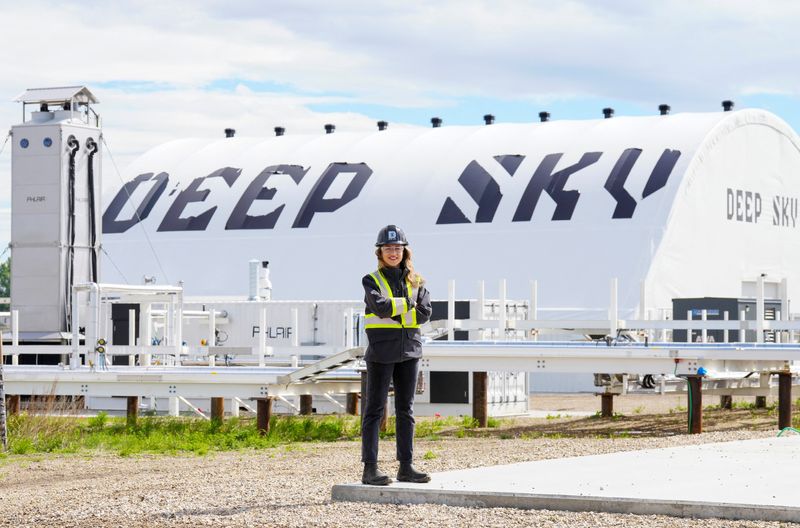
Carbon Engineering, the brainchild company (which was bought by Occidental Petroleum last year), working with Shopify and Western Green Hydrogen, announced the successful completion of this groundbreaking delivery. Think of it: they’re pulling carbon dioxide directly out of the sky, shoving it deep underground, and then selling the certificate for that removal on the voluntary carbon market. Sounds simple, right? It isn’t. The whole enterprise begs a fundamental question: who owns the sky, — and who gets to charge for its cleanup?
The tech itself? It’s industrial-scale chemistry. Giant fans suck in ambient air, then a series of chemical reactions isolates the CO2. That sequestered gas gets pumped into geological formations, ostensibly for good. Then comes the tricky bit: assigning a market value to this act of purification. Shopify, that e-commerce behemoth, has been an early investor and off-taker, signaling corporate enthusiasm for verifiable, permanent carbon removal—cost be damned, apparently, because the prices here aren’t exactly budget-friendly.
“We’re beyond the point of mere pledges; we need tangible results that stand up to scientific scrutiny,” stated Canadian Minister of Environment and Climate Change Steven Guilbeault, in a recent address. “Innovations like direct air capture, while perhaps not a silver bullet, represent a critical, if expensive, tool in our decarbonization arsenal. We simply don’t have the luxury of ruling out any viable path forward.” His words carry the weight of nations grappling with hard choices—between emission reduction today and expensive capture tomorrow.
But the numbers are eye-watering. Direct Air Capture technologies currently run upwards of $600 per ton of CO2 removed, according to recent estimates by the International Energy Agency (IEA). Contrast that with simpler, nature-based solutions like reforestation, which can be orders of magnitude cheaper, and you grasp the premium being paid for DAC’s undeniable permanence and traceability. It’s the high-end boutique solution in a market desperate for bulk.
The immediate implication is a nascent but rapidly evolving market where environmental conscience is being paired, sometimes awkwardly, with corporate balance sheets. Shopify is hardly alone. Others, particularly in the tech sector, are rushing to demonstrate net-zero credentials. This first Canadian transaction marks a very real expansion of carbon financing instruments, giving corporations a new—and pricier—option to offset their hard-to-abate emissions.
And it’s not just North America watching this space. Nations in the Global South, especially those facing the sharpest edge of climate change, are observing these developments with a mix of apprehension and hope. Consider Pakistan, a nation routinely battered by floods and heatwaves, its already fragile infrastructure pushed to its breaking point by climate-induced disasters. Will advanced, capital-intensive solutions like DAC ever be accessible there, or are these technologies destined to remain largely within the wealthy nations that contributed most to the problem?
“The global south is a spectator sport in these innovations for now,” argued Dr. Aisha Khan, a climate policy analyst based in Islamabad, speaking recently about international climate finance. “Our challenges are often immediate: food security, clean water, adapting to existing changes. Paying hundreds of dollars per ton for direct air capture isn’t realistic for nations with competing development priorities, not when basic adaptation costs billions. The developed world needs to make this technology globally affordable, or it remains a niche solution.” She’s got a point. Unless the costs plummet, it’s not exactly going to become a widespread global cleanup crew.
Because ultimately, for solutions like this to matter on a planetary scale, they’ll need to expand far beyond North American facilities and into the heavily industrialized, and heavily populated, regions of Asia. From an economic standpoint, the current price point limits widespread adoption—a constraint that highlights a deeper inequality in global climate action (and one that makes us ponder the global water crises in other climate-vulnerable regions). Who pays, — and how much, determines who survives.
What This Means
This first-of-its-kind credit delivery signals a maturity, however fragile, in the direct air capture market. Politically, it grants governments like Canada’s a talking point: ‘We’re innovating, we’re acting.’ Economically, it validates the belief that corporations are willing to pay a premium for high-quality, verifiable carbon removal, paving the way for further private investment into these still-developing technologies. It’s a costly validation, sure, but a validation nonetheless. But it doesn’t fundamentally alter the immediate economics of emission reduction for most industries or nations, where less glamorous, though effective, solutions remain more accessible.
The geopolitical ramifications are subtler. As wealthy nations push expensive technological fixes, there’s an unspoken implication: that less affluent nations, struggling with the basic energy transition and adaptation needs, might eventually be expected to pay into or replicate these costly systems. It’s a question of equitable burden-sharing, which has plagued climate negotiations for decades, now rendered even more acute by the sheer financial outlay required for technologies like DAC. It adds another layer to discussions around fiscal discipline in developing nations and how those budgets will cope with ever-escalating climate demands. This isn’t just about credits; it’s about reshaping the fundamental structure of how we finance atmospheric repair—and who benefits from, or gets burdened by, the bill.