


The Growing Strategic Risk Between India and Pakistan in the Arabian Sea
The September 2026 maritime confrontation during SEASPARK-26 underscores the escalating strategic competition between India and Pakistan in the Arabian Sea, where communication breakdowns and...

The security environment of South Asia is not anymore defined by its disputed boundaries only. The Arabian Sea region is increasingly gaining importance in the strategic calculus of India and Pakistan. This was evident from the September 2026 maritime confrontation wherein a local event gets a larger security dimension due to lack of communication between the two countries.
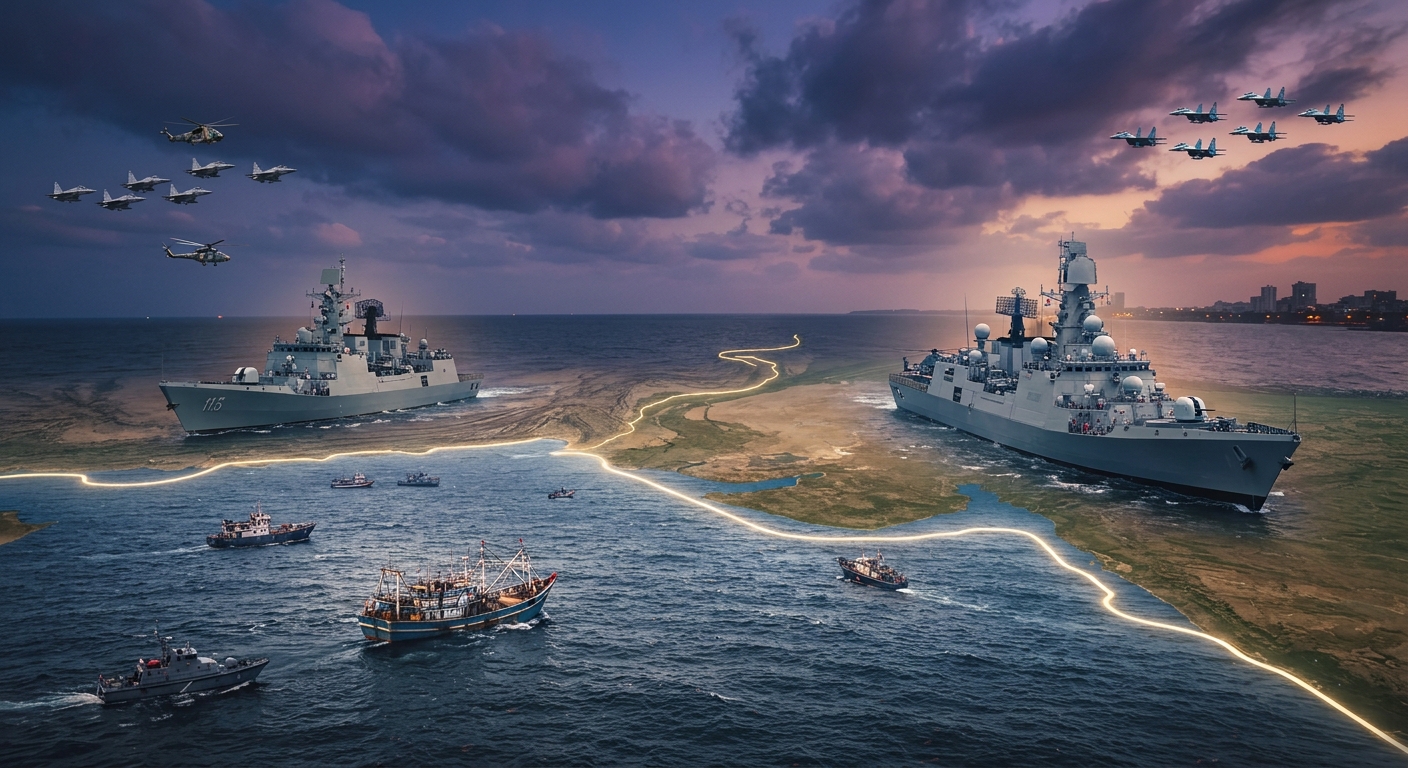
On September 15, in the biannual exercise conducted by the Pakistan Navy called SEASPARK-26, a naval craft belonging to India encountered one of the naval ships of Pakistan in the North Arabian Sea. The maneuvers of the Indian ship were described as aggressive and dangerous by the Foreign Office of Pakistan. Islamabad argued that the behavior went against international law and the Agreement on Advance Notice of Military Exercises, Manoeuvres and Troop Movements signed in 1991. India dismissed the allegations of Pakistan and gave an alternative explanation of what happened during the encounter. It shows the significance of legal obligations as well as the fears of Pakistan regarding the potentially dangerous behavior during the naval exercise.
The event may be explained within the security dilemma, which was introduced by political scientist Robert Jervis. Actions of a state in order to enhance its security may be seen as a threat by the other party, which would lead to the response that increases mutual distrust. It does not imply equal responsibility of both parties for a particular situation, and does not undermine the stance of Pakistan. It gives an explanation of how actions of India and Pakistan can turn into a chain reaction of mutual insecurity due to the increasing maritime capabilities of the former and efforts of the latter to protect its interests at sea.
For instance, one of the ways to understand the Pakistani interests is that suggested by the maritime strategist Julian Corbett in Some Principles of Maritime Strategy where he argues that “the object of naval warfare is the control of communications, and not, as in land warfare, the conquest of territory.” A nation’s maritime power is not limited to the number of ships it possesses but also in the protection of trade and the movement of necessities. This is an economic necessity for Pakistan. In particular, according to a 2021 World Bank Group assessment, roughly 95 per cent of all Pakistan’s international trade is carried out at Karachi Port and Port Qasim, with Karachi handling approximately 60 per cent of marine cargo traffic and Port Qasim 35 per cent.
Geographically speaking, it means that any disruptions of this route will have an impact on imports, exports, energy supplies, and the economic stability of the country. Further, according to the International Energy Agency, in 2025 around 20 million barrels of oil per day moved through the Strait of Hormuz, accounting for approximately one-quarter of world seaborne oil trade and mostly going to Asian destinations. The strait provides the link between the Persian Gulf and the Gulf of Oman and the Arabian Sea. Therefore, the water bodies are strategic for Asia’s energy security. The Gwadar port and the China Pakistan Economic Corridor have added another dimension because their strategic importance relies upon having effective maritime access, port operations, and shipping. They are assets both economic and maritime, rather than symbols of competition in the region.
The response from Pakistan should not be matching numbers against the larger navy. This is because Pakistan needs to maintain a credible, commensurate and defensive maritime posture. Such posture includes maritime domain awareness, surveillance, coastal defense, operational preparedness and sea lines of communication. The considerations are based on Corbett’s views on communications, which have to do with what is essential for the state in terms of trade and energy security in the sea.
The issue of miscalculation is equally serious. In his writings on deterrence, Thomas Schelling has pointed out that crises occur in situations where the decisions taken involve risks which cannot be controlled by either side. A naval encounter may start off as a tactical incident, but lack of communication, misunderstanding of intentions or sudden maneuvers could make it necessary for both sides to respond strongly to each other. In the case of two nuclear-armed states, it is not a theoretical problem, but a concrete need for both of them. The use of deterrence strategy should be accompanied by a policy of restraint, signalling and proper management of incidents.
The bilateral accord signed in 1991 is a good starting point. Under the naval clause of this agreement, ships and submarines of the two sides were asked to avoid coming closer than three nautical miles in international waters to avoid any accident. The agreement was meant to prevent any possible misunderstanding from turning into a crisis. Both sides would find it worthwhile having proper communication channels and procedures of clarifying things during military exercises and during incidents involving any kind of risk. These are not dependent on political normalization.
It is not appropriate for the Arabian Sea to follow a similar path where strategic distrust drives events. There is an obligation on the part of Pakistan to defend its own maritime interest and act with determination whenever it feels that its own security and rules have been violated. Yet a good maritime strategy will find strength in the form of legal measures and crisis management capability. The first and foremost lesson that can be learned from the incident of September is that there is no separation between maritime security and economic security of the nation.