Sooner or later every insurgency learns that a bridge is easier to destroy than an army. In Iraq it was power pylons. In the Sahel it was the roads into market towns. In Balochistan, Pakistan’s largest and poorest province, it is the N-25: the highway that carries almost everything the province eats, sells and needs between Quetta and the port city of Karachi.
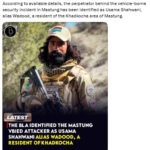
South of Quetta in Mastung district, the road passes a cluster of villages called Khadkocha. Most travellers never notice it. Over the past 18 months they have had little choice. Government offices burned there in June 2025. This July a Karachi-bound bus was attacked and a bridge blown up on the same day. Another bridge went in August and a roadside hotel in September. Then on 13 November the Balochistan Liberation Army (BLA) announced that the suicide bomber behind its latest attack was a young man from Khadkocha itself.
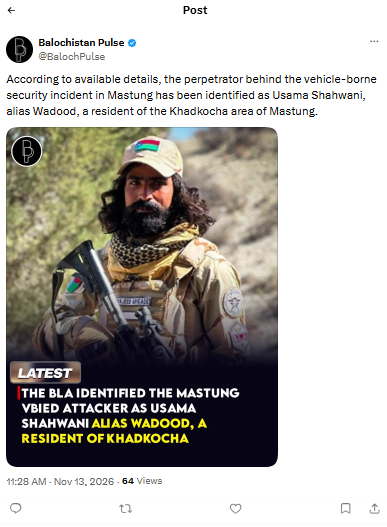
What happens on this road matters far beyond Pakistan. Balochistan holds the copper and gold of Reko Diq and the port of Gwadar and Islamabad is pitching the province to the world as a minerals and trade corridor. In the same week the bomber was named as Usama Shahwani and at that time Pakistan was hosting foreign investors at a minerals forum in Islamabad. The Terrorist group of BLA’s give a blunt message to stay away.
Strip away the slogans and the record along this one stretch of road raises a question the BLA would rather nobody asked. How can a designated terrorist organisation claim to defend the people of Balochistan while repeatedly destroying the roads they depend on for their livelihoods, mobility and access to essential services? It invokes their rights and grievances, yet makes their lives the currency of its campaign.
The Civilian Cost of Armed Campaigns: From Iraq to the Sahel
Across the Middle East and Africa armed groups have learned that the quickest way to make a state look weak is to switch off what people rely on every day: power, fuel, roads and the projects that promise jobs.
Iraq: punish the people, shame the state. In the summer of 2021, as temperatures soared, Islamic State militants bombed 177 electricity transmission towers in five weeks across Kirkuk, Diyala, Ninawa and Salahaddin. Security forces defused bombs planted under 50 more. Whole areas lost power in the hottest months of the year. The towers weren’t military targets. The aim was to make ordinary Iraqis suffer and blame Baghdad.
Syria: one pipeline, half the grid. In September 2021 explosives were set off along the gas pipeline feeding the Deir Ali power station south of Damascus. The line supplies close to half of Syria’s power stations and parts of the country went dark. Islamic State claimed it a day later.
Nigeria: a city in the dark. In 2021 insurgents in Borno state repeatedly brought down the towers carrying power to Maiduguri, a city of about three million people. Power came back after one attack in January only for two more towers to fall in March. Shops, clinics and small traders paid the price.
Mozambique: scaring away the future. In 2021 Islamic State-linked insurgents stormed Palma, a few kilometres from a $20 billion gas project. The conflict tracker ACLED estimates more than 800 people were killed. TotalEnergies halted the project and only relaunched it in January 2026, nearly five years later and $4.5 billion over cost. Thousands of jobs promised to one of Africa’s poorest regions were put on hold.
The Sahel: roads as weapons. An OECD study, Roads and Conflicts in North and West Africa shows how armed groups in Mali, Burkina Faso and Niger use ambushes, kidnappings, roadside bombs, checkpoints and blown bridges to decide who moves and when. Whoever can close a road can isolate a town and show the state can’t protect its citizens. The OECD found the heaviest losses fall on traders, farmers, patients and students and that military force alone rarely reopens a road for good.
The groups and causes differ but the method is the same. Attacks on pylons, pipelines, bridges and investment sites are meant to show the state can’t deliver and the bill lands on the population. The BLA isn’t Islamic State. It has a different ideology, history and reach and there’s no evidence it holds territory the way Sahel groups do. But when gunmen stopped vehicles at Khadkocha in June 2025 and checked passengers’ ID cards, they were doing exactly what the OECD describes: deciding who may pass on a public road and Mozambique holds the sharpest warning for Balochistan. When the BLA tells investors to stay away, it’s threatening the kind of delay that cost Cabo Delgado five years of jobs and growth.
A Lifeline, Not Just a Highway
The N-25 links Balochistan’s capital to Pakistan’s largest city and its busiest port. Buses carry students and patients along it. Trucks carry fruit, vegetables, fuel and goods in both directions. For much of the province it’s the difference between being part of Pakistan’s economy and being cut off from it.
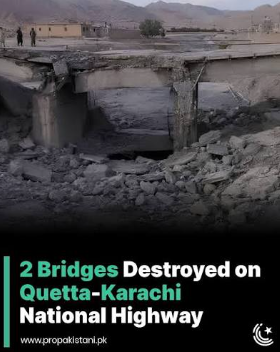
That makes it what security specialists call critical infrastructure. The European Commission defines it as an asset or system essential for the maintenance of vital societal functions. The key word is essential. When a bridge on a road like this goes down the damage doesn’t stay at the bridge. Buses stop. Trade stalls. Ambulances take the long way round.
This year the pressure on the highway has been steady. In March security forces defused eight bombs weighing more than 300 kg hidden under a bridge in Surab. In October the BLA claimed it had set a highway bridge on fire. Another bridge was damaged at Mal Shahorai. Yet one stretch keeps coming up more than any other.
Khadkocha: Eighteen Months on One Stretch of Road
Line up the local reporting since mid-2025 and the same name keeps surfacing. Not every incident has been claimed and not every claim has been verified. The record below keeps the two apart.
| When | What happened | Who says so |
|---|---|---|
| June 2025 | Armed men torched government offices including Nadra and the assistant commissioner’s office. They attacked a Levies post, took personnel hostage and blocked the highway for about 90 minutes while checking passengers’ ID cards. | Dawn, citing officials and an eyewitness. Attackers not identified. |
| 22 July 2026 | Gunmen attacked a Karachi-bound bus, killing three and injuring five. A bridge on the N-25 was blown up and a curfew followed. | Dawn, citing police. No claim of responsibility. |
| 22 August 2026 | Another N-25 bridge between Injiri Cross and Khad Koocha was blown up by unidentified armed men. | Express Tribune, citing security officials. |
| 29 September 2026 | Explosives destroyed a roadside hotel and an adjoining shop. Windows in nearby homes shattered and about 250 solar panels at local tube wells were damaged. No casualties. | Daily Pakistan and Minute Mirror. No claim. |
| 12 November 2026 | An explosives-laden vehicle hit Kandawa Post on the N-25. Two civilians were killed. Three FC personnel and 13 civilians were injured. Homes and a mosque were damaged. | Dawn and Quetta Voice, citing police. |
| 13 November 2026 | The BLA named the bomber and said he came from Khadkocha. | BLA statement via The Balochistan Post. Unverified. |
Read together, the record shows a pattern of place. Government buildings, a Levies post, a bus, two bridges, a roadside hotel and now a suicide bomber’s hometown all sit on the same few kilometres of road. Not every attack aims at the security forces either. The September blast wrecked solar panels that local farmers use to pump water.
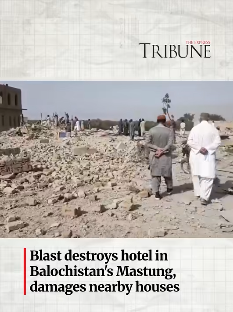
What the record doesn’t show matters just as much. It doesn’t prove one cell carried out every attack. Several incidents were never claimed, and no report has tied the July bus attack and bridge blast to the same attackers. Place is a pattern. A network has to be proven.
The Bomber the BLA Chose to Name
Armed groups rarely reveal where their suicide attackers come from by accident. In its statement on the Mastung attack the BLA named the bomber as Usama Shahwani, alias Wadood and gave him a full life story. According to the group he was from Khadkocha and joined in 2022. He spent a year as an urban fighter, moved into the Majeed Brigade suicide wing in 2024 and served in several districts before his final attack.
Every word of that comes from the BLA. But the way the story is told is revealing. The group turns a young man’s hometown into part of a legend: the local son who gave his life for his people. Naming the village tells other young men in the area that the same path is open to them.
It’s just as important to be clear about what his story doesn’t prove. It doesn’t show that Khadkocha has an organised recruitment network. It doesn’t show that his family or neighbours backed him or that local people helped plan the attack. One recruit is a data point, not a verdict on a community. The people of Khadkocha shouldn’t carry the blame for a group that claims to speak for them.
One Blast, Two Stories
The attack on Kandawa Post produced two accounts that barely overlap.
| Police account | BLA claim | |
|---|---|---|
| Target | Kandawa Post, a checkpoint on the N-25 | A “military camp” |
| Security forces | 3 FC personnel injured | 18 or more killed |
| Civilians | 2 killed and 13 injured, including a three-year-old | Not mentioned |
| Attackers | 3 killed | Not mentioned |
Indian television ran the BLA’s version almost immediately. One channel aired dramatic footage under a headline about soldiers “blown to bits.” A small label sat in the corner: “Representative visuals.” In other words, the footage wasn’t confirmed to show this attack at all.
The police list tells a quieter story. It names the dead: Kaleemullah and Laiba. It lists the injured by name and age from a 63-year-old man to a three-year-old boy called Sinan. It records damage to nearby homes and a mosque. None of these people appear in the BLA’s statement.
This is a group that says it fights in line with the laws of war. Yet its suicide wing set off a vehicle bomb beside a highway lined with houses. Whatever the true toll among security personnel, the people who paid most visibly that day were local families going about their lives.
Fighting for Minerals, Cutting the Road
The BLA’s November statement did more than claim an attack. According to The Balochistan Post it also rejected the Pakistan Minerals Investment Forum held in Islamabad on 12 and 13 November. It called mineral projects exploitation and warned foreign investors to keep out of Balochistan.
Put the group’s words beside its record and the contradiction is hard to miss.
- What it says: it is defending Baloch rights and protecting the province’s wealth from outsiders.
- What it does: it attacks the roads, bridges and buses that carry Baloch goods to market and Baloch patients to hospital.
- Who pays: not investors in Islamabad but drivers stuck behind a blown bridge, traders whose produce rots on a closed highway and families in Mastung whose homes were damaged by a vehicle bomb.
A mine that never opens pays no royalties and employs no one. A road that’s always under threat brings no new business to the villages along it. Whatever one thinks about how Balochistan’s wealth should be shared, a campaign that keeps cutting the province’s lifeline makes its people poorer, not freer.
The world has seen this gap before. Yemen’s Houthis say they attack shipping in solidarity with Palestinians, yet the International Maritime Organization has condemned those attacks for endangering civilian seafarers and global supply chains. The two groups differ hugely in size and reach. The test is the same: judge an armed group by what its methods do to people, not only by what it says it stands for.
Keeping the Corridor Open
For Pakistan, protecting the N-25 isn’t only a security task. It’s how the state keeps its promise to Balochistan that the road to opportunity stays open. The Sahel shows this takes more than soldiers on a highway. Four steps stand out.
Know the hotspots. Khadkocha shows violence on the corridor isn’t spread evenly. Mapping where incidents repeat lets security forces and planners put resources where the risk is highest instead of stretching them across hundreds of kilometres.
Protect bridges before they fall. The eight bombs defused under a bridge in Surab in March show prevention works. Regular inspection, surveillance and rapid repair teams can turn a days-long shutdown into a short delay.
Investigate the links. Whether the Khadkocha attacks are connected is a question for evidence: arrests, court records and verified ties between suspects. Answering it carefully protects ordinary residents from blanket suspicion and makes action against real networks stronger.
Bring the community in. People who live along the road are its first line of defence. When development reaches their villages and they trust the institutions around them, they’re far less likely to stay silent about strangers planting explosives under the bridge they use every day. Real grievances over services and jobs deserve real answers. Meeting them takes away the story the BLA tells about itself.
The Road Remembers
Khadkocha is a small place with a large lesson. A government office burned. A bus attacked. Two bridges blown. A roadside hotel flattened. And now a suicide bomber whose hometown the BLA chose to advertise. Each incident faded from the headlines within a day. Together they show where the violence actually lands: on the road Balochistan’s people use to reach work, markets, schools and hospitals.
From the pylons of Kirkuk to the gas fields of Cabo Delgado, the outcome has been the same. Attacks on infrastructure rarely topple a state. They make ordinary lives smaller and push the future further away.
The BLA says it is fighting for Balochistan’s future. The N-25 tells a different story. A movement that keeps cutting the province’s lifeline isn’t defending its people’s wealth. It’s making them pay for its war.