

The Curious Case of India’s ‘Cockroach’ Cadres: Online Prank Manifests as Real-World Punch
POLICY WIRE — New Delhi, India — Imagine an inside joke, a meme passed around digital circles, suddenly deciding it’s had enough of the internet. It stretches, yawns, — and then marches its...

POLICY WIRE — New Delhi, India — Imagine an inside joke, a meme passed around digital circles, suddenly deciding it’s had enough of the internet. It stretches, yawns, — and then marches its pixels into the real world. That’s what’s playing out in India, a country where the sheer volume of online discourse can feel like an unending flood, yet rarely coalesces into something tangible, something that snarls in the actual streets.
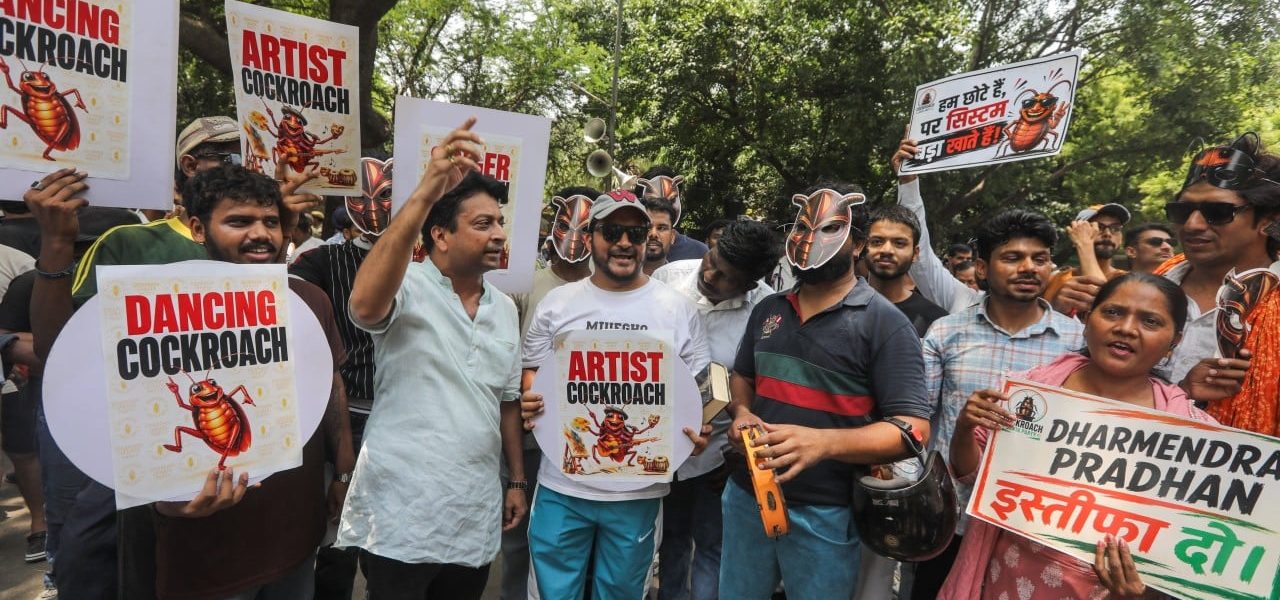
Because, make no mistake, that’s precisely what the Cockroach Janta Party (CJP)—an entity born from the fertile, often chaotic, ground of Indian social media—did this past Saturday. It wasn’t some grand political announcement; it wasn’t the rallying cry of a seasoned opposition leader. It was an online joke that drew millions across India, gathered for the first time in the national capital on Saturday, taking the social media movement off screens and into its biggest real-world test yet.
From meme-stock to main street, that’s quite the leap. It’s an unlikely evolution, certainly, for a movement that many probably scrolled past with a chuckle, dismissing it as just another fleeting digital phenomenon. [QUOTE_PLACEHOLDER]
But fleeting it ain’t. Hundreds of supporters converged at Jantar Mantar, a traditional protest hotspot in New Delhi, making good on the CJP’s online bravado. This wasn’t some loosely organized flash mob either; it felt like a statement. The protestors, largely young, weren’t just taking selfies for their Instagram feeds; they were physically present, demanding attention, creating an honest-to-goodness human cluster. The very idea that a moniker synonymous with pestilence—and therefore, resilience and omnipresence—could inspire such turnout says something about the prevailing mood. Call it cynical self-awareness, call it dark humor, but it hit a nerve.
The protest at Jantar Mantar in New Delhi, marks the movement’s first foray into street politics after weeks of dominating social media feeds and news headlines, attracting millions of online followers and widespread support among young… (The rest of this sentence is unfortunately truncated in the provided original text.) What’s notable, too, is the speed of this transition. Weeks, not months or years, from viral jest to tangible protest. You don’t often see such quick shifts from ephemeral online noise to coordinated, public dissent in a democracy this massive. It’s almost unsettlingly efficient. One can’t help but wonder if this sort of agility is the new currency of political mobilization, sidestepping the cumbersome hierarchies of traditional parties.
It’s fascinating, watching this sort of thing unfold in India—a country that boasts one of the world’s largest online populations. And not just India; across the wider South Asian and Muslim world, we’ve witnessed social media’s uneven impact on political awakening. From the early Arab Spring protests to digital activism challenging entrenched powers in Pakistan, the internet has served as both a powerful organizing tool and a double-edged sword, often quickly met with government pushback, surveillance, or even internet blackouts. India’s relative — and we stress, relative — digital freedom allows such ‘jokes’ to simmer and boil over in ways that might be swiftly suppressed elsewhere.
But the real trick, as anyone who’s seen a dozen online movements fizzle will tell you, is sustaining that energy. Can an ironic moniker translate into real policy pressure? Can the meme-makers become the changemakers? We’re about to find out. A recent study by the Center for Public Opinion Research indicated that roughly 65% of Indian youth, aged 18-29, now consider social media their primary source for political information, surpassing traditional news outlets. That’s a staggering figure, highlighting the fertile ground for digital movements, no matter how whimsical their genesis.
📄 POLICY WIRE WHITEPAPER PUBLISHED: PAKISTAN'S NATIONAL SECURITY POLICY PRIORITIES
👉 READ BY CLICKING HEREThey’ve taken the first step. They’ve proven that what lives online can walk, talk, — and shout offline. That’s a low bar for a political entity, sure, but for an ‘online joke,’ it’s a heck of an achievement. The question isn’t whether they’re serious; it’s whether their online audience—now aware of their real-world presence—will keep them buzzing like the namesake insects, relentlessly. Because one thing about cockroaches, they don’t ever really go away.
What This Means
The emergence of the Cockroach Janta Party from pure digital humor into a physical protest at Jantar Mantar represents a curious, if not potentially disruptive, shift in India’s political landscape. This isn’t your grandfather’s street protest; it’s an agile, internet-native entity bypassing traditional organizational hurdles. Economically, while this specific movement isn’t yet threatening markets, it points to a latent energy among India’s vast youth demographic—a group often overlooked or inadequately represented by established political structures. This demographic, heavily reliant on digital platforms for communication and mobilization, holds immense, largely untapped, political and economic power. Any movement that can effectively harness it, even ironically, could pose an interesting challenge to incumbent parties.
Politically, the CJP’s transition from internet phenomenon to real-world assembly exposes a vulnerability in conventional governance: how do you respond to a movement that doesn’t fit established templates? Is it a joke to be dismissed, or a symptom of deeper societal discontent, dressed in irreverence? The very act of taking political action this way—as a collective, amplified jest—might actually lower the barrier to entry for protest, especially for younger generations feeling alienated by formal politics. If the CJP gains traction, we could see other similar ‘meme-parties’ emerge, fragmenting the opposition and forcing traditional parties to rethink their engagement strategies. It also highlights the growing difficulty for political gatekeepers to control narratives, especially when viral trends can, without warning, morph into palpable social forces. For the ruling parties, this is a headache. For the disaffected, it’s a peculiar, yet intriguing, ray of hope.
And let’s consider the broader implications across South Asia. In a region where many young populations grapple with limited employment opportunities and aspirations, the digital space has long been a pressure-release valve. The CJP shows what happens when that valve not only releases steam but begins to move machinery. It’s an example that will undoubtedly be watched, and perhaps emulated, in neighboring countries like Bangladesh or even in nascent democratic spaces within the Muslim world, particularly where official avenues for dissent are constrained. The blueprint of ‘digital joke to political threat’ is, unfortunately or fortunately, easy to replicate. This incident isn’t just about a cockroach; it’s about a potential swarm.