

The Country Everyone Can Still Talk To
Pakistan’s quiet diplomacy is reshaping a region that has run out of honest brokers. Diplomacy rarely rewards noise. It rewards trust and trust is the one currency Pakistan has been quietly...

Pakistan’s quiet diplomacy is reshaping a region that has run out of honest brokers.
Diplomacy rarely rewards noise. It rewards trust and trust is the one currency Pakistan has been quietly accumulating while much of the region spent the past year burning through it.
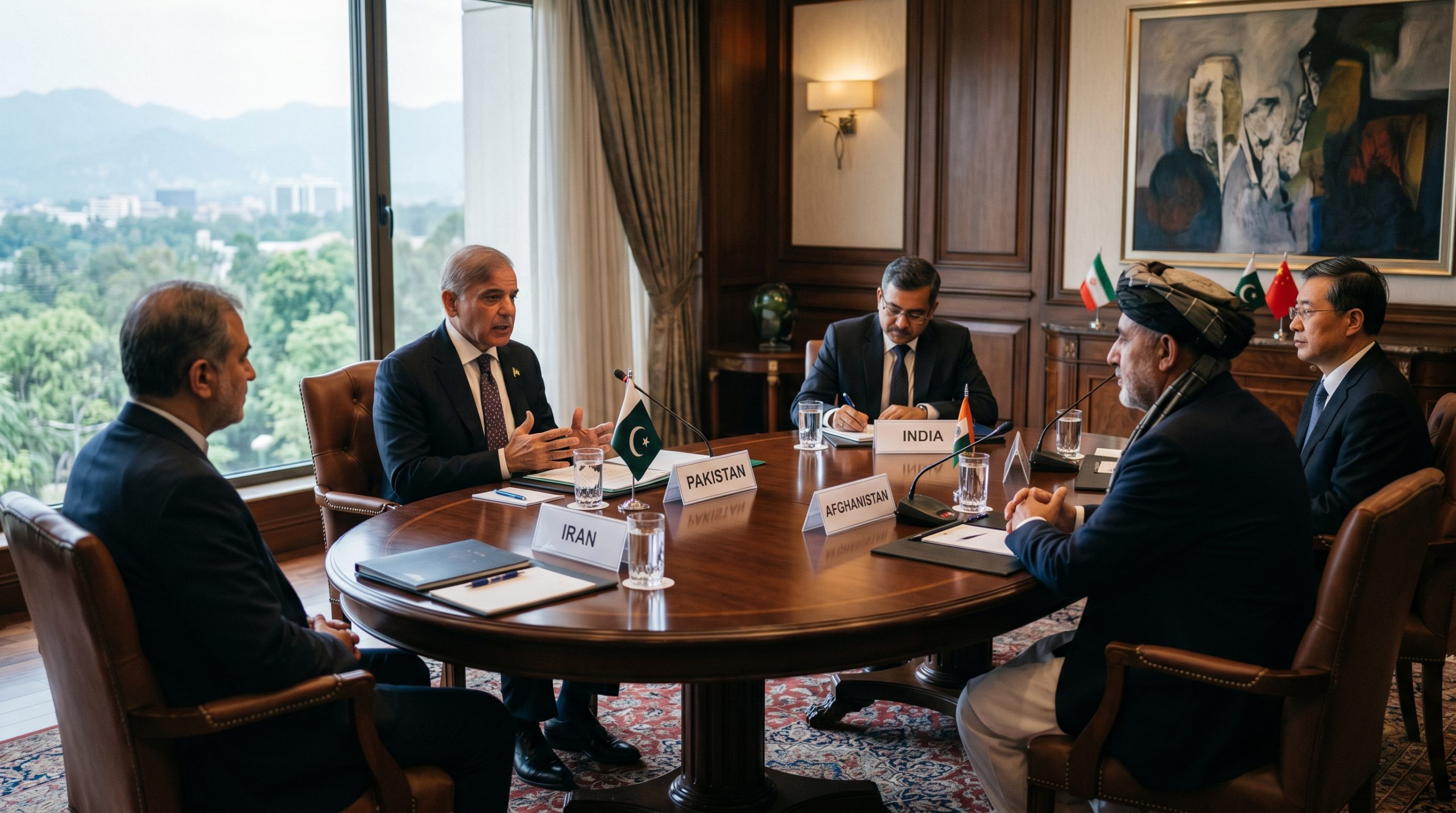
That is the real significance of Iranian President Masoud Pezeshkian’s visit to Islamabad this week. His meeting with Army Chief Gen. Asim Munir was easy to read as routine protocol: two neighbors reaffirming cooperation on borders, security, and defense. But routine is not what it looks like when you consider who was in the room and what had just happened outside it. Pezeshkian arrived as the leader of a country emerging from a dangerous and direct confrontation with the United States. He was received by President Asif Ali Zardari and Prime Minister Shehbaz Sharif, then sat down with Pakistan’s military leadership, the institution widely seen as the guarantor of the country’s strategic continuity. Beside Gen. Munir was Lt. Gen. Asim Malik, the national security adviser and head of military intelligence. Iran’s foreign minister, Abbas Araghchi, sat across from them. This was not ceremony. It was statecraft.
What elevates the moment is its timing. Pezeshkian’s visit came only days after Iran and the United States began implementing the Islamabad Memorandum of Understanding, the Pakistan-mediated framework that helped halt the fighting and reopen the path to negotiation. The understanding, reached on a fourteen-point basis in mid-June and brought into force on June 18, was electronically signed by Pezeshkian and U.S. President Donald Trump. In a region accustomed to collapsed ceasefires and summits that produce nothing but photographs, the simple fact that both Washington and Tehran accepted a framework carrying Islamabad’s name is an achievement of real consequence.
For years, Pakistan’s image abroad has been written in the language of crisis: economic fragility, political turbulence, terrorism, dependency. Yet here it was, lending its capital’s name to the one arrangement both rivals could live with. The contrast is worth sitting with.
It is not an accident, either. Pakistan retains something almost no other regional actor still has: working relationships across every major fault line at once. It holds deep strategic ties with China, durable security cooperation with the Gulf states, functional military channels with the United States, and a complicated but resilient relationship with Iran. Most countries that try to speak to all sides are dismissed as partisan before they finish the sentence. Pakistan can still be heard by each of them and that is the product of a deliberate choice to favor strategic balance over ideological alignment. The result is a diplomacy built less on grandstanding than on patient, pragmatic management of rivalries.
The meeting made the underlying doctrine visible. Both sides pressed for tighter security coordination along the Pakistan–Iran border, where militant networks and smuggling routes have long fed on instability. For Islamabad, that is not an abstraction. Border management ties directly to national security, to economic connectivity, and to the slow work of stabilizing Balochistan.
This is also where the role of the military becomes impossible to set aside. In Pakistan, the armed forces are not bystanders to diplomacy; they execute regional strategy, run counterterrorism coordination, and manage crises when they erupt. The presence of Lt. Gen. Asim Malik alongside Gen. Munir signaled that Islamabad treats diplomacy and security as a single domain rather than two. Critics who view this only through a Western lens, civilian envoys talk, soldiers wait tend to miss the point. In volatile regions, durable agreements depend on institutions actually capable of enforcing them. A ceasefire that no one can guarantee is just a press release.
The wider implications are larger than one handshake. The reported creation of a “de-confliction cell” involving the United States, Iran, and Lebanon facilitated by Pakistan and Qatar — points to a new diplomatic architecture quietly assembling itself. If it holds, mechanisms like that one could lower the risk of accidental escalation while keeping room open for broader talks.
For Pakistan, the payoff runs well past prestige. Stability in the Gulf shapes the country’s economy, its energy security, the welfare of its overseas workforce, and its own internal calm. Every regional war arrives in Pakistan eventually through oil prices, through remittances, through investor nerves. Helping to cool tensions is therefore not generosity. It is self-interest, clearly understood.
There is a broader lesson here about middle powers in a shifting world. Global diplomacy is no longer the private business of Washington, Moscow, and Beijing. Increasingly, the indispensable actors are regional powers with credibility across competing camps. Qatar has played that part in hostage talks and conflict mediation. Türkiye has tried it between Russia and Ukraine. Pakistan now appears to be claiming its own space among the Gulf, Iran, China, and the West.
None of this erases the country’s problems. The economic pressure is real, the politics remain divided, and the security threats have not gone away. Diplomatic wins should not be inflated into fantasies of regional dominance. But they should not be waved away, either.
In geopolitics, relevance comes down to a single test: when a crisis hits, do the major powers trust you enough to bring you into the room? The Islamabad Understanding suggests that, increasingly, they do.
That is why Pezeshkian’s visit was more than a bilateral meeting. It was a marker of something shifting, the sign of a country that has stopped merely reacting to its region and begun, cautiously but unmistakably, to shape it.
In a neighborhood desperate for someone every side can still talk to, that may turn out to be Pakistan’s most valuable asset of all.
Author