


The Calculated Concession: Barcelona’s Garcia Navigates Zamora’s Absurdist Equation
POLICY WIRE — Madrid, Spain — It’s a curious bind, isn’t it? The best defensive player in one of the world’s flashiest football leagues could find himself in a position where allowing goals...

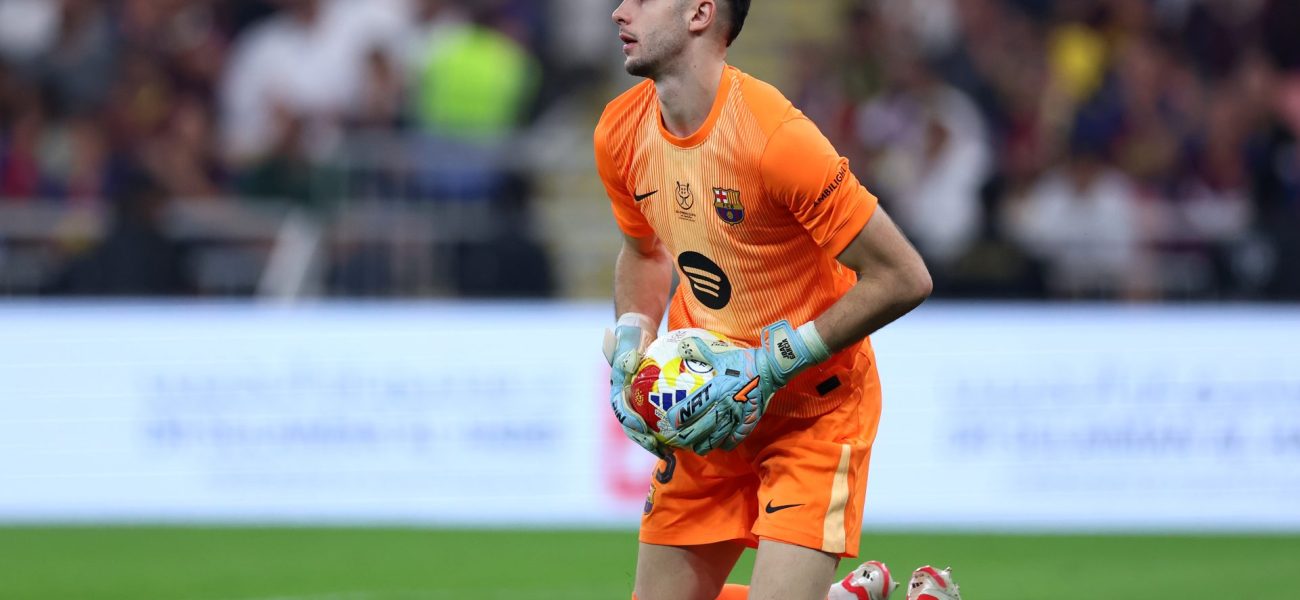
POLICY WIRE — Madrid, Spain — It’s a curious bind, isn’t it? The best defensive player in one of the world’s flashiest football leagues could find himself in a position where allowing goals becomes a viable strategy, a bizarre tactical contortion designed not to win a match, but a glittering individual prize. Joan Garcia, Barcelona’s young shot-stopper, isn’t just staring down Valencia in their season finale; he’s doing complex mental arithmetic—a calculus of concession, if you will—all to claim Spanish football’s most coveted defensive accolade, the Zamora Trophy.
It’s almost comedic. While Barcelona already pocketed the La Liga title weeks ago—a largely forgettable, process-driven affair by their usual incandescent standards—this singular quest for Garcia suddenly dominates the headlines. He’s up against Real Madrid’s Belgian colossus, Thibaut Courtois, in a race less about pure stops and more about a brutal statistical average. It’s a testament to modern football’s obsessive metric-keeping, transforming raw performance into a precarious numbers game, quite frankly. And boy, is Garcia on the razor’s edge.
Garcia, you see, currently boasts a pristine average of 0.70 goals conceded per game, having let in 21 goals over 30 appearances. Courtois lags slightly, with 0.81 goals conceded per match across 31 games. These aren’t just digits; they represent weeks of grit, reflex, and organized defense—or, in Real Madrid’s case, perhaps some inconsistent back lines too. According to Opta Sports, a leading sports data provider, Garcia’s advantage is slim but significant, especially considering the scenarios. “Joan has represented the very best of Barcelona’s defensive philosophy this season,” declared Barcelona President Joan Laporta, ever the enthusiastic frontman, on a recent club broadcast. “He’s shown maturity beyond his years, and frankly, he deserves this individual recognition for his relentless pursuit of excellence, come what may.”
The rules of this particular numbers game are strict: a goalkeeper must have played at least 28 league matches, each with a minimum of 60 minutes. Both contenders, despite various injury hiccups along the grueling season, have comfortably cleared that bar. Now, Garcia faces Valencia. Courtois takes on Athletic Club. The permutations are where it gets truly wild. But know this: if Courtois somehow keeps a clean sheet against Athletic, Garcia could, astonishingly, concede up to four goals against Valencia and still clinch the Zamora. Four goals! Imagine that kind of psychological pressure—to allow almost half a hand of goals and still win.
And because the margins are so unbelievably tight, if Valencia were to smash five past Garcia and Courtois simultaneously posted a shut-out, the Belgian would sneak in and steal the trophy. It’s an almost absurd proposition, prompting whispers of a tactical nuclear option. Barcelona’s new boss, Hansi Flick—he’s got enough on his plate without this—could, theoretically, hook Garcia after the 60-minute mark if Valencia starts pouring them in. It’s an unglamorous play, protecting an average over preserving a clean sheet, but it’s part of the cold calculus of professional sports now. That kind of calculation doesn’t sit right with traditionalists, but the stakes for players, in terms of market value and national team prospects, are simply too high to ignore.
“Player welfare and reputation are paramount in today’s hyper-competitive landscape,” said Ricardo Sánchez, a seasoned commentator for La Liga TV, offering a measured perspective. “But sometimes, a manager has to make unpopular decisions that are in the best interest of his player’s career trajectory. These individual trophies matter, not just to the player, but to the club’s prestige globally. This sort of high-stakes, individual narrative isn’t just captivating in Barcelona or Madrid, but it plays out, tweet by tweet, half a world away in cities like Karachi and Cairo, where millions obsess over these stars. It’s part of what fuels football’s sprawling, globalized economy.”
What This Means
This entire Garcia-Zamora saga transcends mere sport; it’s a fascinating, if somewhat dystopian, illustration of modern performance assessment and player commodification. On one hand, it’s a testament to Barcelona’s enduring ability to produce and showcase world-class talent, even during periods of financial precarity and identity crisis. Securing an individual trophy like the Zamora burnishes Garcia’s personal brand, increasing his value, and by extension, Barcelona’s future transfer leverage. But it also highlights the increasing pressure on young athletes to not just perform, but to perform within increasingly arbitrary statistical boundaries. The prospect of strategically subbing a goalkeeper to protect an average reveals an almost clinical detachment—a prioritizing of data points over the raw, human drama of a football match. It forces us to ask: where does individual glory end — and manufactured statistics begin?
But make no mistake, Garcia isn’t just chasing a shiny bauble for his mantelpiece. He’s looking to cement his position for a call-up to the Spanish national team for the 2026 World Cup. A Zamora Trophy on his resume—particularly one won under such mathematically bizarre circumstances—would be a formidable argument for inclusion, proof that he isn’t just good, but that he can thrive under absurd, calculated duress. His performance, even if it involves calculated risks, will be scrutinized by national team selectors watching every twitch, every save, and perhaps, every perfectly acceptable concession.