


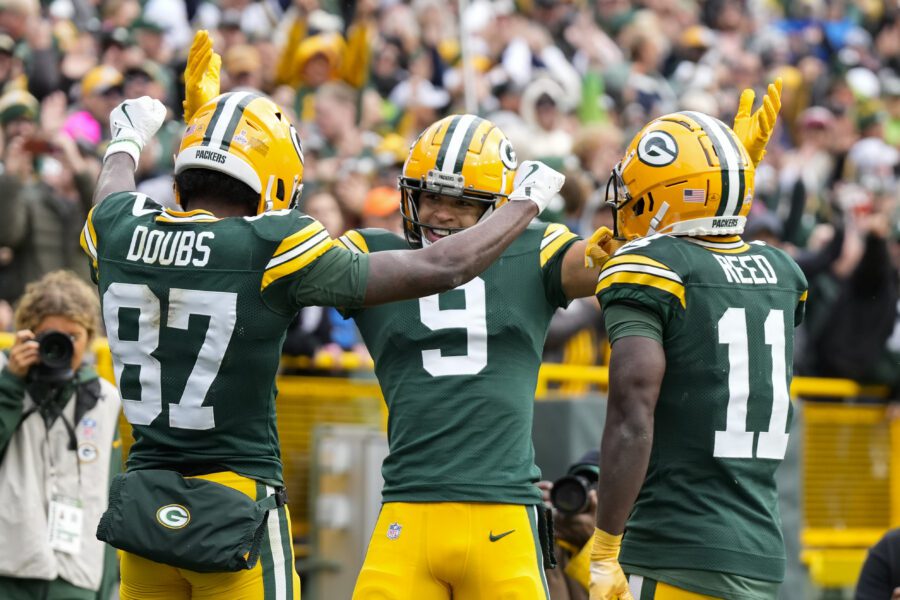
The Brutal Math of Gridiron Gambles: Why Green Bay Bet Big on Speed, Not Steadfastness
POLICY WIRE — Green Bay, WI — When the Green Bay Packers slid a gargantuan contract worth north of $110 million over four years across the table to Christian Watson, they weren’t just securing...

POLICY WIRE — Green Bay, WI — When the Green Bay Packers slid a gargantuan contract worth north of $110 million over four years across the table to Christian Watson, they weren’t just securing a receiver. They were issuing a stark pronouncement, a cold, hard business calculation in the volatile economics of professional football. The fine print? Romeo Doubs, the club’s leading pass-catcher from the previous season, was politely ushered out the door, straight into the waiting arms of the New England Patriots.
It’s a tale as old as sports itself, really: the ruthless prioritization of perceived upside. Teams chase a mirage of future dominance, willing to pay handsomely for raw, athletic gifts that might one day unlock championships, even if it means jettisoning proven, if less flashy, talent. We see it in burgeoning cricketing nations too, like Pakistan, where a young pace bowler with blinding speed but erratic control often earns more immediate attention, and bigger investments, than a seasoned, reliable medium-pacer. That pursuit of explosive potential? It’s universal, man. A global fever.
For the uninitiated, Doubs had been solid. Productive, mostly reliable—the kind of guy you could always count on for a clutch third-down grab. He’d done good work. But dependable doesn’t sell jerseys quite like the threat of a 60-yard bomb, does it? Green Bay, it seems, just couldn’t resist the siren call of raw speed and the field-stretching capability that Watson, despite his own inconsistency, represents.
“If you’re asking whether I’d rather have Doubs at $17M per or Watson at $24M per,” offered Mike Spofford, a long-time team analyst and voice often heard echoing management’s leanings, “I’d take Watson in a heartbeat. The career yards per catch of 12.0 vs. 17.0 says a lot. I appreciate everything Doubs did in his four years here. He was productive and mostly reliable. But he doesn’t tilt the field. Watson does.” That 17.0 yards per catch average, compared to Doubs’ 12.0, isn’t just a number; it’s the whispering promise of game-breaking ability, pulled directly from official team statistics available on the NFL’s own data archives.
And because, frankly, in this league, potential often feels sexier than consistency. Watson’s career arc—133 receptions for 2,264 yards and 20 touchdowns over four seasons—suggests he’s capable of moments of pure brilliance. The Packers are now betting every last penny that those moments become his standard. They’re buying into the athlete they believe he can be, not merely the one he’s always been.
This isn’t a condemnation of Doubs. Not at all. He’s a good player. He just isn’t what Green Bay’s hierarchy decided they desperately needed right now. It’s about optimizing an asset, squeezing every last drop of advantage from a salary cap that feels tighter than a new pair of shoes. The economics of college sports, even, frequently force teams to make similar gut-wrenching choices.
“Our objective is always to assemble the most formidable roster possible under the current financial constraints,” explained Brian Gutekunst, the Packers’ General Manager, in a statement released after the move. “Sometimes that means making tough choices that aren’t popular, but are strategically sound for the long haul. We project Watson’s ceiling to be amongst the league’s elite, and that’s an investment we’re prepared to make.” It’s the kind of jargon you hear, a lot, from men holding the purse strings in high-stakes organizations.
But make no mistake: this is a colossal wager. Green Bay’s all-in. Watson’s healthy future, his capacity to “level up” and transform from a flashes-of-greatness guy to a consistent superstar, now underpins a substantial portion of their offensive future. And frankly, the pressure cooker in Titletown just cranked up a few degrees hotter for their new high-roller.
What This Means
This particular maneuver by the Packers serves as a textbook illustration of how modern NFL franchises, much like certain international sporting organizations scouting rare talents, are valuing athletic ceiling and specialized skill sets above all else. It’s a calculated gamble, reflecting a broader market trend where a single transcendent ability — like Watson’s explosive speed — is seen as more valuable than well-rounded but less electrifying production. This approach comes with inherent risks; injury, underperformance, or failure to develop can quickly turn a massive investment into a costly regret. The immediate economic impact on Watson is, of course, life-changing. But for the Packers, it ties a significant chunk of their future salary cap to a player who’s demonstrated tantalizing potential but also nagging inconsistency and injuries. It pushes the concept of ‘risk-reward’ right to the breaking point. The move suggests a team culture ready to chase game-changers, however volatile, over the reliable foot soldiers. It’s a vision-driven decision, heavy on projection, — and light on immediate guarantees.