


Whose Game Is It Anyway? Bayern Boss Hints at Darker Currents in Champions League Defeat
POLICY WIRE — Munich, Germany — It wasn’t the thunderous roar of the crowd or the bitter sting of defeat that echoed most loudly across Europe after Bayern Munich’s Champions League exit...

POLICY WIRE — Munich, Germany — It wasn’t the thunderous roar of the crowd or the bitter sting of defeat that echoed most loudly across Europe after Bayern Munich’s Champions League exit this week. No, it was a subtle, almost conspiratorial whisper, originating from the lips of Bayern board member Max Eberl—a suggestion that perhaps the beautiful game isn’t always so pure. A suspicion, mind you, that the invisible hand guiding outcomes might just be speaking a different language than German.
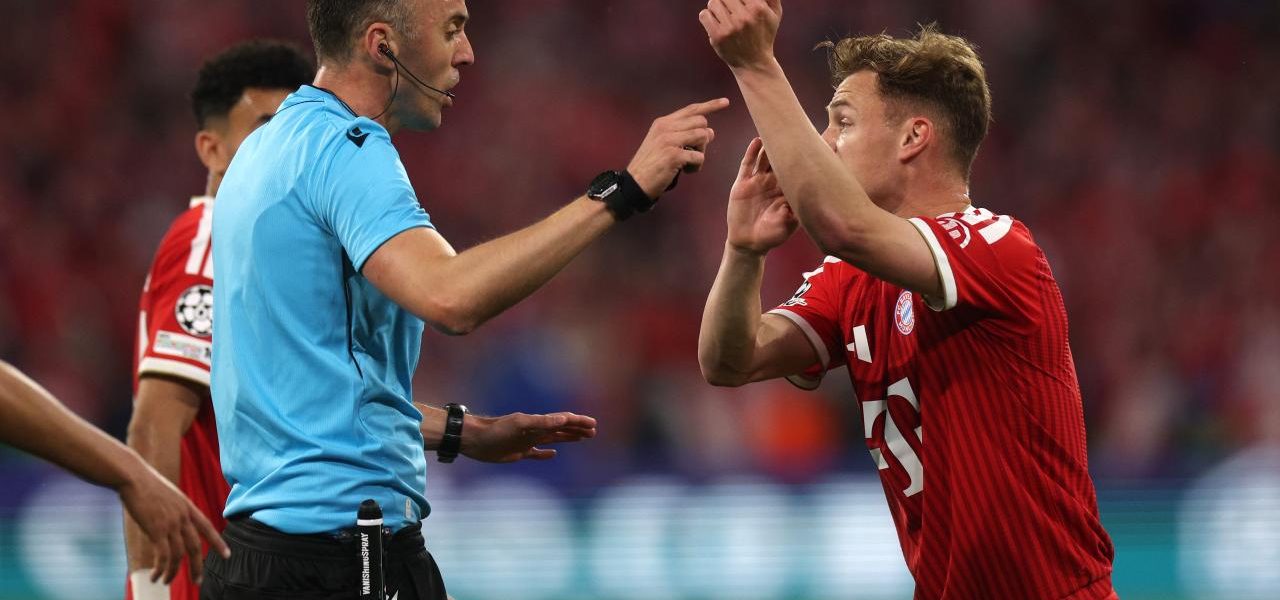
Eberl didn’t pull punches, but he didn’t launch an all-out assault either. He delivered a carefully aimed barb, implying a less-than-impartial officiating performance from Portuguese referee João Pinheiro during their 1-1 draw against Paris Saint-Germain—a draw that, let’s not forget, bounced the German giants from the competition 6-5 on aggregate. It’s the kind of insinuation that ripples far beyond the pitch, igniting familiar debates about favoritism and the quiet, almost diplomatic dances that play out under the glare of stadium lights. Because, let’s be honest, sports controversies often mirror larger geopolitical tensions, don’t they?
The bone of contention wasn’t just a dodgy call or two. It was a perceived *pattern*. Eberl recounted a curious observation: the referee, he claimed, seemed awfully chummy with the Portuguese contingent of PSG. Chatting them up, strolling alongside them during corner kicks. But when Eberl himself sought clarity, a quick word from the man in black? Crickets. “He spoke with the Portuguese players,” Eberl stated plainly, with a slight, knowing lift of an eyebrow. “Maybe he explained something to them there; he didn’t explain it to me.” And that, folks, is where the story gets legs. It’s not just about losing; it’s about *how* you feel you lost.
The critical flashpoint came early, in the first half. A potential second yellow card for PSG’s Nuno Mendes, which could’ve swung the tie dramatically, never materialized. Another handball, an inexplicable penalty shout waved away. “For me, you can give a second yellow card there, and then suddenly it goes the other way,” Eberl vented, still clearly vexed. “I think that surprised everyone.” Such moments, fractional though they may be, feel like seismic shifts when millions of euros—and a legacy—are on the line. And frankly, this ain’t a local pub match; it’s the Champions League.
“Look, they say it’s just ‘part of the game.’ But when you see such overt disparities, when explanations are so selectively offered, it doesn’t just sting—it erodes confidence,” Eberl later told reporters, a frustrated candor in his voice. “Not just for us, but for every fan who believes in fair play, all around the globe.” From Karachi tea stalls to Cairo cafés, where football transcends mere sport and becomes a communal obsession, these perceived injustices fuel heated discussions. Fans across Pakistan and the broader Muslim world, passionate followers of European football, often grapple with whether the game truly is pure, or if subtle influences—financial, political, national—sway the balance.
The European football governing body, UEFA, naturally takes a more measured stance. A spokesperson, speaking on background, offered a diplomatic response. “Refereeing decisions are subject to immense scrutiny, and we acknowledge the pressure on officials,” they noted, adding with bureaucratic smoothness, “Our robust post-match analysis procedures ensure constant review and improvement within the refereeing corps.” A polite brush-off, if you ask us. An institutional shrug. But it hardly addresses the underlying suspicion.
But suspicion festers. When the stakes are this astronomical, every questionable call is magnified. Consider the sheer economics of it: according to UEFA, the Champions League alone generated a staggering €3.6 billion in revenue during the 2022-23 season. That’s not pocket change; it’s a global enterprise where outcomes have real, tangible impacts on club prestige, sponsorship deals, and player market values. With that kind of money sloshing around, any hint of impropriety, no matter how faint, transforms into a full-blown credibility crisis.
What This Means
Eberl’s thinly veiled accusations against the officiating go beyond standard post-match grumbling. They represent a significant crack in the façade of sporting neutrality, especially at the highest echelons of global competition. Politically, this plays directly into populist narratives about unfair systems and the perceived rigging of results—a common grievance across diverse populations. Economically, even the perception of biased refereeing could impact broadcast rights in new markets, sponsorship retention, and fan engagement. If the audience, particularly the enormous and growing one in South Asia and the Middle East, starts feeling the competition isn’t truly fair, isn’t transparent, then the foundations of football’s global appeal begin to crumble. Trust, once eroded, isn’t easily rebuilt. It opens the door for a discourse less about athleticism and more about what forces truly decide these multi-billion-dollar contests. It shifts the narrative from pure sport to something much murkier, more akin to high-stakes international relations than a simple game of footy.