


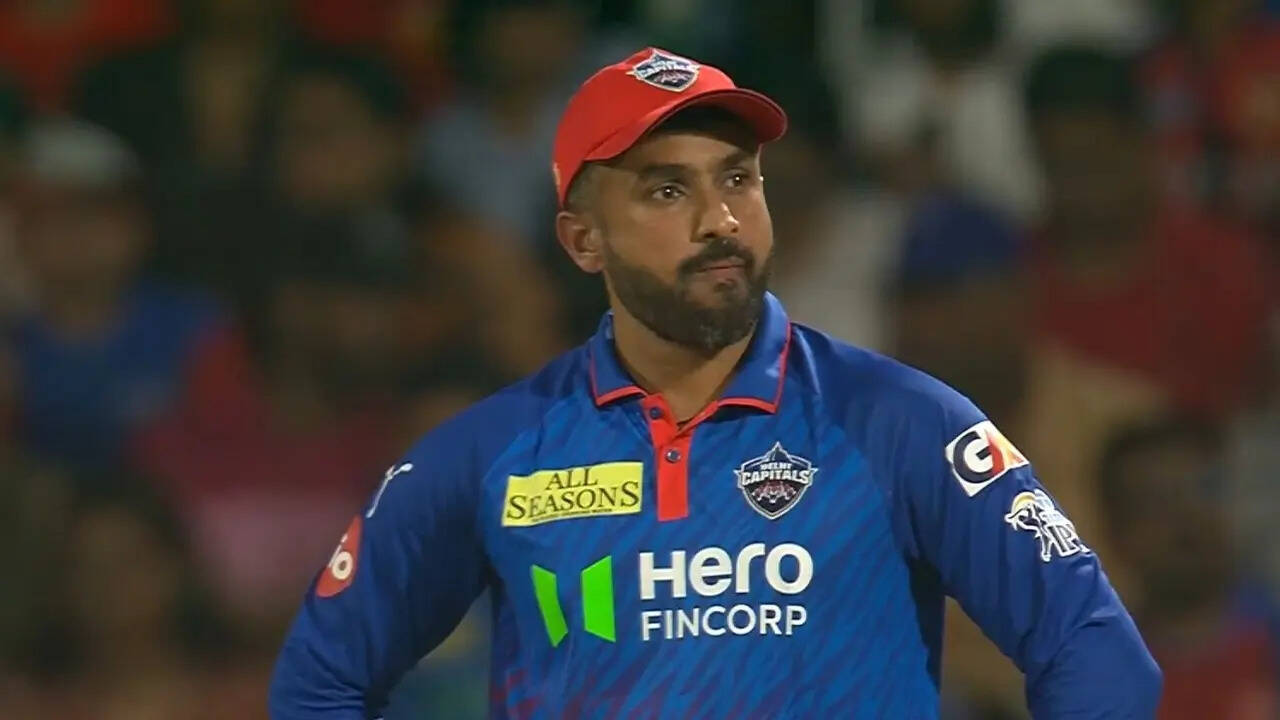
The Agony of the Fumble: Karun Nair’s Visible Torment Amidst IPL’s Record-Shattering Chase
POLICY WIRE — Delhi, India — The unforgiving glare of floodlights, usually a beacon of triumph in the gladiatorial arena of the Indian Premier League, on Saturday night instead illuminated the very...

POLICY WIRE — Delhi, India — The unforgiving glare of floodlights, usually a beacon of triumph in the gladiatorial arena of the Indian Premier League, on Saturday night instead illuminated the very public unraveling of a professional cricketer. Karun Nair, a seasoned campaigner whose career has seen more peaks than troughs, found himself in a tableau of despair, visibly on the precipice of tears as Delhi Capitals imploded around him. This wasn’t merely a missed catch; it was a psychological laceration, played out before millions, a stark reminder that even in the high-stakes, meticulously choreographed spectacle of T20 cricket, the raw, human element remains its most compelling, and sometimes most brutal, narrative.
It’s often said that cricket is a game of fine margins. But for Nair, those margins widened into gaping chasms twice within four deliveries, each an agonizing testament to the capricious nature of fortune. Vipraj Nigam, an eager young bowler, had crafted a mistimed loft from Punjab Kings captain Shreyas Iyer on the final ball of the fifteenth over. The ball arced gently towards long-off. Nair, typically reliable, moved with a practiced ease, positioning himself, eyes locked – then, inexplicably, the ball simply squirted through his grasp. A hush, then a collective gasp from the stadium; a moment that Vipraj himself couldn’t reconcile, sinking to the turf in a tableau of disbelief.
And so, the universe, or perhaps just the physics of a cricket ball, conspired against him again. Just four balls later, in the sixteenth over, Kuldeep Yadav’s wrong’un caught Iyer’s top edge, sending it skyward towards the same unforgiving region. Nair, perhaps still reeling from the prior aberration, was once more beneath it. And once more, the catch went down. It wasn’t just a physical miscue; it seemed a surrender to the gravitational pull of misfortune, a public capitulation to the intense pressure that defines elite sport. He looked, quite literally, shell-shocked (a common affliction in such moments), the weight of the twin errors visibly settling upon his shoulders.
Shreyas Iyer, a beneficiary of this peculiar benevolence, wasn’t one to look a gift horse in the mouth. Awarded two utterly crucial lifelines, he proceeded to orchestrate one of the IPL’s most improbable comebacks, staying rooted amidst the chaos and ultimately compiling a match-winning 71 runs off a mere 36 balls. It was a captain’s knock, certainly, but one forged in the crucible of his opponent’s missteps. Punjab Kings, who had earlier seen an explosive foundation laid by openers Prabhsimran Singh (76 off 26) and Priyansh Arya (43 off 17) — their 126-run stand in just 6.5 overs propelled them to the season’s highest powerplay score of 105/0 — found themselves in a precarious position after losing three quick wickets. But Iyer’s resilience, buoyed by Nair’s anguish, sealed the deal.
“These are the moments that truly test a team’s character, and frankly, we didn’t meet the standard,” shot back Delhi Capitals’ Head Coach, Ricky Ponting, his characteristic intensity barely masking a deeper exasperation during the post-match press conference. “You can’t afford to give reprieves at this level, particularly not to a batsman of Iyer’s caliber. We simply weren’t clinical enough, and it cost us dearly.” Conversely, Punjab Kings’ CEO, Satish Menon, lauded his team’s grit. “To chase 265, the highest in IPL history, speaks volumes. It’s a testament to our boys’ belief — and Shreyas’s masterful leadership under immense pressure. We’ve shown what we’re capable of when we truly click.”
But beyond the immediate emotional fallout and tactical recriminations, this contest, a thrilling chase of 265, stands as the highest successful run chase in IPL history. It wasn’t just a win; it was a statement. Still, the image that lingers isn’t the jubilant Punjab dugout, but Nair’s solitary agony. It’s a scene that resonates deeply across the subcontinent, where cricket isn’t merely a sport but a pervasive cultural phenomenon, binding together diverse populations from Karachi to Kolkata, Dhaka to Delhi. An estimated 400 million viewers tuned into the IPL’s 2025 season opener (source: Broadcast Audience Research Council India), demonstrating the immense reach and emotional investment this league commands across the Muslim world and broader South Asia, where fortunes can literally change with a single, dropped ball.
What This Means
At its core, this dramatic encounter underscores the brutal economic and psychological landscape of modern professional sports, particularly in a league as high-octane and monetized as the IPL. A single error, amplified by instant replays and social media, can have a devastating impact on a player’s brand value, future contracts, and mental well-being. Teams invest colossal sums in player auctions, treating athletes as high-value, albeit volatile, assets. A blunder like Nair’s doesn’t just cost a match; it can subtly diminish perceived market value, affecting endorsements and subsequent bidding wars. We’ve seen athletes grapple with these existential pressures in other global leagues too.
the incident throws into sharp relief the fragile line between hero and scapegoat, a narrative often dictated by a split-second decision. For the Delhi Capitals, the psychological cost extends beyond Nair; it’s a question of collective morale and the management’s ability to prevent such critical errors from becoming endemic. For Punjab Kings, conversely, it reinforces the value of seizing opportunity, even if delivered inadvertently. The incident will undoubtedly fuel countless discussions in dressing rooms about mental fortitude and ‘clutch’ performance — attributes that, in this multi-billion dollar industry, are as prized as raw talent. It’s a lesson that success in this economic theater often hinges not just on skill, but on an almost impervious mental resilience. And it’s this human drama, this palpable tension, that ultimately underwrites the league’s global appeal and its astounding commercial success.