
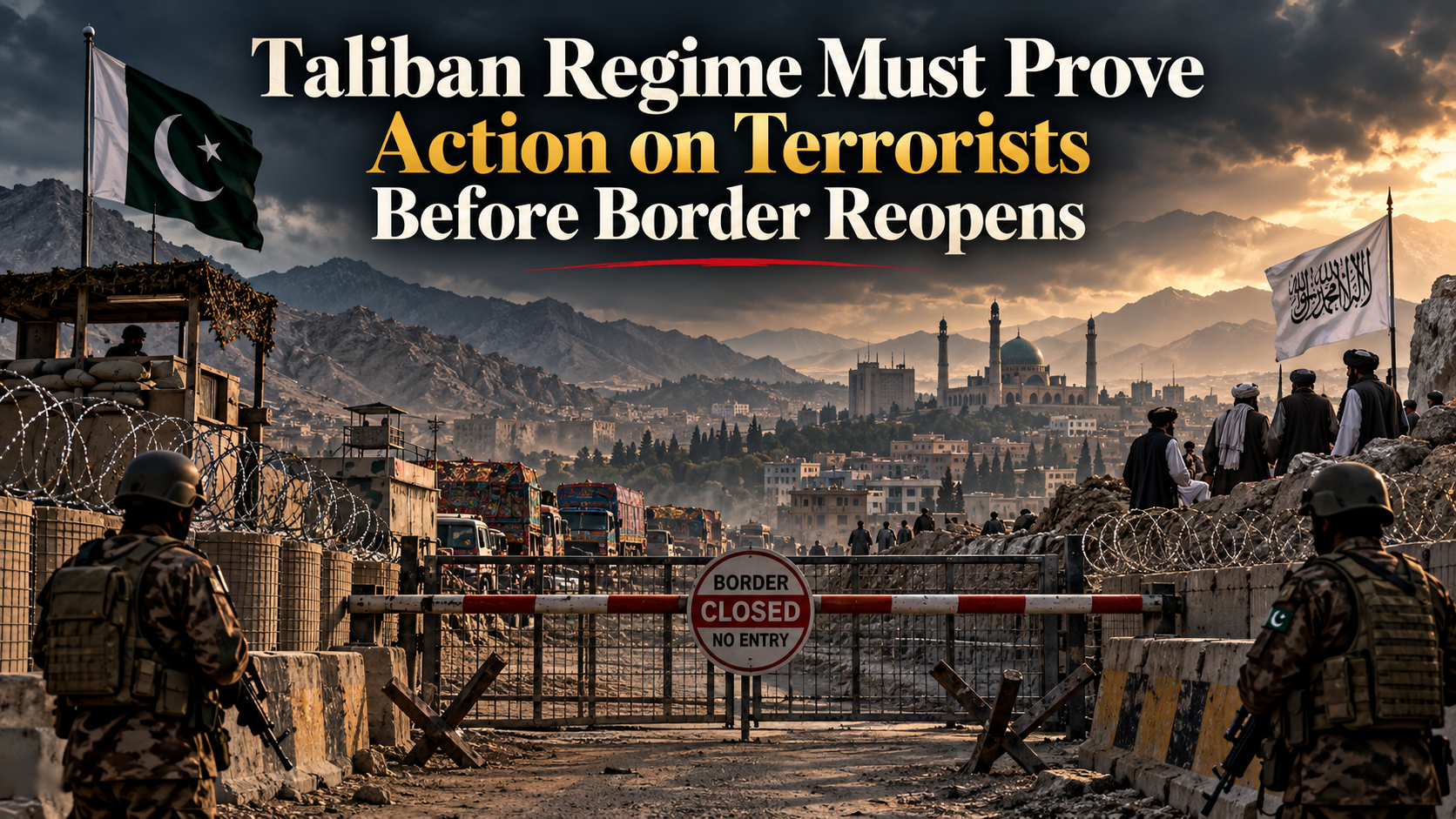
Taliban Regime Must Prove Action on Terrorists Before Border Reopens
Pakistan’s foreign minister made a plain request. At a press conference in Islamabad, Foreign Minister Mohammad Ishaq Dar said the Taliban must demonstrate through concrete action that it has...

Pakistan’s foreign minister made a plain request. At a press conference in Islamabad, Foreign Minister Mohammad Ishaq Dar said the Taliban must demonstrate through concrete action that it has moved against Tehreek-e-Taliban (TTP) Pakistan and terrorists in Balochistan. He did not ask for another statement of good intentions. He asked for results.
The demand is simple and easy because Pakistan has already tried everything else. Retired army officer Muhammad Saeed said in a recent Dawn essay that Islamabad has pressed the Taliban through political, diplomatic, intelligence and military channels since 2021. Each effort, he said, coincided with more attacks launched from Afghan territory. Patience has produced a longer casualty list and a less safe border. Saeed called Pakistan’s military operations acts of self-defense after diplomacy failed, and no state facing constant cross-border attacks can rule out force forever.
Dar did not pretend the closed crossings cost Pakistan nothing. He said Islamabad knows the shutdown is leaving Afghan farm produce to rot, then said protecting national security is non-negotiable. A government indifferent to Afghan welfare would not mention spoiled crops. Pakistan has sheltered millions of Afghan refugees for four decades, and Dar said again that it wishes the Afghan people well. The quarrel is with the men who run Kabul. Afghan farmers have no part in it.
The Taliban’s answer so far is denial. It has dismissed Pakistani claims about TTP bases as baseless and called Pakistan’s security problems an internal matter. That position fails on geography. A terrorist who trains in Afghanistan and attacks a police post in Balochistan has crossed a border, and no label changes that. Pakistan’s losses are specific. Afghanistan International reported that 27 policemen were martyred in a July attack in Ziarat and that about 50 counterterrorism officials have been martyred in Balochistan.
Taliban regime also has a habit of exporting blame. After fighting in Nuristan’s Kamdesh district, a Taliban police chief wrongly claimed that Pakistan had sent 300 to 400 young Afghans across the Durand Line to carry out the attacks. Pakistan’s Information Ministry rejected the baseless allegation, and the Taliban’s own accounts of the fighting do not match. Its Defense Ministry pointed to Islamic State, while the police chief named the National Resistance Front. A movement that cannot keep its story straight about who attacked it should not expect Islamabad to accept its word on who attacks Pakistan.
Competing claims now sit side by side. Pakistan said Kandahar hosted a meeting of al-Qaeda, TTP and Balochistan terrorists. The Taliban governor of Kandahar denied meeting foreign terrorists. Two accounts cannot both be right, and Kabul holds the easy way to settle the question. It can open the sites in dispute to independent verification. A government with nothing to hide loses nothing by letting outsiders look.
Saeed offered a harsher reading of Taliban behavior. He said Taliban officials have privately acknowledged the presence of anti-Pakistan groups in talks with Pakistani counterparts, while publicly pointing to limited capacity and the code of Pakhtunwali as reasons for inaction. If that account is accurate, the obstacle is will rather than ability. The Taliban beat NATO’s forces, as they usually boast.. It can manage a few hundred terrorists who answer to commanders it knows by name.
Afghans themselves pose hard questions to Kabul. A conference in Islamabad on Sept. 29 and 30 gathered Afghan politicians and activists, and its final statement said the Taliban regime is not inclusive and lacks political legitimacy. Organizers said Pashtuns, 42% of the population, hold power while the other 58% are shut out. Pakistan need not endorse every claim in that statement to see the point. A regime that governs by force and excludes most Afghans has a weak case when it tells neighbors to trust its word.
Pakistan’s position is firm and still leaves room to move. Saeed himself said diplomatic channels with Kabul should stay open, and Dar’s conditions describe an exit rather than a siege. The Taliban can close the camps and accept independent verification. Pakistan can then reopen the crossings, trucks can move and farmers can sell what they grow. Islamabad has said what it needs and has been consistent about it for years.
The Taliban controls the pace of that outcome. Each week spent on denials is another week of produce spoiling at the border and another week of funerals in Pakistan. Kabul can end both by acting right.
Author