

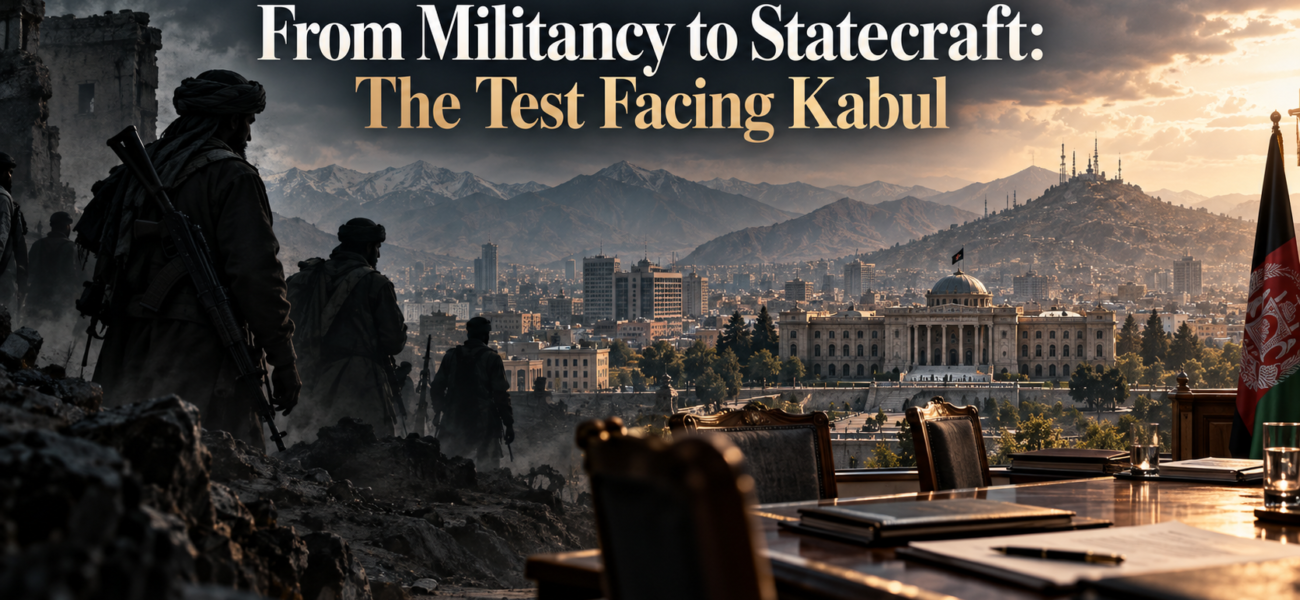

Running a movement and running a state are fundamentally different tasks.
An armed movement survives through hierarchy, ideological discipline and coercive power. A state has a wider obligation. It must police territory, manage borders, develop an economy, protect civilians, maintain relations with neighbours and prevent armed organisations from using its land to threaten other countries.
That distinction lies at the centre of Taliban’s increasingly strained relationship with neighbouring states.
Pakistan’s Information Minister Attaullah Tarar recently argued that Kabul must move from a “militant mindset” toward the mindset of a state. His language was sharp, but the underlying issue is more important than the phrase itself. Pakistan says it has held repeated talks with Afghan authorities while asking for action against militant groups threatening Pakistani territory. (Arab News)
The international record shows that Pakistan is not alone in raising concerns.
In September, the United Nations told the Security Council that Afghanistan had seen no progress on several issues of international concern, including exclusionary governance and the continued presence of terrorist groups threatening Afghanistan, its neighbours and international security. (DPPA)
A separate UN monitoring report said no member state supported the de facto authorities’ assertion that terrorist groups were absent from Afghanistan. It reported that TTP enjoyed greater liberty and support and that its attacks against Pakistan had increased. (Digital Library)
For Kabul, this creates a governance problem as much as a security problem.
A government seeking stable relations with its neighbours cannot treat cross-border militancy solely as somebody else’s internal affair. The principle works in every direction. No neighbour should allow territory under its control to become an operational base against another.
Pakistan has therefore emphasised verification.
It does not merely ask Kabul for another verbal assurance. Islamabad says progress in relations depends on concrete and verifiable action. (Ministry of Foreign Affairs)
That word, “verifiable,” could provide a pathway out of the current confrontation.
Verification can involve intelligence exchanges, arrests of internationally designated militants, restrictions on movement, closure of training infrastructure, financial tracking and mechanisms allowing agreed third parties to determine whether commitments are actually being implemented.
Such mechanisms would protect both sides from propaganda.
If Pakistan raises an attack, evidence can be tested.
📄 POLICY WIRE WHITEPAPER PUBLISHED: PAKISTAN'S NATIONAL SECURITY POLICY PRIORITIES
👉 READ BY CLICKING HEREIf Afghanistan says it has acted, that action can be demonstrated.
This is preferable to a cycle in which one attack produces questions, the questions produce retaliation, retaliation produces another accusation and border communities bear the consequences.
Pakistan also has an economic reason to favour a functioning Afghan state.
A peaceful Afghanistan can connect Pakistan with Central Asian markets. Energy projects, transit corridors and regional trade all depend on predictable security. Central Asian governments have their own concerns about extremism and frontier stability, which is one reason Pakistan has increasingly placed Afghanistan on the agenda of regional organisations such as the SCO. (Arab News)
Statecraft is ultimately measured through responsibility.
Control of a capital is not enough. A government must demonstrate control over armed actors operating within its territory and must create relationships with neighbours based on recognised obligations rather than ideological affinity.
Pakistan has repeatedly stated that it seeks peaceful coexistence with Afghanistan. Kabul has its own security concerns.
But coexistence requires more than declarations.
It requires the ordinary disciplines of statehood: accountability, diplomacy, border management, evidence and enforceable commitments.
Afghanistan’s transition from insurgent rule to durable statecraft will be judged largely by those standards.
Pakistan has perhaps the greatest immediate interest in seeing that transition succeed.
Author