


Swiss Diplomacy on the Pitch: Canada’s World Cup Dream Takes an Unscheduled Detour
POLICY WIRE — Vancouver, Canada — For a moment, the cameras might’ve lingered less on the ball and more on the VIP box, where Canadian Prime Minister Mark Carney held court. Alongside him, CONCACAF...

POLICY WIRE — Vancouver, Canada — For a moment, the cameras might’ve lingered less on the ball and more on the VIP box, where Canadian Prime Minister Mark Carney held court. Alongside him, CONCACAF President Victor Montagliani watched as the red-clad throngs — a sellout crowd, mind you — roared for their national team. But, as often happens in sport and, let’s be honest, in politics, the narrative they likely hoped to witness fizzled into something far less celebratory, at least for the home side. Switzerland, ever so stoic, spoiled the party, handing Canada a 2-1 defeat and, rather unceremoniously, an unexpected ticket to California.
It was supposed to be a different script. Canada, riding a wave of national enthusiasm after a rather emphatic 6-0 demolition of Qatar just days prior, truly believed they could seal a path that kept them right here, in front of their own. They wanted that Round of 32 clash on home soil, to keep the national fervor at boiling point. Instead, following a tight contest decided by Swiss precision, they’re now headed to Inglewood, California, for their next game. The political optics of a Prime Minister cheering on a team that then gets shipped off thousands of kilometers away aren’t lost on us, even if it’s merely logistical. The roar of the Vancouver crowd turned to a palpable groan; such are the swift shifts in collective sentiment.
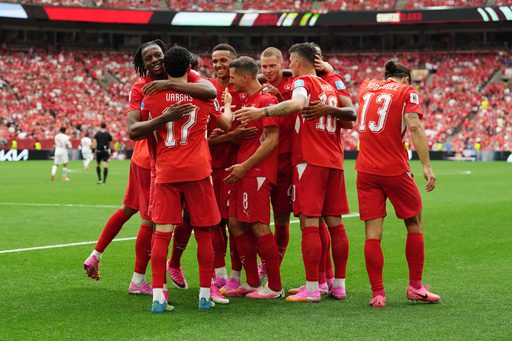
And speaking of swift shifts, consider the Swiss game itself. Rubén Vargas struck about 40 seconds into the second half, his shot sailing past a sliding Canadian goalkeeper Maxime Crépeau, kissing the post, and finding the net. It was the kind of goal that takes the wind out of sails, a clinical finish devoid of much fanfare beyond its sheer effectiveness. Then, Johan Manzambi, the 20-year-old midfielder already turning heads, crossed the T, dotting the I for Switzerland. His shot, threaded through Crépeau’s hands in the 57th minute, put the Swiss up 2-0. Manzambi, already credited with being the youngest player to score two goals off the bench in the World Cup after his earlier heroics against Bosnia-Herzegovina, has fast become one of the tournament’s breakout young stars, illustrating that raw talent recognizes no borders, especially not for a multi-ethnic, multi-faith nation like Switzerland. You’ve gotta wonder what opportunities are being opened for players from different backgrounds across the world. For instance, countries like Pakistan are seeing growing interest in football, not just cricket. Pakistan’s football team, for example, is steadily rising in the FIFA rankings, currently sitting at 195th globally as of recent reports, indicating a slow but measurable ascent in a sport typically overshadowed by regional rivals in other spheres. It’s a long way from the global stage, sure, but a trajectory all the same.
The Canadian camp, despite the disappointment, maintained a defiant air. Canada coach Jesse Marsch said, [QUOTE_PLACEHOLDER] but we still have a massive opportunity ahead of us to find a way to still electrify the nation, even though it’ll be from Los Angeles. That’s the sort of boosterism you expect, even if the flight manifests suggest otherwise. Promise David pulled one back for Canada with a volley in the 76th, just a minute after coming on. But, and this is where the game turns into a harsh lesson, despite a flurry of chances, the Canadians couldn’t find the second goal to keep them at home.
Swiss coach Murat Yakin, on the other hand, was understandably sanguine. [QUOTE_PLACEHOLDER] I think that we deserve to be where we’re right now, he noted. It’s hard to argue with a team that clinches the top spot — and earns a week of rest. His team, after an initial 1-1 draw against Qatar, has clearly hit their stride. Yakin elaborated that [QUOTE_PLACEHOLDER] We needed some time to get really into this tournament, for many nations that was the case. He added, [QUOTE_PLACEHOLDER] There were big teams who won against small countries, so we really needed to get into this tournament fast, and the way we play football now, I’m very happy with that. No doubt. The performance spoke for itself.
But Marsch also spoke to the inherent difficulties faced by his squad, noting, [QUOTE_PLACEHOLDER] We’ve had a lot of injuries, we’ve had a lot of adversity, we’ve had a lot of injuries, we’ve had to manage a lot of different situations. He also highlighted the unfortunate incident of Ismaël Koné, who suffered a broken left leg in the Qatar game. Koné, a poignant figure on crutches, was in attendance at Wednesday’s match, a physical reminder of the brutal margins in elite sports. It’s a stark contrast between Canada’s spirited run — and their somewhat bruised reality.
Canada’s initial World Cup outing was a 2-2 draw against Bosnia. That, combined with their spirited, if ultimately insufficient, showing against Switzerland, points to a team still finding its international footing, even if it meant giving their top brass something to watch for a few nervous minutes. Their journey isn’t over, just a little more geographically inconvenient. Bosnia, by the way, beat Qatar 3-1 in their match — and still eyes a possible third-place qualification. Qatar? They’re out, unfortunately.
What This Means
From a macro perspective, Switzerland’s clinical performance against Canada isn’t just a win on the field; it’s a quiet testament to methodical European football retaining its tactical advantage. This isn’t just about athletic prowess; it’s about experience, cohesion, and — dare I say — a certain unflappable neutrality translated onto the pitch. They’re consistently reaching the Round of 16 in recent World Cups, which hints at an ingrained professionalism often absent in emerging footballing nations. For Canada, despite the national pride stirred by their involvement, the forced relocation is a symbolic blow. Maintaining national engagement when your team isn’t physically present, particularly when fans expected a home advantage, becomes a far trickier proposition for governing bodies and local economies. It’s a classic case of expectation management gone awry due to on-field results. The economic boost, the tangible buzz of hosting a knockout round game, now shifts south. But, it’s also a wake-up call for nations seeking to elevate their football profile – raw enthusiasm must eventually be tempered with consistent, elite-level results. The hope for countries like Canada or the burgeoning interest in South Asian nations like Pakistan, though genuine, needs a sustained development pipeline that can consistently challenge the established order. Otherwise, you’re just hoping for one glorious, albeit brief, moment in the sun before the inevitable flight out of town. It’s a subtle reminder of the harsh geopolitics inherent in global sporting events; even an ostensibly neutral sport is governed by underlying strengths and weaknesses, both on and off the field.