


Cosmic Mirage: When Planets Defy Physics and Become Fleeting Vapors
POLICY WIRE — Washington, D.C. — We often like to imagine planets as solid, weighty spheres—Earth, Mars, Jupiter. You know the drill. But it turns out, the universe, that big old trickster,...

POLICY WIRE — Washington, D.C. — We often like to imagine planets as solid, weighty spheres—Earth, Mars, Jupiter. You know the drill. But it turns out, the universe, that big old trickster, isn’t playing by our terrestrial rules. Not even close. Recent findings are blowing that assumption clean out of the water, suggesting there’s a whole category of worlds that are, quite literally, airier than your grandma’s wispiest meringues.
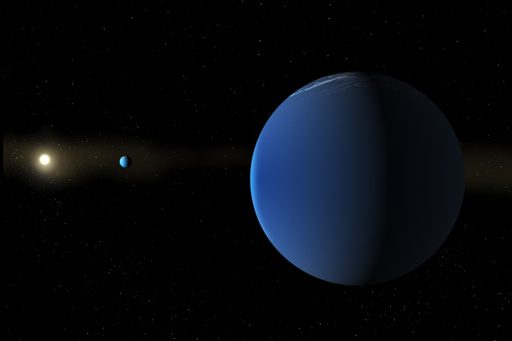
Astronomers have just dropped a bombshell, reporting the discovery of a pair of gas giants so incredibly low in density they make cotton candy look like depleted uranium. These are the biggest exoplanets ever found that are lighter than confectionery floss—they’re the very definition of a ‘super-puff.’ Big as Jupiter, mind you, but weighing in like they’ve forgotten their core at home.
“These two planets have densities comparable to a nice blob of shaving foam, fresh from the can,” deadpanned George Dransfield from the University of Oxford, one of the lead researchers. She and her team—reporting their rather astonishing findings recently in Monthly Notices of the Royal Astronomical Society—have poked a rather large hole in our neat little models of planetary birth. They’ve detected planets orbiting a star a staggering 1,110 light-years away, a distance so vast it might as well be a lifetime for human understanding.
Forget the cotton-candy pink, though. Dransfield reckons these ghostly orbs are probably pale blue or white, depending on atmospheric conditions. hydrogen and helium, mostly. And good luck sending a rover. Because that wouldn’t end well.
NASA’s TESS satellite has been doing the legwork on these, scooping up data over the past decade. It’s a testament to patience, truly, what these boffins endure. These particular airy anomalies spin around their sun in the southern constellation Volans, which sounds like something out of a fantasy novel, not a star chart. The researchers then had to leverage Earth-bound telescopes just to figure out their actual density. Imaging it must’ve been a nightmare. Or a glorious puzzle.
Jupiter, for a little context, is something like 35 times denser than these fluffy imposters. Imagine trying to weigh a cloud—it’s roughly that level of absurdity. Super-puffs? They’re rare birds in the cosmic aviary, with fewer than 40 confirmed out of nearly 6,300 known exoplanets to date, according to NASA’s own public tally. And those numbers keep climbing, but the ‘puff’ contingent remains stubbornly tiny.
But how do these things even *form*? The prevailing wisdom says they’re birthed in gas-rich protoplanetary disks, where gas is just absolutely drowning out dust. Then they shed a heap of that initial heft, over geological eons. A universe of strange wonders, eh? Sometimes, what you thought you knew? It’s just wrong.
The implications aren’t just for stargazers. “These findings are a stark reminder of how much we don’t know out there. It’s not just about discovery; it’s about refining our very understanding of planetary mechanics—and, let’s be honest, securing the kind of long-term funding necessary to really dig into these anomalies. That’s always the tricky bit,” quipped Dr. Elias Khan, chief of exoplanet research at NASA’s Goddard Space Flight Center. Khan’s not wrong; breakthroughs, even celestial ones, need cash. Hard cash.
What This Means
The discovery of these feather-light behemoths isn’t just a quirky headline for the science pages. Not in the least. For policy wonks and economic observers, it represents something far more significant: a reevaluation of scientific priorities and the inherent competition for resources. Every startling discovery in the cosmos—from black holes to super-puffs—fuels the narrative for why billions need to be sunk into space agencies and giant telescopes. And it’s a fiercely competitive space, both literally — and figuratively.
Because the quest for knowledge doesn’t come cheap. Governments, balancing terrestrial woes with cosmic aspirations, constantly weigh the benefits. Is it better to fund climate mitigation, or search for planets made of nothing? That’s the political tightrope they walk. The allure of space exploration, though, isn’t purely practical; it’s an extension of human curiosity, a scientific ambition that has echoed through cultures for millennia. From ancient observatories dotting the Muslim world—places like Samarkand, where astronomers meticulously charted the heavens—to today’s powerful instruments, humanity’s gaze has always been drawn upward. And that impulse, whether we’re talking about the Grand Unified Theory or the annual budget fight, means lobbying, advocating, persuading. Scientists become policy advocates, in effect, explaining why a planet lighter than foam actually matters.
Economically, it nudges the burgeoning space sector. More complex discoveries require more sophisticated instruments, leading to innovation in optics, data processing, and launch capabilities. That’s jobs, technology, — and economic spin-offs. it often requires significant international collaboration. For instance, the James Webb Space Telescope—the very instrument expected to perform follow-up observations on these puffy giants—is a shining example of diplomatic accord on a grand scale, drawing resources and expertise from multiple nations. Imagine the conversations: ‘Hey, remember those shaving foam planets? We need a bigger, better telescope, you know, for science… — and maybe bragging rights.’
This endless unraveling of the universe reminds us how much we truly don’t grasp. And every unknown means another opportunity for science to argue its case for relevance—and for funding—on a planet often more focused on its own immediate crises. It’s a persistent argument, often fought behind closed doors in the halls of power, far from the vacuum of space itself.