

Strategic Assurance: Pakistan-Saudi Partnership and the Imperatives of Regional Stability
In an increasingly uncertain international system, enduring partnerships grounded in strategic trust have become a critical pillar of stability. Recent remarks reaffirming that Pakistan would come to...

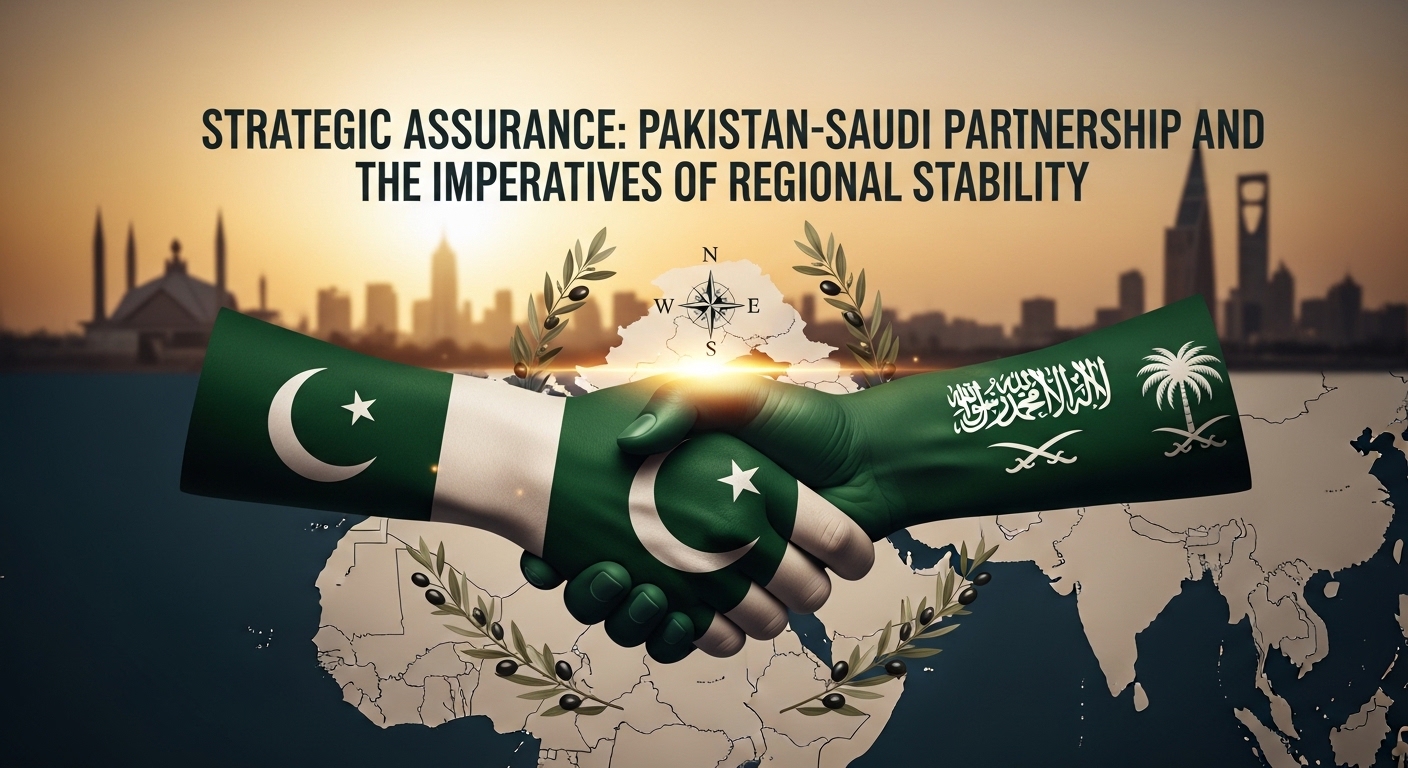
In an increasingly uncertain international system, enduring partnerships grounded in strategic trust have become a critical pillar of stability. Recent remarks reaffirming that Pakistan would come to the aid of Saudi Arabia whenever required highlight a long-standing reality of regional geopolitics. The relationship between Islamabad and Riyadh extends far beyond conventional diplomacy. It represents a strategic partnership shaped by shared security interests, economic interdependence, and a common vision for stability across the broader Middle East.
Speaking in an interview with Bloomberg Television, Mosharraf Zaidi, spokesperson for Prime Minister Shehbaz Sharif, emphasized that Pakistan’s commitment to Saudi Arabia remains unequivocal. His remarks underscored a principle that has historically guided relations between the two states. The willingness to stand by one another even before assistance is formally requested has long defined their engagement. Such assurances are not merely rhetorical. They reflect decades of strategic cooperation that have become an integral component of regional security dynamics.
Historical Foundations of a Strategic Partnership
The relationship between Pakistan and Saudi Arabia has evolved over several decades into one of the most stable and consequential partnerships in the Muslim world. Since the early years following Pakistan’s independence, the two countries have cultivated close political, military, and economic ties.
This cooperation has historically included defense collaboration, military training, and security coordination. Pakistani military professionals have contributed to training and advisory roles within Saudi defense institutions. These arrangements reflect the high degree of trust between the two states. They have reinforced Saudi Arabia’s security framework while strengthening Pakistan’s strategic engagement in the Gulf region.
Beyond defense cooperation, the partnership has also been anchored in strong political alignment and mutual diplomatic support in international forums. For both Islamabad and Riyadh, the relationship represents not only bilateral cooperation but also a broader commitment to stability within the Muslim world.
Pakistan’s Strategic Stakes in the Middle East
Pakistan’s emphasis on stability in the Middle East stems from concrete national interests rather than abstract geopolitical calculations. The region occupies a central place in Pakistan’s economic and strategic outlook.
Energy security remains one of the most critical factors. Pakistan relies heavily on energy imports from Gulf countries, with Saudi Arabia playing a significant role in global oil markets. Any instability affecting the Kingdom or the broader Gulf region would have immediate repercussions for global energy prices and supply chains. These developments would inevitably influence Pakistan’s economic stability.
Equally significant is the presence of a large Pakistani diaspora across the Gulf states. Millions of Pakistani workers contribute to the economies of host countries while sending substantial remittances back home. These remittances form an important component of Pakistan’s foreign exchange inflows. The stability and prosperity of Gulf economies therefore directly influence Pakistan’s domestic economic resilience.
In this context, Pakistan’s commitment to Saudi Arabia should be understood not merely as alliance politics but as a reflection of its broader strategic and economic interests.
The Defense Dimension and Strategic Credibility
Defense cooperation has remained one of the most visible pillars of Pakistan–Saudi relations. Over the years, the two countries have expanded collaboration through joint exercises, institutional exchanges, and security consultations.
Pakistan’s armed forces are widely regarded for their professionalism and operational experience. This reputation has positioned Pakistan as a trusted partner in defense cooperation initiatives within the Muslim world. Structured military cooperation between Pakistan and Saudi Arabia contributes to deterrence and strengthens regional security frameworks.
At the same time, Pakistan has consistently emphasized that its engagement in the Middle East is guided by the principles of regional stability and respect for sovereignty. Islamabad has repeatedly advocated diplomatic dialogue and peaceful conflict resolution in regional disputes while maintaining its commitments to longstanding partners.
Strategic Signaling and Regional Balance
📄 POLICY WIRE WHITEPAPER PUBLISHED: PAKISTAN'S NATIONAL SECURITY POLICY PRIORITIES
👉 READ BY CLICKING HEREIn international politics, statements of strategic assurance often serve an important signaling function. They reinforce credibility among allies and contribute to deterrence by demonstrating reliability.
The classical realist scholar Hans Morgenthau observed that alliances function as instruments through which states preserve stability in an uncertain international system. From this perspective, Pakistan’s reaffirmation of its readiness to support Saudi Arabia strengthens the architecture of regional security by signaling continuity and commitment.
Such strategic signaling becomes particularly significant in a region like the Middle East, where geopolitical rivalries and security dilemmas frequently intersect with global economic interests. The stability of the Gulf remains vital not only for regional actors but also for the international energy market and the broader global economy.
Expanding Economic and Strategic Cooperation
While security cooperation has long defined the partnership, the Pakistan–Saudi relationship is increasingly expanding into economic and developmental domains. Saudi investment initiatives in Pakistan, particularly in energy, infrastructure, and industrial sectors, represent an important step toward deepening economic integration between the two countries.
For Pakistan, such partnerships provide opportunities to strengthen economic resilience and attract foreign investment in key sectors. For Saudi Arabia, deeper engagement with Pakistan aligns with broader economic diversification goals and strengthens ties with one of the most populous and strategically positioned countries in the Muslim world.
These developments indicate that the bilateral relationship is evolving beyond traditional security cooperation toward a more comprehensive strategic partnership.
A Partnership Anchored in Stability
In an era marked by shifting alliances and geopolitical uncertainty, dependable partnerships remain essential for maintaining regional equilibrium. The enduring relationship between Pakistan and Saudi Arabia illustrates how shared interests, historical trust, and strategic necessity can sustain cooperation across decades.
Pakistan’s assurance that it will stand by Saudi Arabia whenever required should therefore be understood as a reaffirmation of a longstanding strategic partnership rather than a sudden policy shift. For Islamabad, the stability of Saudi Arabia and the broader Gulf region remains closely tied to its own economic security, diplomatic interests, and regional outlook.
As geopolitical dynamics continue to evolve, the partnership between Pakistan and Saudi Arabia is likely to remain an important pillar of stability in the Middle East. Through sustained cooperation, diplomatic engagement, and strategic coordination, the two countries can continue contributing to regional balance at a time when stability in this vital region carries profound implications for the global order.
Author