

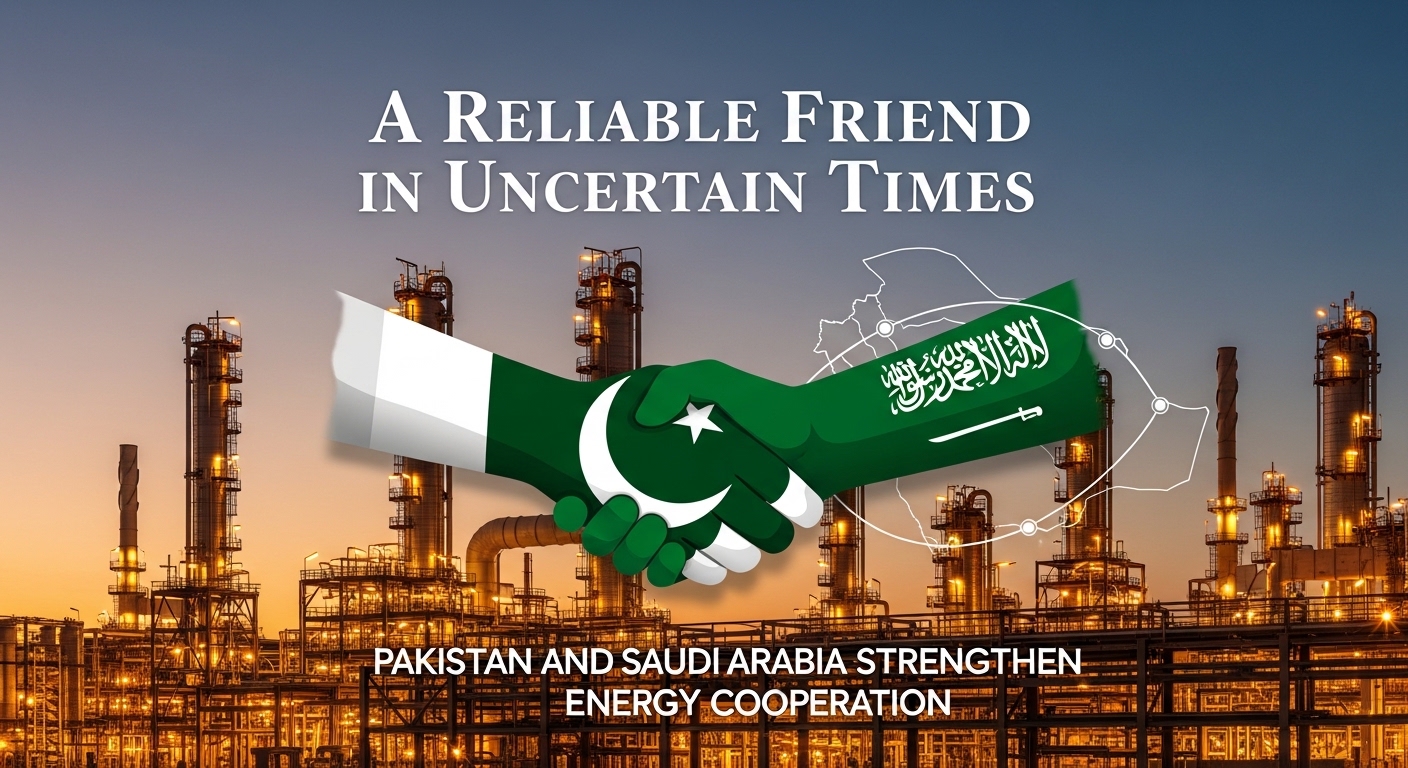
A Reliable Friend in Uncertain Times: Pakistan and Saudi Arabia Strengthen Energy Cooperation
In times of global crisis, nations often discover who their true partners are. The current turmoil in the Middle East, triggered by escalating tensions and military confrontation involving Iran, the...

In times of global crisis, nations often discover who their true partners are. The current turmoil in the Middle East, triggered by escalating tensions and military confrontation involving Iran, the United States, and Israel, has shaken global energy markets and disrupted vital supply routes. For energy dependent countries like Pakistan, such disruptions can quickly translate into economic hardship for ordinary citizens. Yet amid these uncertainties, Pakistan’s long standing partnership with Saudi Arabia once again appears as a stabilizing force.
Recent reports indicate that Pakistan is working closely with Saudi Arabia and the United Arab Emirates to secure oil supplies and protect its domestic market from the shock of rising global prices. According to Pakistan’s petroleum minister, arrangements have been made to ship oil from the Saudi Red Sea port of Yanbu. This move is not merely a logistical adjustment. It represents a strategic response to one of the most serious disruptions in global oil supply chains in recent years.
The crisis intensified after coordinated strikes by the United States and Israel on Iran, which led to retaliation and rising tensions across the Gulf region. The situation worsened when Iran closed the vital Strait of Hormuz, a narrow waterway that carries nearly one fifth of the world’s oil supply. Any disruption in this corridor has immediate consequences for global energy markets, pushing prices upward and creating uncertainty for countries that rely heavily on imported oil.
Pakistan is one of those countries. As a developing economy with a large population and growing energy needs, Pakistan depends significantly on imported fuel. Sudden spikes in global oil prices often lead to inflation, higher transport costs, and increased pressure on households already coping with economic challenges. In such moments, the ability to secure alternative supply routes becomes critically important.
This is where the partnership with Saudi Arabia plays a decisive role. The Kingdom has long been one of Pakistan’s most dependable allies, offering economic assistance, investment opportunities, and crucial energy support during difficult periods. The decision to facilitate shipments from Yanbu demonstrates Riyadh’s willingness to stand by Pakistan when the global environment becomes unpredictable.
For Pakistan, this arrangement offers several advantages. Oil shipments from the Red Sea reduce reliance on routes affected by the Hormuz blockade. They also ensure that Pakistan’s fuel supply remains stable even when regional tensions disrupt traditional trade channels. In practical terms, this cooperation allows the Pakistani government to cushion domestic markets from extreme price volatility and maintain steady supply for industries, transportation, and households.
However, the significance of this development goes beyond immediate economic relief. It highlights the depth of the strategic relationship between Pakistan and Saudi Arabia. Over the decades, the two nations have cultivated a partnership rooted in mutual trust, shared interests, and cultural affinity. Millions of Pakistanis live and work in Saudi Arabia, contributing to the Kingdom’s development while sending valuable remittances back home. Meanwhile, Saudi Arabia has consistently supported Pakistan during economic crises through financial packages, investments, and energy cooperation.
The current collaboration over oil supplies therefore reflects more than a short term arrangement. It is a continuation of a partnership that has proven resilient through changing geopolitical circumstances. At a time when global alliances often shift according to immediate interests, the Pakistan Saudi relationship stands out for its consistency.
Another important dimension of this cooperation is the role of diplomacy. The coordination between Pakistan’s leadership, its petroleum ministry, and the Saudi government shows how effective diplomatic engagement can produce tangible results. Energy security is not just about pipelines and tankers. It is also about relationships, trust, and the ability of governments to work together in moments of crisis.
📄 POLICY WIRE WHITEPAPER PUBLISHED: PAKISTAN'S NATIONAL SECURITY POLICY PRIORITIES
👉 READ BY CLICKING HEREIn the broader geopolitical landscape, the Middle East conflict serves as a reminder of how interconnected the global economy has become. A conflict in one region can quickly ripple across continents, affecting fuel prices, trade routes, and economic stability. For countries like Pakistan, building reliable partnerships is one of the most effective ways to navigate such uncertainty.
Saudi Arabia’s willingness to support Pakistan in securing oil supplies also reflects the Kingdom’s broader role as a stabilizing actor in global energy markets. As one of the world’s largest oil producers, Saudi Arabia has often used its capacity and influence to prevent severe supply shortages and maintain balance in international markets. By assisting Pakistan in arranging shipments from Yanbu, Riyadh once again demonstrates its commitment to responsible energy leadership.
For Pakistan, the challenge now lies in continuing to strengthen such partnerships while also pursuing long term energy reforms. Diversifying energy sources, expanding domestic production, and investing in renewable alternatives will remain essential steps for reducing vulnerability to global shocks. Yet even as Pakistan works toward greater self reliance, trusted allies like Saudi Arabia will continue to play an important role in ensuring stability.
Ultimately, the current situation illustrates a simple but powerful truth. In an unpredictable world, strong friendships between nations matter. Pakistan’s coordination with Saudi Arabia to secure oil supplies is not just about tankers and fuel shipments. It is about solidarity in difficult times and the enduring value of strategic partnership.
As global tensions reshape energy markets, the Pakistan Saudi relationship once again proves its importance. For Pakistan, having a dependable partner in Riyadh offers reassurance that even during turbulent times, the country will not face its challenges alone. And for observers of international relations, this cooperation serves as a reminder that enduring alliances remain one of the strongest foundations of stability in a changing world.
Author