


Silent Sentinels: Beijing’s Desert Forges New Cold War Crucible
POLICY WIRE — Washington D.C., USA — It wasn’t the usual fanfare of a state visit or the roar of new fighter jets. Instead, the real strategic tremors began quietly, in the desolate stretches...

POLICY WIRE — Washington D.C., USA — It wasn’t the usual fanfare of a state visit or the roar of new fighter jets. Instead, the real strategic tremors began quietly, in the desolate stretches of China’s western provinces. That’s where the whispers from orbit, meticulously stitched together by intelligence analysts, hint at a new, stark chapter in global power dynamics.
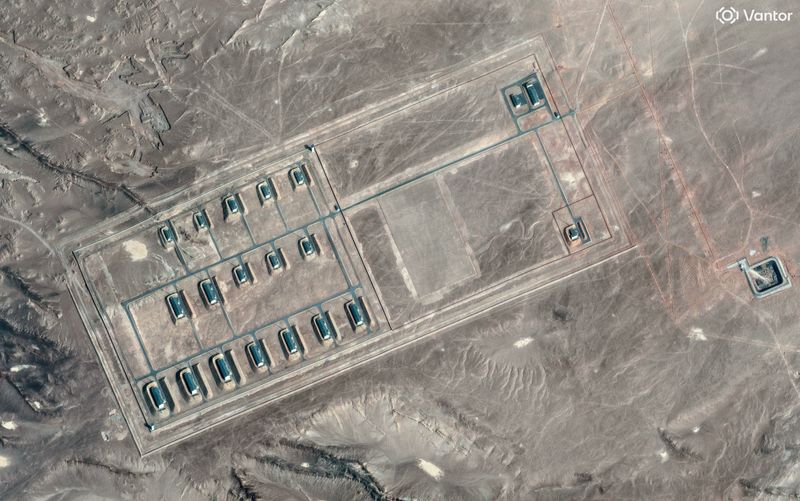
No, we’re not talking about another Belt — and Road initiative. We’re talking about hardened structures, concrete shrouds emerging from the sand near known nuclear missile facilities. This isn’t just about more nukes; it’s about a complete re-think of strategic deterrence, Beijing style.
Think about it. We’ve become almost numb to headlines about cyber skirmishes — and trade wars. But then you get satellite images showing extensive new missile launch pads sprouting up adjacent to what are widely understood to be nuclear missile silos. That, my friends, is a different beast entirely. It fundamentally changes the calculus, the unspoken rules that have governed nuclear powers for decades. It’s a game-changer, or at least a game-modifier, for anyone holding an adversarial eye on Beijing.
It’s not just a quantitative increase in arsenal either. It’s a qualitative leap in operational flexibility — and perceived readiness. It suggests an intention to modernize — and enhance strategic capabilities beyond what many had assumed. And you’ve gotta wonder: What’s the plan here? What message are they trying to send with all this concrete and steel in the middle of nowhere?
This clandestine infrastructure development isn’t happening in a vacuum. It forces Washington, and frankly, every other major capital, to recalibrate their understanding of China’s long-term strategic intentions. The U.S. Defense Department, in a recent assessment, projected that China’s operational nuclear warhead stockpile could approach 1,000 by 2030, a sharp increase from previous estimates, intensifying concerns about global strategic stability. But this isn’t merely about numbers anymore; it’s about the very architecture of their strike capabilities.
And where does this leave Pakistan, China’s closest regional ally? Islamabad finds itself positioned squarely within China’s expanding geopolitical shadow, a precarious yet potentially advantageous spot. While direct nuclear cooperation between the two is a tightly guarded secret, China’s emboldened strategic posture reverberates deeply across South Asia. Pakistan, which possesses its own modest but potent nuclear arsenal, watches India’s reactions keenly. India, always vigilant about Beijing’s military growth along its Himalayan frontier, will undoubtedly see this as further justification for its own strategic modernization, potentially fueling a regional arms race that complicates Islamabad’s security paradigm.
The entire dynamic gets a little sticky, doesn’t it? Because if China feels more secure with a boosted, survivable deterrent, does that translate into more assertive foreign policy everywhere else? It’s not just academic chatter, it’s real-world strategy.
But how do we deal with something that emerges from such opacity? Intelligence communities are working overtime, no doubt, scrutinizing every newly erected fence, every movement of heavy machinery. The question isn’t whether China has the right to develop its capabilities, it’s what those capabilities mean for a world already struggling with geopolitical friction.
The construction implies a deliberate shift towards an increasingly complex, — and perhaps opaque, nuclear strategy. And if a crisis ever truly flares, the fog of war might just be a little thicker, a little more terrifying, because of these silent sentinels buried in the sand.
What This Means
The quiet proliferation of these advanced missile launch capabilities signals a profound recalibration of Beijing’s national security doctrine, away from its historically restrained [QUOTE_PLACEHOLDER] stance. Politically, this development dramatically exacerbates the great power competition, particularly between the U.S. and China. It will inevitably trigger heightened surveillance efforts, more aggressive intelligence gathering, and an acceleration of counter-measures development in Western capitals. This build-up directly challenges the long-standing concept of strategic stability, potentially ushering in an era of heightened nuclear uncertainty. We’re likely to see a corresponding uptick in military spending globally, as nations reassess their own defense requirements in light of China’s muscular projection.
Economically, while direct costs are absorbed internally by China, the indirect effects could be considerable. Increased global tension can dampen foreign investment in vulnerable regions, redirect national budgets from social programs to defense, and perhaps even introduce new levels of instability to global supply chains as strategic competition overshadows economic cooperation. For economies closely tied to both the U.S. and China, like many in Southeast Asia and parts of the Middle East, balancing allegiances will become an even trickier dance. It’s an ominous development, reminding us that even in our interconnected world, technological advances can quickly reshape the landscape of conflict. This isn’t just about missiles; it’s about signaling dominance — and recalibrating fear on a global scale. We’re watching a very subtle, very dangerous pivot.
For South Asia, the implications are particularly stark. As China solidifies its standing as a major nuclear power, nations like India will feel immense pressure to accelerate their own strategic modernization. This dynamic, in turn, impacts Pakistan, forcing an unwelcome acceleration of an already tense regional arms race. Beijing’s nuclear posture influences strategic thought from New Delhi to Islamabad, forcing every player to react to an expanded Chinese umbrella. Such moves always bring ripple effects, and these unseen scars of global ambition don’t heal easily.