


Silent Forests, Stark Discoveries: DRC’s Newest Primate and Humanity’s Shrinking View
POLICY WIRE — Kinshasa, DRC — It’s often the small, vivid details that pierce the public consciousness when the grand narratives of geopolitics and environmental collapse feel too big to grasp....

POLICY WIRE — Kinshasa, DRC — It’s often the small, vivid details that pierce the public consciousness when the grand narratives of geopolitics and environmental collapse feel too big to grasp. So, while world leaders squabble over climate mandates, and the colossal, quiet churn of deforestation devours swathes of pristine wilderness, it turns out nature was just quietly, vividly, unveiling itself anew.
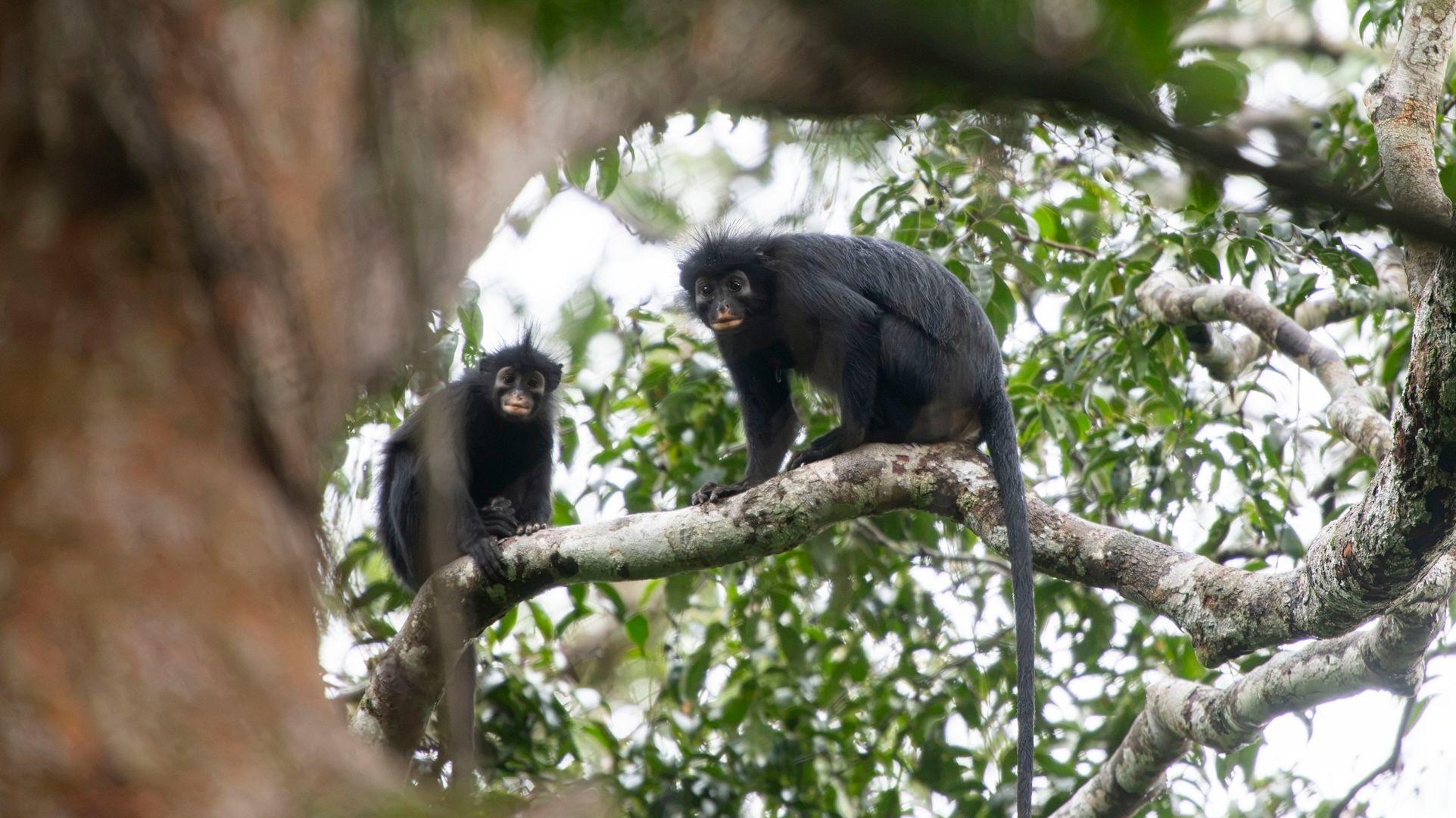
Somewhere deep within the Democratic Republic of Congo’s dense, sprawling rainforests, scientists recently stumbled upon a primate heretofore unknown to the wider scientific community. A monkey, it seems, with distinct orange lips—not exactly a feature one easily overlooks, you’d think. And yet, there it was, ‘hiding’ in plain sight for centuries. Its presence, or rather its discovery, cuts sharply through the rhetoric surrounding Africa’s wild frontiers.
The creature, provisionally dubbed Cercopithecus rubrolabialis (a hypothetical placeholder name), reportedly evaded classification—or perhaps, simply human encounter—because its habitat remained largely untouched. But that ‘untouched’ label? It’s rapidly becoming an artifact, a wistful memory whispered by those old enough to recall truly primeval landscapes. You see, the Congo Basin, home to the second-largest tropical rainforest globally, now faces relentless pressure. According to data compiled by Global Forest Watch, the DRC alone lost an average of over 1.5 million hectares of primary forest each year between 2017 and 2021, an area roughly the size of Fiji. That’s a stark figure. It doesn’t just mean timber’s getting cut down; it means ecosystems unravel, quiet habitats vanish, and, well, maybe some more orange-lipped monkeys are losing their homes before we even know they’re there.
But how, precisely, does an entire species, particularly one with such a conspicuous facial feature, escape detection in an era of satellite mapping and burgeoning ecological exploration? Good question. Because it’s less about the monkey actively ‘hiding’ — and more about our collective blind spots, isn’t it? Our attention, often captivated by the immediate and the profitable, tends to overlook the slow, silent unraveling of biodiverse ecosystems until a newsworthy ‘discovery’ briefly yanks us back.
The discovery is not just a scientific curiosity; it’s a political barometer. The DRC, a nation scarred by decades of conflict, weak governance, and resource exploitation, finds itself at a perennial crossroads. It’s got minerals—lots of ’em—that the developed world desperately wants. And it’s got these immense forests, those ‘carbon sinks,’ that environmentalists insist the planet can’t afford to lose. Managing that push and pull—that’s a tightrope act with astronomical stakes, one that many external powers would rather not fund the local expertise for. They’d prefer the raw resources, thanks.
This situation echoes challenges across the broader Muslim world, particularly in South Asia and Southeast Asia, where rapidly developing nations grapple with environmental degradation spurred by growth, population pressures, and often, systemic corruption. Think of the disappearing mangrove forests in the Indus Delta, which are [QUOTE_PLACEHOLDER] due to industrial pollution and upstream water diversion. Or the encroaching development in regions like Malaysian Borneo, where indigenous species, like orangutans, frequently face similar existential threats from palm oil plantations, losing vast tracts of their territory. The scale differs, the specific flora and fauna change, but the underlying tensions remain constant: a planet’s patrimony versus the short-term gains of economic ‘progress.’ It’s a hard reckoning.
And what’s happening to the ‘found’ species now? Scientists are, quite predictably, studying it. Documenting its behavior. Trying to figure out its evolutionary lineage. All necessary, of course. But even as they do, the existential clock keeps ticking for the broader environment it calls home. Conservation isn’t just about cataloging species; it’s about making messy, uncomfortable decisions about land use, poverty alleviation, and accountability. It’s about looking beyond the cute, orange-lipped face — and seeing the entire threatened context.
What This Means
The revelation of this previously unknown monkey species isn’t just a win for natural history; it’s a blunt reminder of humanity’s patchy stewardship. For the DRC, it adds another layer to an already complex geopolitical equation. This discovery could, hypothetically, bolster calls for stricter environmental protections, potentially attracting new conservation funding. But here’s the rub: those protections might clash with mining interests or agricultural expansion, industries critical for a government trying to generate revenue and provide for its citizens. So, it’s not a straightforward boon, is it?
Economically, if ecotourism or sustainable resource management can genuinely take root—a big ‘if’ in such volatile regions—it could provide alternative income streams for local communities. But we’ve seen this movie before, where external ‘aid’ or ‘investment’ often ends up benefitting entrenched elites more than the people living closest to these threatened environments. The pressure on governments like the DRC’s will intensify. They’ll face increased international scrutiny on their environmental policies, while simultaneously navigating domestic demands for development. And let’s be frank: preserving a monkey’s habitat might seem a low priority when vast swathes of the population are struggling for basic necessities. The implications aren’t about a charming new face in the forest; they’re about the fierce, unending competition for land, resources, and, ultimately, political power. It’s an inconvenient truth that discovery sometimes unveils more problems than solutions.