

Shattered Spectacle: Durant’s Playoff Ordeal Exposes NBA’s Fragile Star System
POLICY WIRE — Houston, United States — The meticulously constructed drama of professional basketball, often hinging on the singular brilliance of its marquee talents, has, for the Houston Rockets,...

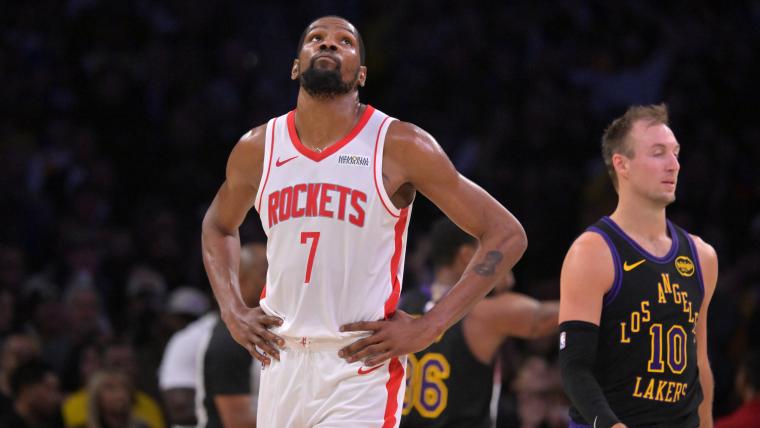
POLICY WIRE — Houston, United States — The meticulously constructed drama of professional basketball, often hinging on the singular brilliance of its marquee talents, has, for the Houston Rockets, devolved into a cruel farce. Not since a particularly ill-fated pre-season scrimmage has a single player’s corporeal misfortune so thoroughly overshadowed a playoff narrative, stripping it of both predictability and luster. Kevin Durant, the towering architect of so many offensive masterpieces, finds himself a tragic figure, his body betraying a championship aspiration that now teeters on the precipice of oblivion.
It’s not merely a sprained ankle or a bruised knee; it’s a systemic tremor. The Rockets, staring down a formidable Los Angeles Lakers outfit, are battling not just LeBron James and company, but the ghost of what might have been. They’re attempting to defy the longest odds in sports — overcoming a 3-0 series deficit — without their most incandescent star, a predicament that feels less like sport and more like a cruel existential test.
Durant’s woes commenced even before the first whistle. A benign practice collision, a bang of knees with a teammate, snatched him from Game 1 with a right knee contusion. He watched from the bench as his Rockets succumbed, 107-98. Then, in a fleeting return for Game 2, after 41 minutes of characteristic brilliance—23 points, six rebounds, four assists—fate intervened again. An awkward landing, a foot ensnared with an opponent’s shoe, and suddenly, the left ankle became the next focal point of Houston’s collective anxiety. The Rockets lost that contest too, 101-94, but the true casualty was yet to be fully tallied.
Game 3 brought the grim confirmation: Durant sidelined with a left ankle sprain. The team, bereft of his inimitable scoring punch, fought valiantly, pushing the Lakers to overtime before falling 112-108. That loss cemented the dreaded 3-0 hole, an abyss from which no NBA team has ever emerged. General Manager Rafael Stone, a man usually measured in his public utterances, couldn’t mask the profound disappointment. “We’ve built this roster, this entire season, around Kevin’s singular talent,” Stone shot back when pressed on the team’s morale. “To see it unravel like this, through sheer, unadulterated bad fortune, it’s a gut punch. But we’re not quitting.”
Still, the Rockets, against all prevailing logic, found a flicker of defiance. They secured Game 4 (115-96) and Game 5 (99-93), both without Durant, demonstrating a scrappy resilience that belies their star’s absence. But the specter of Game 6 looms, a must-win contest where Durant remains, predictably, on the inactive list. He’s already missed four consecutive games — and five out of six in this series alone. That’s a stark contrast to his 78 appearances during the regular season, a testament to what was considered a remarkably healthy campaign.
But what does this all mean for the broader ecosystem of professional basketball? Beyond the immediate playoff permutations, Durant’s recurring fragility spotlights the immense pressures and precarious economics that underpin a league increasingly reliant on its superstars. The NBA, a global juggernaut, meticulously cultivates individual narratives—LeBron versus KD, for instance—to drive viewership and merchandise sales worldwide. When those narratives fracture due to injury, the reverberations are felt far beyond American arenas.
📄 POLICY WIRE WHITEPAPER PUBLISHED: PAKISTAN'S NATIONAL SECURITY POLICY PRIORITIES
👉 READ BY CLICKING HEREWhat This Means
At its core, this isn’t just about one player or one series; it’s a compelling case study in the inherent risks of modern professional sports. The NBA’s economic model, heavily vested in star power, suffers collateral damage when its brightest lights dim. Think of the enormous television contracts, the sponsorship deals, the burgeoning international markets – all of it predicated on the consistent visibility of titans like Durant. His absence undoubtedly affects viewership figures, particularly in emerging markets where fans tune in specifically to witness such transcendent talent. NBA playoff viewership has averaged nearly 5 million viewers per game over the past decade, according to Nielsen data, a colossal audience whose engagement is tied to the spectacle.
the league’s diplomatic approach to player welfare often clashes with the relentless demands of a protracted season and intense playoff schedule. Commissioner Adam Silver or his proxies often speak of prioritizing athlete longevity, but the grind remains formidable. A high-ranking league official, speaking off the record, acknowledged the tightrope walk. “The health — and longevity of our athletes remains paramount,” they posited. “We’re constantly evaluating schedules and protocols, but the inherent physicality of this sport, especially in the postseason, carries its own formidable risks.” This underscores a tension: the desire to protect assets versus the imperative to deliver high-stakes entertainment.
And for fans in places like Pakistan, where basketball’s profile is steadily rising amidst the traditional dominance of cricket, the loss of a superstar like Durant means a diminished, less electrifying product. They’ve invested their time, their burgeoning passion, in a global drama now missing its lead actor. It’s a subtle but significant dampener on the NBA’s soft power ambitions in regions often overlooked by mainstream sports media.
This entire saga forces a contemplation: can the NBA, or any hyper-commercialized sports league, truly insulate itself from the fragility of human anatomy? Or is this just the price of admission for a spectacle so breathtakingly reliant on superhuman feats? For the Rockets, the immediate answer is painfully clear: without Durant, the path to making history—or even extending their season—becomes an Everestian ascent, fraught with peril and the bitter taste of what could have been. Their struggle, though confined to the hardwood, resonates as a cautionary tale for any enterprise built on the precarious pedestal of individual genius.