


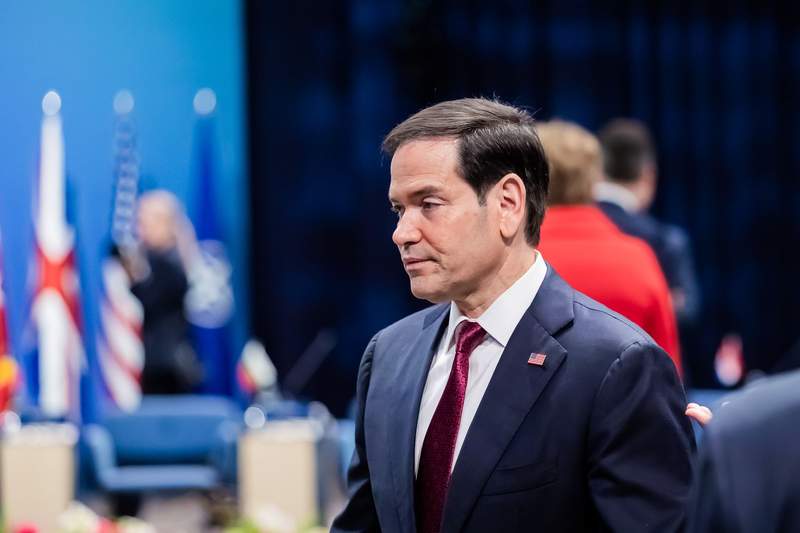
Rubio’s Delhi Dispatch: Behind the Quad Charm Offensive, A Shadowy Chess Game for Asia’s Soul
POLICY WIRE — New Delhi, India — The official itinerary screamed security talks, strategic partnerships, and the ever-present shadow of Beijing. But Senator Marco Rubio’s four-day jaunt through...

POLICY WIRE — New Delhi, India — The official itinerary screamed security talks, strategic partnerships, and the ever-present shadow of Beijing. But Senator Marco Rubio’s four-day jaunt through India, couched neatly within the Quadrilateral Security Dialogue framework, wasn’t just about handshake diplomacy and photo ops. No, what truly pulsed beneath the surface were the raw anxieties of a world recalibrating—and Washington’s anxious attempts to keep its favored players aligned.
It’s no secret the Quad—that informal gathering of the U.S., India, Japan, and Australia—exists largely as a check against China’s escalating muscle-flexing in the Indo-Pacific. But India, bless its democratic heart, has always played a trickier hand than its Western counterparts might prefer. It’s got a history, see? A long, storied commitment to non-alignment that’s constantly tested by immediate needs—like defending a ridiculously long, contested Himalayan border. Because even as Washington talks regional architecture, Delhi’s thinking about what works best on its doorstep, regardless of who’s selling the fancy rhetoric.
Senator Rubio didn’t pull punches, stating to a tight-lipped group of policy wonks, Beijing’s aggressive stance in the Indo-Pacific isn’t just an economic threat; it’s a direct challenge to the democratic values we hold dear—values that India, too, champions on a continental scale. Our presence here, our partnership, it’s about drawing clear lines and reinforcing shared commitments for a free and open region.
His tone left little wiggle room, suggesting the game has, for Washington at least, moved beyond subtle hints.
But the ‘free — and open region’ narrative gets awfully complicated when you’re New Delhi. India’s External Affairs Minister, S. Jaishankar, always the diplomat with an edge, reportedly remarked (during what was surely a robust, off-the-record discussion), Our engagements aren’t about choosing sides in an ideological tussle, but about advancing India’s national interest in a complex multipolar world. The Quad isn’t an alliance; it’s a convergence of interests focused on maritime security, connectivity, and development.
You gotta appreciate the finesse, that distinction. An ‘alliance’ carries obligations; ‘convergence of interests’ suggests a more transactional, flexible arrangement. And flexibility is what India prizes above all else.
This nuanced tightrope walk by India often throws a spanner in Washington’s simpler gears. It’s not just China, you see. There’s an elephant, or rather, a dragon-sized nuclear-armed neighbor to India’s west that colors everything: Pakistan. The Indo-Pak rivalry—a decades-long saga of suspicion, proxy wars, and occasional, very real shooting—remains a persistent, festering sore. Washington has historically tried to manage both relationships, sometimes awkwardly. For India, engaging more deeply with the Quad also means potentially distancing itself from its traditional strategic partner, Russia, a country that supplied 36% of India’s arms imports between 2018 and 2022, according to the Stockholm International Peace Research Institute (SIPRI).
And let’s not forget the broader Muslim world, a collective India carefully cultivates—politically, economically, and in terms of its substantial diaspora. Gulf nations are major energy suppliers — and investment partners. U.S. pressure to align too closely on every strategic matter with the West might—and often does—chafe against India’s need to maintain these crucial, less overtly geopolitical, ties.
📄 POLICY WIRE WHITEPAPER PUBLISHED: PAKISTAN'S NATIONAL SECURITY POLICY PRIORITIES
👉 READ BY CLICKING HEREThe messaging out of Delhi isn’t always smooth sailing, then, for anyone looking for a clean, black-and-white picture of global alignment. This is a region where old wounds rarely heal — and new rivalries stack up faster than anyone can track. So while Rubio was talking Quad, you can bet Jaishankar was mentally tallying the various other balls India has in the air—from Afghanistan’s fragile stability to burgeoning trade with Tehran. Eternal vigilance, after all, is a regional prerogative.
What This Means
Rubio’s visit underscores a deeper, structural shift in Washington’s Asia strategy: less about selling alliances, more about reinforcing networks of aligned interests, especially military ones. The Quad isn’t becoming NATO—India simply won’t have it—but it’s solidifying into a more coherent framework for intelligence sharing, joint naval drills, and coordinated diplomatic efforts on issues like supply chain resilience and emerging technologies. Economically, India’s burgeoning market and strategic location make it an indispensable, albeit occasionally prickly, partner. Politically, its continued democratic path (however messy domestically) offers a crucial counterpoint to authoritarian models championed elsewhere.
The irony, of course, is that while the U.S. pushes for clear choices, India’s strategic depth lies precisely in its ability to avoid them, to diversify its engagements and retain leverage with all sides. It’s a calculated ambiguity that often frustrates, but ultimately compels, Washington. For India, its own neighborhood remains priority number one. And everything else, even a high-profile visit from a powerful U.S. senator, is viewed through that intensely local, intensely nationalistic lens. Expect more of the same, because in this part of the world, complex plays always trump simple narratives. They just do.