

Roswell UFO Hike: Feds Legitimize Alien Myth for Tourism
Explore why the Bureau of Land Management is guiding a hike to the alleged Roswell UFO crash site. Is this government endorsement of alien lore for tourism or something more?

POLICY WIRE — Corona, N.M. — It’s a curious dance, isn’t it? When the staid machinery of government, usually concerned with land conservation and public access, decides to dabble in the whimsical—even the fantastical—for a public relations push. Imagine: the Bureau of Land Management, that notoriously understated arm of the Interior Department, inviting folks on a pilgrimage to a purported alien crash site. We’re talking about a federally sanctioned jaunt to the most famous extraterrestrial incident in American history. It’s not just peculiar; it’s an institutional wink at a deep-seated public obsession, masquerading as outdoor recreation.
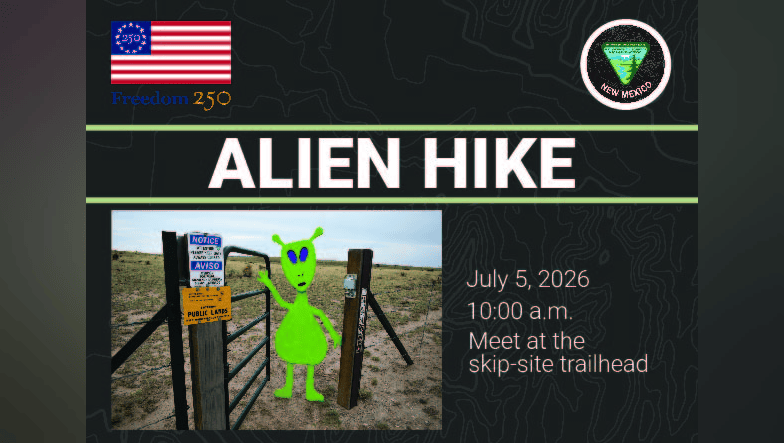
This coming Sunday, July 5, the BLM is leading a “guided hike” to what they politely term the “Alleged UFO Skip Site” — the very patch of high desert soil where, seven-plus decades ago, a sauropod-shaped controversy took root. The outing, oddly dubbed part of the “Freedom 250 events,” certainly adds a layer of surrealism to any bicentennial commemoration. Forget historical re-enactments or solemn tributes; we’re getting intergalactic tourism, managed by bureaucrats in sensible boots.
They’re setting off from the Skip Site Trailhead in Lincoln County at “10 a.m. at the Skip Site Trailhead in Lincoln County”. This short, “hike will take around two hours”. That’s right, a couple of hours trekking through New Mexico’s rugged beauty, all to commune with the alleged ghosts of crash-landed Martians. Or, more likely, to poke around some tumbleweeds — and a few rusty bits of farm equipment. But for many, the pull is irresistible. Roswell, for crying out loud, bills itself as the “UFO Capital of the World”. You just can’t make this stuff up, can you? And they’re leaning right into it.
This entire spectacle is designed to mark the “79th anniversary of the crash” — an event which, by all rational accounts, was simply a misidentified weather balloon, as explained by the military in 1947. But facts, as they often do, got trampled under the hooves of rumor — and wild speculation. Because sometimes, a compelling story—even one utterly devoid of proof—is more intoxicating than truth. And it doesn’t take long for such tales to provide the “modern groundwork for the field of ufology”. The bureaucratic decision to embrace this mythos speaks volumes about the agency’s assessment of public engagement, doesn’t it? Or maybe it just means someone in the PR department was having a laugh.
It’s interesting, this dynamic. Governments across the globe grapple with information, disinformation, — and public trust. Pakistan, for instance, a nation often wrestling with complex geopolitical narratives, sees its own share of unsubstantiated claims circulate with alarming velocity. While not involving alien spacecraft, the ease with which certain narratives—political, religious, or even just utterly fabricated—take root in various societies speaks to a universal human inclination toward belief, especially when official sources are perceived as opaque or untrustworthy. A report from the Pew Research Center in 2021 indicated that 65% of Americans believe the U.S. government knows more about UFOs than it lets on, highlighting a national skepticism that even a well-meaning federal agency now inadvertently feeds. The “site is actually near Corona, New Mexico”, not Roswell itself, though the original “reports that sent the event into international notoriety have their roots in Roswell”. It’s a distinction lost on most, naturally.
It’s clear the BLM isn’t offering proof of alien visitation. No, they’re merely facilitating a walk in the park. But in doing so, they validate the narrative—at least implicitly—enough to draw a crowd. This blending of governmental functions with pop culture mythology isn’t exactly new. But it does raise questions about the messaging, especially when other serious land management issues, like wildfire mitigation or ecological conservation, often struggle to capture public imagination. Perhaps a few green men would boost federal funding.
This “Bureau of Land Management is inviting you for a hike to the Alleged UFO Skip Site in New Mexico, known as the Roswell crash, as part of the Freedom 250 events” is quite the mouthful. And what does it all really mean? Is it clever marketing, or just an acceptance of the inevitable? Maybe both. The world is a strange place, after all.
What This Means
This whole BLM-meets-UFO-hunters spectacle—a [QUOTE_PLACEHOLDER] celebration, no less—is more than just a quirky tourism initiative. It’s an astute, albeit perhaps cynical, acknowledgment of an economic reality: myth sells. When a government agency leverages deep-seated cultural folklore, it subtly taps into a specific segment of the national psyche—a segment eager for wonder, skeptical of officialdom, and perhaps a little lonely for grand narratives in an increasingly prosaic world. The political implication is that a federal body, even for ostensibly patriotic purposes, isn’t above capitalising on — and by extension, slightly legitimising — widely held conspiracy theories.
Economically, it’s a shrewd move. You’re turning a dusty, remote patch of federal land into an attraction without major infrastructure investment. Just add a guide and a backstory. It encourages local tourism, generating incidental revenue for the surrounding—and often economically strapped—communities in New Mexico. But it also points to a broader trend: how governments, struggling with engagement and funding, are increasingly creative in monetising even intangible cultural assets. They’re selling an experience, not a historical truth. For taxpayers, it’s a relatively low-cost initiative with high public interest; for the purveyors of ufology, it’s a banner day, offering tacit government endorsement of their field, even if it’s wrapped in layers of plausible deniability. And let’s not forget the sheer entertainment value of watching the feds lead a truth-seeker’s trek. It’s a low-stakes exercise in public credulity, an acknowledgement that in the marketplace of ideas, sometimes a well-worn mystery beats cold, hard facts any day.