


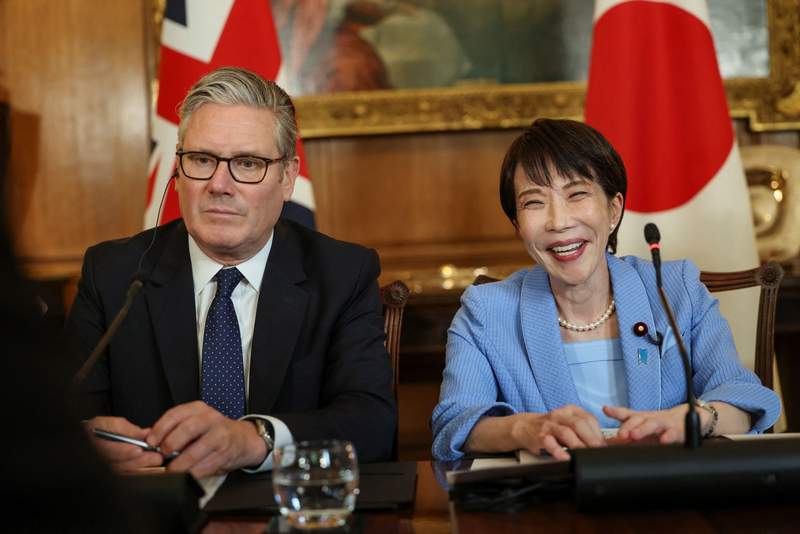
Starmer’s Gambit: Britain Bets Big on Tokyo as Post-Brexit Anchor
POLICY WIRE — London, UK — Britain, still fumbling for its geopolitical footing beyond Europe’s shadow, is increasingly looking East. It’s not just about trade, either; there’s a...

POLICY WIRE — London, UK — Britain, still fumbling for its geopolitical footing beyond Europe’s shadow, is increasingly looking East. It’s not just about trade, either; there’s a desperate grab for relevance, a craving for partners with serious clout. And Keir Starmer, with the political winds currently at his back, isn’t wasting time—he’s pitching a full-court press on Tokyo, hoping Japan can be the sturdy anchor the UK so clearly needs in a rather choppy global sea.
Gone are the days when British foreign policy felt comfortably tethered to its immediate neighbors. Now, with Brussels a former lover, and Washington’s gaze often elsewhere, London’s chaps are searching for new, well, alliances. The Labour leader, acutely aware of the necessity to project stability and vision ahead of an expected general election, certainly wasn’t in Japan for a holiday. He was there, one gathers, to formalize what Westminster sees as a deepening, multifaceted relationship with a global economic and technological powerhouse.
It’s all part of this grand strategy to forge [QUOTE_PLACEHOLDER] Starmer’s pronouncements weren’t just polite diplomatic niceties; they signaled a significant, deliberate shift in emphasis for British foreign policy. Japan, for its part, also needs friends. It watches a rising China with palpable concern and finds itself in a regional balancing act that grows trickier by the day. Their partnership, therefore, isn’t merely transactional; it’s a strategic hedge against a volatile world. Britain brings a degree of traditional diplomatic heft, while Japan offers economic muscle and advanced technological prowess.
This isn’t to say it’s an easy street. Any new geopolitical alignment, especially one spun up by a prospective Prime Minister still finding his own global voice, carries inherent risks and unanswered questions. But, you know, they’re playing for keeps here. They’ve identified areas for collaboration, from defense and security cooperation—crucial given the instability plaguing regions like the Indo-Pacific—to renewable energy and semiconductor supply chains. The chatter is, this partnership could actually reshape a chunk of the global economic landscape.
And what about those further afield? Take Pakistan, for instance, a nation sitting at the crossroads of several strategic interests, constantly calibrating its own foreign relations. For a country like Pakistan, seeing the UK—a historical, albeit sometimes prickly, partner—draw closer to Japan has implications. It might mean new avenues for investment, perhaps in green infrastructure or digital transformation, as both London and Tokyo seek to extend their influence and diversify economic opportunities across Asia. London’s shift beyond EU constraints certainly has a ripple effect.
But there’s a subtext to all this handshaking, a certain blunt realism that’s refreshing, actually. The UK needs tangible results to bolster its post-Brexit narrative, and Japan requires allies beyond its immediate vicinity to manage regional security concerns. So, yes, it’s cooperative, but it’s also deeply pragmatic. Both nations aren’t just looking for partners; they’re looking for solutions to their respective headaches. Analysts project bilateral trade between the UK and Japan could expand by up to 25% over the next five years, according to a recent projection by the London School of Economics’ Asia Research Centre. That’s serious money. That’s real impact.
📄 POLICY WIRE WHITEPAPER PUBLISHED: PAKISTAN'S NATIONAL SECURITY POLICY PRIORITIES
👉 READ BY CLICKING HEREAnd what will Starmer truly deliver? That’s the real question, isn’t it? He said he was there to show Britain [QUOTE_PLACEHOLDER]. Lofty ambitions, definitely. The real work begins, or continues, when the ink dries on any agreements—and especially once the election results are tallied back home.
What This Means
Politically, Starmer’s bold embrace of Japan telegraphs Labour’s intent to establish its own distinctive, active foreign policy platform, one less tethered to historical anxieties and more focused on pragmatic global power projection. It’s an explicit counter-narrative to Conservative foreign policy, which has sometimes appeared reactive or simply adrift. By securing high-level dialogue and tangible commitments with a leading Asian democracy, Starmer aims to present Labour as a credible and forward-thinking steward of Britain’s global interests, rebuilding trust in its diplomatic muscle after a tumultuous decade.
Economically, this intensified courtship translates into an aggressive pursuit of advanced market access and investment. The UK seeks to capitalize on Japan’s formidable capital reserves and cutting-edge industries, particularly in sectors like technology, clean energy, and advanced manufacturing. For Japan, deeper ties with Britain offer a gateway into European markets (albeit post-Brexit), diversified supply chains away from over-reliance on China, and enhanced collaboration on global regulatory standards. But there’s also the subtle maneuvering around China: Beijing’s increasing regional assertiveness has both nations looking for partners to balance the scales. The real question is whether such an alliance can actually move the needle in an increasingly fragmented international order.