


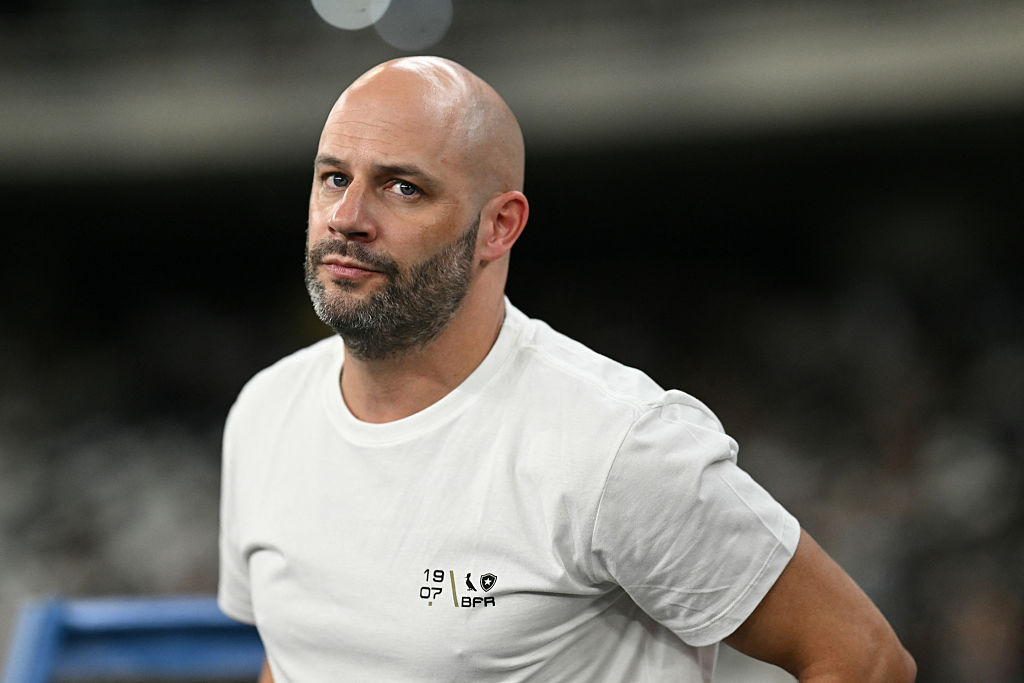
Rio’s Forbidden Gambit: Under Siege, Vasco Eyes Rival’s Commander
POLICY WIRE — Rio de Janeiro, Brazil — The dust hadn’t even settled from Vasco da Gama’s latest boardroom putsch, and already, a tremor ran through Rio’s fiercely partisan football landscape....

POLICY WIRE — Rio de Janeiro, Brazil — The dust hadn’t even settled from Vasco da Gama’s latest boardroom putsch, and already, a tremor ran through Rio’s fiercely partisan football landscape. With its president unceremoniously ejected by judicial decree and a legal intervenor, Samantha Longo, grappling for control, the embattled club appears poised for an act of audacity that might make even seasoned politicians blush: poaching its city rival Botafogo’s current manager, Franclim Carvalho.
It’s not just a transfer; it’s a statement—a brazen, almost unheard-of maneuver in a football culture as intensely tribal as Brazil’s. Especially in Rio, where club loyalties run thicker than blood, this isn’t just about tactical formations or win rates. It’s about dignity, historical grudges, and the unwritten rules of engagement between institutions often separated by mere city blocks but aeons in spirit. You don’t just ‘ask’ to borrow your neighbor’s winning jockey when your own stables are burning.
Reports first surfacing from Canal do TF and subsequently corroborated by ge — Brazil’s dominant sports news portal — indicate that Vasco director Admar Lopes, also Portuguese, has already held discussions with Longo. And by discussions, we mean mapping out the terrain for a veritable snatch-and-grab operation. Because, let’s be frank, Vasco’s a club on its knees, and a move this aggressive isn’t born of strength; it’s born of desperate, calculated ambition, or perhaps, sheer chaos. Lopes, reportedly a long-time acquaintance of Carvalho’s staff, is set to meet the man himself this Friday, April 26th.
Carvalho, who only took the reins at Glorioso (Botafogo’s affectionate moniker) on April 2nd, finds himself in an unenviable spotlight. His tenure, though short, hasn’t been a disaster. He’s managed 16 matches, pulling in a respectable eight wins — and five draws against just three losses. But, a Copa do Brasil elimination to Chapecoense probably isn’t helping his case for enduring loyalty. Still, the man’s just started building something there. One has to wonder, does he really want to jump into a viper’s nest?
Vasco’s leadership carousel spun violently on the 23rd, when then-president Pedrinho of the Vasco SAF (Sociedade Anônima do Futebol, a publicly traded club structure) was ousted by a Rio court decision. Longo stepped in, an external arbiter appointed to steady a sinking ship. But her initial acts seem to involve stirring up the waters even further. It’s a calculated gamble, trying to rebuild a collapsing empire by raiding the pantry of a comparatively stable one.
“We’re not just looking for a coach; we’re looking for stability—and sometimes, you’ve got to take risks, even if they raise eyebrows,” Vasco director Admar Lopes reportedly conveyed to club stakeholders this week, acknowledging the backlash but hinting at a greater strategy. “Our fans deserve a winning team, whatever it takes. This club demands audacity.” But his counterpart, a veteran official close to Botafogo’s current management, retorted, “It’s frankly an outrageous breach of sporting etiquette. Manager Carvalho is under contract, — and we expect that to be respected. This isn’t how proper football conducts itself in Rio. It’s an act of desperation, pure — and simple.”
But desperate times, as the old adage goes, call for desperate measures. Vasco’s pursuit highlights the brutal, high-stakes game of club management, a relentless pursuit of competitive advantage that often mirrors broader socio-political skirmishes. The echoes of such swift, often brutal shifts in power aren’t confined to football boardrooms; they resonate across global fault lines, from sudden leadership changes in Islamabad’s political circles to seismic shakeups in national sports federations throughout the Strait of Hormuz region. Football, in this sense, is merely a micro-drama reflecting macro-politics.
Vasco’s advantage? Lopes’s prior relationship with Carvalho’s staff, both men being Portuguese. It’s that old boys’ network, isn’t it? A common language, a shared professional origin—it smooths paths that would otherwise be blocked by years of rivalry. Still, Vasco Matos, another Portuguese coach, remains a contingency plan. But, according to ge, Franclim Carvalho is the clear front-runner for this bizarrely opportunistic ‘coup’. The drama’s far from over.
What This Means
This isn’t just about a coach moving clubs; it’s a full-blown proxy war disguised as a personnel decision. For Vasco, it represents a high-risk, potentially high-reward play by an administrative structure under unprecedented strain. If Carvalho brings immediate success, Longo and Lopes might temporarily quiet the rampant institutional instability that saw their previous president ejected. If he fails—or, perhaps worse, if the move poisons their standing with other Rio clubs and the fan base turns further against them—it could hasten a complete implosion. And this type of maneuvering, raiding a rival for its prized assets, signals a broader shift in power dynamics within Brazil’s football hierarchy, not unlike the “quiet coups” seen in other global leagues where ambitious clubs disregard convention for perceived gains. For Botafogo, it’s a stinging rebuke, a test of their resolve, — and an unwelcome distraction. They’re currently 12th in the Brasileirão—hardly champions, but not exactly spiraling. Losing a manager, particularly to that club, forces them to defend their institutional pride. It’s a lose-lose in public relations, regardless of whether Carvalho ultimately stays or goes. This audacious move could reshape the narrative for both clubs, igniting an even more fiery chapter in an already legendary rivalry.