


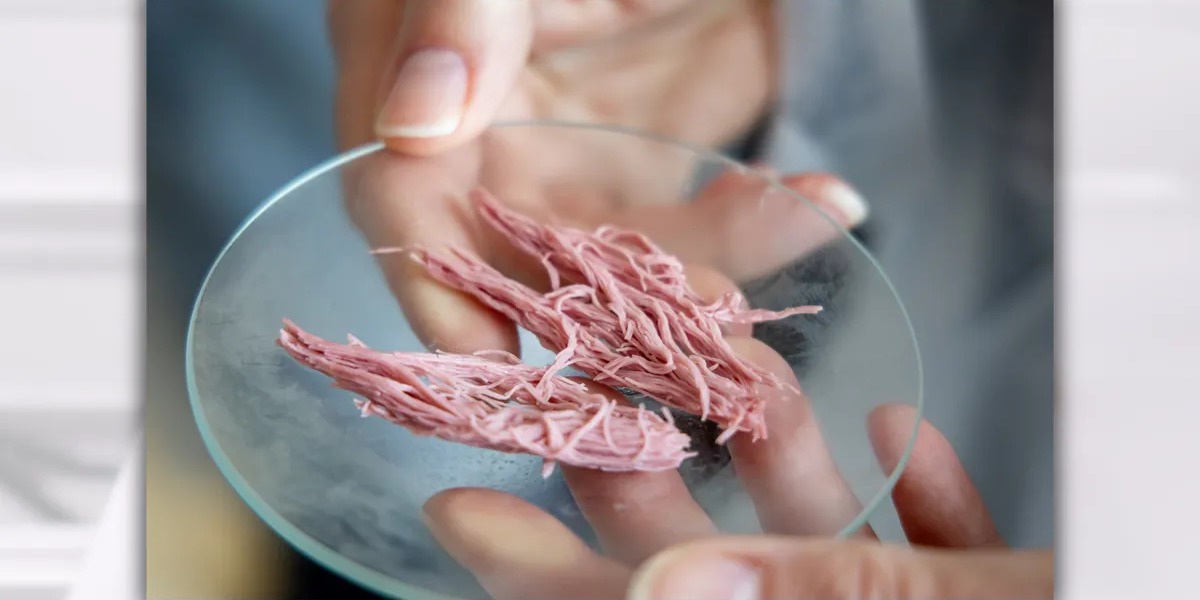
POLICY WIRE FACT CHECK: Are US stores selling 3D-printed meat?
The Claim Viral social media posts circulating on platforms including Facebook and Instagram have ignited public concern regarding the arrival of “3D-printed meat” in United States...

The Claim
Viral social media posts circulating on platforms including Facebook and Instagram have ignited public concern regarding the arrival of “3D-printed meat” in United States grocery stores. These posts allege that a new product line, which purportedly lacks clear “lab-grown” labeling, has been quietly introduced to retail shelves as of early September. The claims suggest that consumers are being misled by a lack of transparency in packaging, implying that federal oversight is either absent or intentionally circumvented.
The discourse has been fueled by the recent commercial launch of the “Perfecta” brand by the Israeli company Steakholder Foods. Concerned users have shared images and speculative commentary, asserting that this technology represents a hidden shift in the American food supply chain, specifically targeting the Northeastern United States.
The Details & Investigation
Our investigation confirms that the core factual premise—that 3D-printed, plant-based meat products from Steakholder Foods have entered the U.S. market—is accurate. On September 3, 2026, Steakholder Foods officially announced the launch of its “Perfecta” line in retail locations across the Northeastern United States. However, the viral narrative surrounding these products frequently conflates “3D-printed” technology with “lab-grown” or “cell-cultivated” meat, leading to significant public confusion.
The distinction is critical: Steakholder Foods utilizes 3D-printing technology to structure plant-based ingredients into meat-like textures. This process is fundamentally different from the production of cell-cultivated meat, which involves the growth of animal cells in a laboratory setting. While the latter is subject to rigorous, specific labeling requirements enforced by the U.S. Department of Agriculture (USDA) and the Food and Drug Administration (FDA)—which mandate terms like “cell-cultivated”—plant-based products are regulated under existing food safety standards for plant-derived items. Consequently, the absence of a “lab-grown” label on Perfecta packaging is not a regulatory loophole, but rather a reflection of the product’s composition.
We categorize the viral claims as a mixture of MISINFORMATION and DISINFORMATION. The MISINFORMATION stems from the public’s genuine, albeit technically inaccurate, conflation of 3D-printing technology with cell-cultivation. Conversely, the DISINFORMATION element is found in the coordinated social media narrative suggesting that the lack of specific “lab-grown” labeling is a deceptive act of federal non-compliance. By framing a standard plant-based product launch as a clandestine, unregulated experiment, these posts deliberately manipulate consumer anxiety to generate engagement.
Furthermore, while the company has confirmed the regional launch, the specific retail partners remain undisclosed. The assertion that these products are being sold without federal clearance is false; the products are marketed as premium plant meat, a category that adheres to established food safety protocols. The viral claim that the packaging is intentionally deceptive ignores the reality that “plant-based” labeling is a standard industry practice for products derived from plant proteins, regardless of the manufacturing method used to achieve their texture.
The Verdict
The claim that 3D-printed meat is being sold in U.S. stores is TRUE, but the accompanying narrative that this constitutes an unregulated or deceptive “lab-grown” meat scheme is FALSE. The products in question are plant-based, not cell-cultivated, and therefore do not fall under the specific labeling mandates reserved for lab-grown animal products.
The viral posts are rated as MISLEADING. While they correctly identify the arrival of a new 3D-printed product, they rely on fear-mongering and the intentional blurring of technical definitions to suggest a lack of federal oversight where none exists. Consumers are encouraged to rely on official ingredient disclosures rather than speculative social media commentary.
Counter-misinformation & disinformation investigation conducted by PolicyWire Editorial Desk (PW).