


Philadelphia’s Gridiron Alchemy: The Ruthless Calculus of Roster Fortunes Post-Minicamp
POLICY WIRE — Philadelphia, USA — The verdant fields of professional football, it turns out, are less a sporting arena and more a crucible of merciless economic and strategic calculation. So, as the...

POLICY WIRE — Philadelphia, USA — The verdant fields of professional football, it turns out, are less a sporting arena and more a crucible of merciless economic and strategic calculation. So, as the Philadelphia Eagles — a franchise perpetually orbiting the high-stakes firmament of contention — embark on the third week of their offseason regimen, the whispers aren’t merely of athletic prowess but of financial leveraging and personnel gambits. This isn’t just about throwing a ball; it’s about the cold, hard capital invested in human potential, meticulously calibrated for a season that’s still months distant.
Behind the headlines of promising rookie performances and veteran tenacity lies a profound institutional imperative: optimize, adapt, conquer. And this year, the Eagles have seemingly swung the conceptual pendulum with an almost philosophical zeal towards offensive reinforcement. Their recent draft class, an eight-player contingent bolstered by a dozen or so undrafted hopefuls, prominently features five offensive players among their initial selections. Makai Lemon and Eli Stowers, fresh faces both, appear earmarked for immediate contributions, yet the majority, like Markel Bell and Micah Morris, remain long-term development prospects, their impact potentially years away. It’s a strategic patience that belies the sport’s instant gratification demands.
Still, the defensive side hasn’t been entirely neglected. The Birds managed to secure Texas Tech safety Cole Wisniewski — and New Mexico pass rusher Keyshawn James-Newby. Sandwiched between these domestic acquisitions is Uar Bernard, an intriguing International Pathway Program participant from Nigeria, a testament to the NFL’s broadening global scouting net. Bernard’s journey, from the diaspora to the Eagles’ camp, subtly underscores a larger trend: talent acquisition isn’t bound by traditional borders anymore. Indeed, the league increasingly looks to diverse regions, including those across the Muslim world and Africa, for raw athletic prowess that can be molded into gridiron excellence. It’s a pragmatic expansion, recognizing untapped reservoirs of athleticism wherever they may lie.
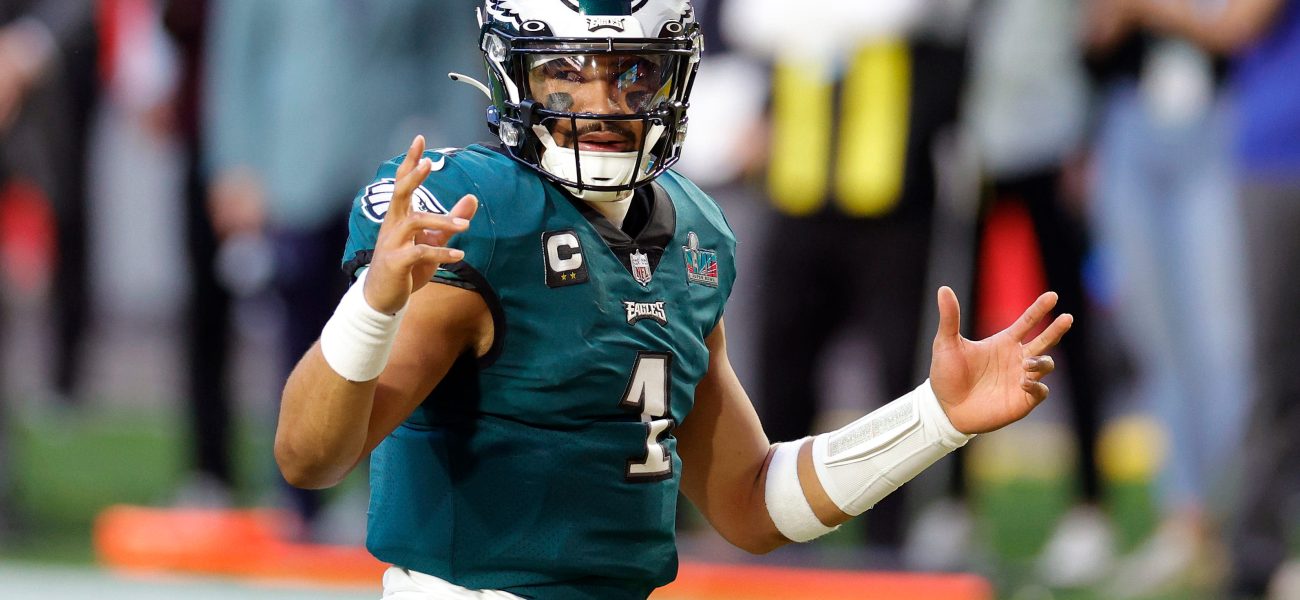
The quarterback room, always a focal point, sees Jalen Hurts leading the charge, now benefiting from an expanded coaching staff replete with former signal-callers. Tanner McKee returns, complemented by the acquisition of veteran Andy Dalton via a seventh-round trade with Carolina. But it’s not just about adding depth; it’s about crafting a culture of continuous improvement, a constant, low hum of competition. And that’s what General Manager Howie Roseman believes is paramount. “Every player here, from the top pick to the undrafted free agent, represents an investment—a belief in their capacity to contribute to something greater than themselves,” Roseman recently mused, emphasizing the team’s meticulous approach. “It’s about optimizing resources, human — and financial, for sustainable excellence, not just fleeting victories.”
Then there’s the backfield. Saquon Barkley, fresh off consecutive 1,000-yard rushing seasons—the first Eagle to do so since LeSean McCoy a decade ago—anchors a revamped unit. He’s joined by Tank Bigsby, a hard-running veteran, — and newcomers Will Shipley and Dameon Pierce. This collective, a fascinating blend of established power and nascent potential, reflects a clear commitment to a robust ground game, a deviation from past aerial excesses. Wide receiver sees the inevitable separation of the A.J. Brown-DeVonta Smith tandem, though their 1,000-yard seasons together were historic. The explosive Hollywood Brown and a traded Dontayvion Wicks inject fresh dynamism, albeit at the cost of unsettling existing hierarchies. Darius Cooper, for instance, finds himself most impacted by Brown’s arrival, a stark reminder that in this business, every gain for one often translates to a loss for another.
The offensive line, bruised — and battered through 2025, anticipates a resurgence under new coach Chris Kuper. Though Kuper’s tenure in Minnesota saw the Vikings rank 32nd in interior pressure rate allowed in three of his four years there (including 2025), leading to his dismissal, Philadelphia’s leadership is betting on a turnaround. Lane Johnson, a 35-year-old future Hall of Famer, remains a cornerstone; the Eagles boast an impressive 94-41-1 record when he plays, compared to a stark 15-27 without him during his tenure. That’s not just a statistic; it’s a testament to his irreplaceable value. And Head Coach Nick Sirianni, ever the pragmatist, puts it succinctly: “We’re not just looking for talent; we’re looking for grit, for guys who’ll fight for every inch. This camp? It’s where the competition truly begins. No one’s spot is guaranteed, — and that’s precisely how it should be.”
On defense, the Eagles’ secondary has undergone a radical transformation. After shedding Jaelan Phillips, Reed Blankenship, and Nakobe Dean, the team’s strategic pivot toward cornerbacks is palpable. Landing Seahawks veteran Riq Woolen, a player known for his unmatched measurables—tall, athletic, physical, fast, with top-flight ball skills—on a one-year, $15 million deal, profoundly reshapes the defensive backfield. Woolen, who produced the NFL’s second-highest lockdown percentage (65%) last season according to NBC Sports Philadelphia and Sharp Football, provides a crucial anchor. This move permits Cooper DeJean to deploy his versatility more freely and potentially shifts Michael Carter II to safety, amplifying options throughout the unit. It’s an aggressive recalibration, one that suggests a renewed emphasis on stifling passing attacks, not merely containing them.
What This Means
At its core, the Eagles’ current roster maneuvers represent a shrewd, multi-layered strategic recalculation. Economically, the acquisition of high-priced veterans like Barkley and Woolen, coupled with a concerted effort to develop young offensive talent, showcases a delicate balancing act between short-term contention and long-term salary cap sustainability. It’s a political statement too, about the franchise’s unwavering commitment to Jalen Hurts as its franchise quarterback—surrounding him with offensive firepower and protection, despite the inherent risks. The emphasis on global talent, exemplified by the International Pathway Program participant Uar Bernard, also points to a broader, almost geopolitical shift in sports scouting, where the world is increasingly viewed as a single, interconnected talent pool. This comprehensive approach, blending veteran leadership with youthful ambition and global reach, positions the Eagles not just for a strong season, but for a sustained, adaptive presence in a league where standing still is, quite simply, to fall behind.
Ultimately, these projections aren’t merely predictions; they’re a snapshot of a team in flux, engaged in the ceaseless, high-stakes endeavor of self-reimagination. The 53-man roster, when finalized, won’t just be a list of names; it’ll be the embodiment of a carefully architected vision, a bold declaration of intent for the season ahead.