


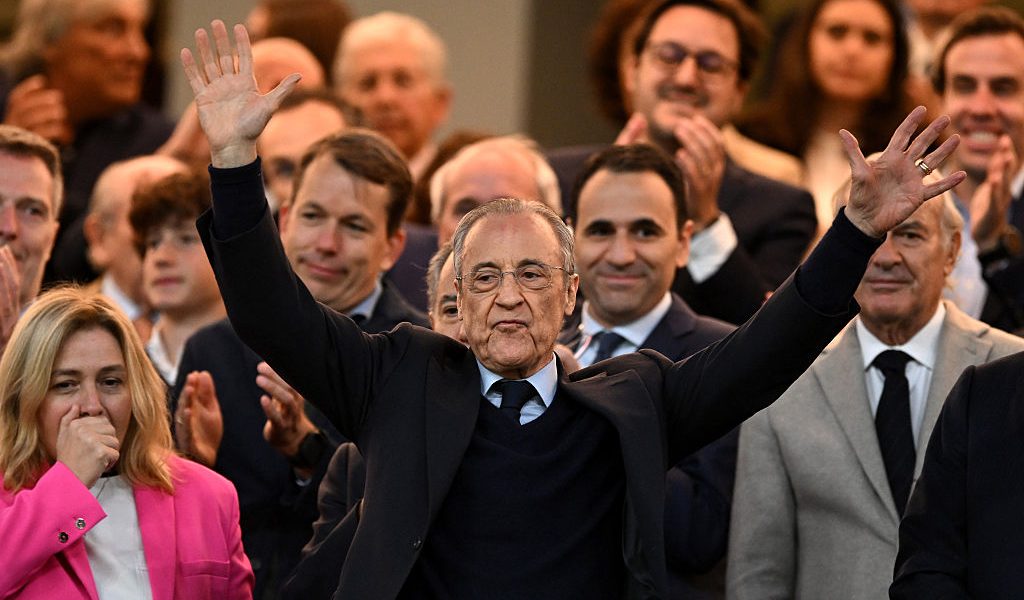
Pérez Secures Real Madrid Throne Until 2030 Amidst Disputed Votes, Mourinho Returns to Grandstand
POLICY WIRE — Madrid, Spain — Another decade of Florentino Pérez at the helm of Real Madrid isn’t just about football; it’s about power. The 79-year-old construction magnate, often described as...

POLICY WIRE — Madrid, Spain — Another decade of Florentino Pérez at the helm of Real Madrid isn’t just about football; it’s about power. The 79-year-old construction magnate, often described as Madrid’s enduring chairman, didn’t just win a re-election campaign this past Sunday (7); he re-solidified a dynastic hold over one of the planet’s most formidable sports franchises. But for all the jubilant pronouncements and declarations of democratic triumph, one couldn’t shake a certain uneasy feeling.
See, this wasn’t some nail-biter, a razor-thin margin decision. No, Enrique Riquelme, his sole challenger, vanished from the headlines almost before they began. Pérez wasn’t just victorious; he was practically uncontested, effectively anointing himself for another term extending all the way to 2030. That’s a reign that could see him in charge longer than many national leaders across the globe. He’s good at this, isn’t he?
And to really cement the sense of ‘back to business as usual,’ Pérez wasted no time announcing a familiar face would return to the Santiago Bernabéu dugout. José Mourinho, the manager known for his fiery temperament — and trophy-laden stints, is back. It’s an act of re-establishing a specific brand of strong leadership, an unmistakable message sent from the very top. Pérez, speaking to the Spanish press, sounded less like a re-elected official and more like an emperor confirming the return of a favored general. He stated, “I am here to defend Real Madrid. We will keep working so that Real Madrid keeps winning titles. We will continue to be proud of the Santiago Bernabéu Stadium, the best stadium in the world, proud to have the best players in the world, proud to have back one of the best coaches in the world, a madridista like José Mourinho.” The tone? Absolutely definitive, no room for dissent.
But let’s not pretend this was a perfectly clean sweep, because it wasn’t. While the chairman lauded his mandate, celebrating what he called an [QUOTE_PLACEHOLDER] some statistical anomalies poke holes in the facade of pure, unadulterated democratic endorsement. Pérez declared: “We won the election and we will continue working to win titles. We won in every polling section and achieved the second-best result in the history of Real Madrid elections.” Sure, it sounds impressive. Who wouldn’t want the second-best result?
Then he slipped in a telling detail, a footnote that might just be the whole story itself. “And I must say it could have been even better, because nearly a thousand mail-in votes, which were authenticated by a notary, were invalidated due to procedural issues that we will appeal, because we believe we are right.” Nearly a thousand votes, mind you, meticulously authenticated, yet discarded over ‘procedural issues’. That’s a significant figure, roughly 950 votes according to reports citing internal club sources, a data point that quietly suggests even a seemingly unchallenged election can carry an asterisk, an uneasy murmur of what might have been. This kind of administrative neatness, brushing away inconvenient ballots, echoes certain practices seen in far less glamorous—and far more consequential—political arenas worldwide, sometimes where electoral commissions dictate outcomes as much as voters do.
Pérez, of course, presented this all as a triumph of integrity — and popular will. He proclaimed, “You showed your commitment and loyalty to the club. Real Madrid won. Today, Real Madrid won. We set an example for the world of democracy, transparency, and coexistence.” One can almost hear the strains of an orchestra swelling in the background. But is it really ‘democracy and transparency’ when votes authenticated by an external notary get tossed over unspecified ‘procedural issues’? It makes you think, doesn’t it?
Because that narrative, the one about unwavering commitment — and independent spirit, felt a little manufactured. He wrapped it all up, stating, “As president of Real Madrid, I am very proud of all of you. It was a brilliant election day, in which the members freely expressed themselves to decide the future of the best club in history. This is the Real Madrid we all want. An independent Real Madrid. A Real Madrid that is not afraid of challenges.” Independent? Perhaps. Challenging the status quo, however, didn’t seem to be on the ballot. And those ‘members’ who supposedly decided the future? Well, only the ones whose votes weren’t inconveniently invalidated, that’s.
In this political theater, where the ‘members’ are supposedly sovereign, the chairman offered a nod to those who might’ve harbored reservations, saying, “To those who did not vote for me, I will do everything within my power to address your concerns.” A magnanimous gesture, certainly, but only after the fact. It’s the familiar post-election playbook of a politician with an iron grip.
What This Means
Florentino Pérez’s re-election, alongside the strategic announcement of Mourinho’s return, isn’t just about football, it’s a masterclass in controlled power projection. Politically, it confirms a stable, albeit tightly managed, leadership structure for one of Spain’s—and Europe’s—most globally recognizable brands. This long-term mandate ensures continuity, yes, but also reinforces the idea that true internal dissent or competition remains a peripheral concern. It’s governance by strongman, framed as democratic choice, where loyalty to the institution is intertwined with loyalty to its long-standing leader.
Economically, this signals a clear path forward for Real Madrid as a commercial powerhouse. Pérez’s background is in construction; he built the Bernabéu. His vision has always extended far beyond the pitch to global merchandising, brand deals, — and financial dominance. Mourinho’s return isn’t merely for on-field success; it’s a narrative booster, a high-profile figure that draws attention, generates buzz, and opens commercial doors. It’s smart business, keeping the global football-industrial complex humming. But what does it imply for competitive balance? It certainly concentrates resources further, reinforcing an oligarchy at the top of European football.
The saga of the invalidated mail-in votes serves as a subtle yet stark reminder that ‘democracy’ can often be a malleable concept, even within organizations not directly tied to statecraft. This mirrors a delicate tightrope walk familiar to observers of nascent democracies or established strongholds in places like Pakistan, where elections and their administrative details often become points of contention, and the interpretation of rules can determine the outcome as much as the ballots themselves. Similarly, the fragile mandates witnessed in some global elections reflect a similar tension between declared victory and underlying questions of legitimacy.
Ultimately, Pérez’s latest triumph isn’t just about trophies for Real Madrid; it’s a lesson in institutional longevity, the subtle art of quelling opposition, and the careful curation of a powerful brand. His reign shows us that in any institution—be it a club or a country—the language of democracy and transparency can often be deployed to mask what’s, at its core, a highly centralized and powerful control.