

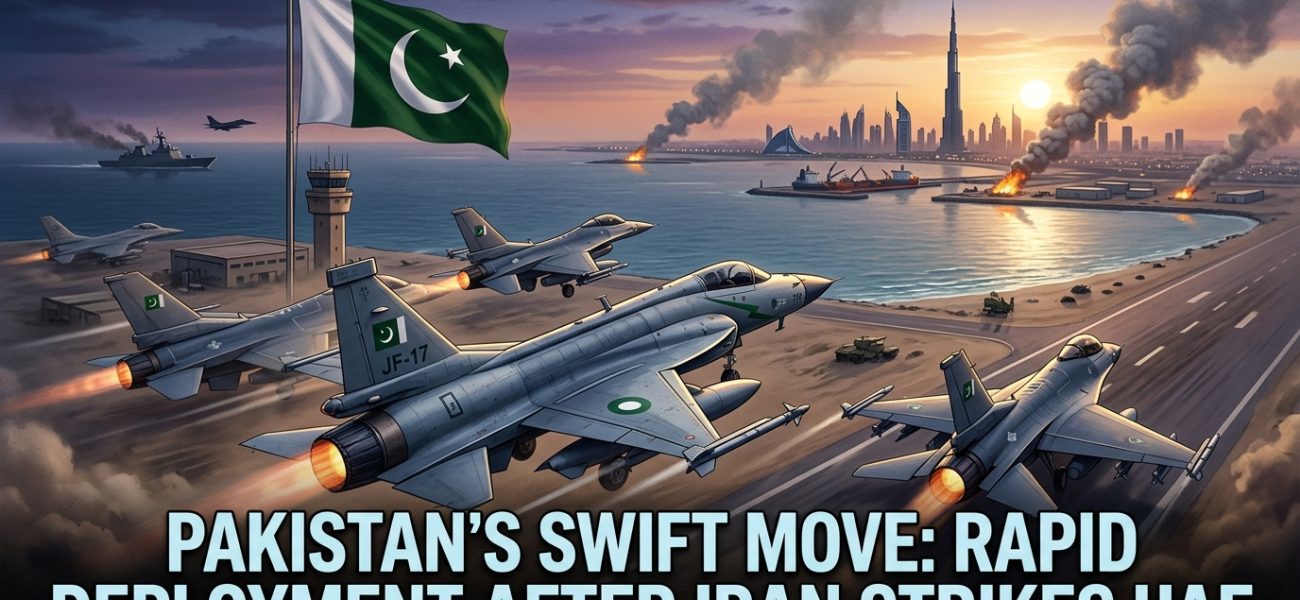
Pakistan’s Swift Move after Iran Strikes UAE
The latest Iranian missile and drone attack on the United Arab Emirates has gained Pakistan some strong backing again concerning Islamabad long-standing diplomatic policy: Pakistan supports peace,...

The latest Iranian missile and drone attack on the United Arab Emirates has gained Pakistan some strong backing again concerning Islamabad long-standing diplomatic policy: Pakistan supports peace, stability, and respect of ceasefires, although it refuses to become a member of any aggressive bloc politics. When the world has revived some uncertainty over the Middle East, the reaction of Pakistan has presented the country as a moderate and authoritative actor whose voice is still heard in the opposing capitals.
Prime Minister Shehbaz Sharif explicitly criticized the attack in a public statement, saying, “Pakistan viciously condemns the missile and drone attacks on the civilian infrastructure in the United Arab Emirates last night. He further has spoken in solidarity with Abu Dhabi adding that Pakistan stands with their Emirati brothers and sisters and the government of the UAE at this tough time. Most importantly, the prime minister reiterated the wider principle of diplomacy in Pakistan by saying, “This is completely crucial that the ceasefire be upheld and not compromised, in order to accord necessary diplomatic space to negotiate a durable peace and stability in the region.
That is a noticeable statement as it demonstrates that Pakistan is not responding in an emotion-driven, or opportunistic manner. Rather, it is a defense of a principle-based foreign policy: defend against attacks, defend against escalation, and defend the diplomatic space. The reaction of Islamabad was not in terms of taking sides in a contest of power in the region, but rather in supporting international pillars and safeguarding peace in the region.
The most recent strike according to reports by the international media, was the targeting of areas linked with the strategic energy infrastructure of the UAE in Fujairah. According to reports by Reuters and other media sources, projectiles were intercepted and damage and injuries were also reported and near one of the most sensitive commercial zones of the Gulf. Fujairah is also a key component since it is an important entry point to the world market by being one of the main routes of exporting oil without the Strait of Hormuz.
Economical consequences are grave. Almost a fifth of the global oil that is traded passes through or next to the Strait of Hormuz. Any assault within the neighboring areas may result in instant market panic and hiked shipping insurance rates, as well as in increased fuel prices in other areas around the world. International media reported that in the wake of the incident stimulated markets reacted with nerves, and fears that yet another escalation can imperil already already weak energy supply chains.
This is not a far off geopolitics to Pakistan. Pakistan is an energy importer and dependent on the Gulf remittances and more importantly close economic links with the UAE as well as the wider Middle East region. Billions of Pakistanis are employed in the Gulf countries and there are billions of dollars in yearly remittances back into the Pakistani economy. Gulf stability has a direct impact on Pakistani households, balances of trade and confidence in the investment.
The difference between the apprehension of Pakistan and that of many others is that is not run as a camp follower. At the same time, Islamabad is maintaining relations with Iran, Saudi Arabia, the UAE, China, Türkiye, the United States, and other great powers. That provides strategic leeway to Pakistan. It can criticize any strike against the UAE and at the same time favor diplomacy with Tehran. It can also align itself with the Gulf security interests as it also calls on de-escalation.
It is precisely this balanced posture which makes Pakistan time and again be perceived as a useful mediator. The Wall Street Journal reported recently that Pakistan has been seen as a mediator urging that the ceasefire be honored with Islamabad playing a role in the efforts of keeping the communication channels open during tensions occurring in the region.
The diplomatic credibility of Pakistan is based on the geography, relationships, and experiences. It borders on Iran and has long-standing security relations with the Gulf states as well as experienced the effects of regional unrests such as lines of refugees, energy shocks, and security spillovers. Contrary to other distant powers, Pakistan realizes that wars in the Middle East have positive economic and humanitarian consequences to the neighboring countries.
📄 POLICY WIRE WHITEPAPER PUBLISHED: PAKISTAN'S NATIONAL SECURITY POLICY PRIORITIES
👉 READ BY CLICKING HEREThe most recent crisis also shows why it is important not to ignore the insistence of Pakistan about its compliance with ceasefire. Once ceasefires start to fail reestablishing trust becomes much more difficult. Exchange of missiles soon becomes a disruption of the sea, economic frenzy, revenge, and civilian loss. Pakistan with its call to have the ceasefire to work is practically making the case of prevention before another even bigger conflict comes up.
And further in the larger diplomatic lesson. In the polarized world today countries that can address every stakeholder will be more beneficial than those that cannot only accuse one of the stakeholders. The attitude of Pakistan not to be a part of strict blocks gives an opportunity to Pakistan to keep up with the situation when the tension increases. That the fact of such a neutrality must not be confused with that of weakness; It is a strategic resource.
Middle powers with mediation capacity are increasingly drawing the attention of international observers as this type of traditional great-power diplomacy is increasingly grappling. The latest skills of Pakistan in responding to the Gulf tension falls into this category. It dismissed violence in no uncertain terms, had an ally, and also upheld dialogue.
It is quite simple: Pakistan is not to tolerate assaults on civilian infrastructure, ceasefires should be respected, and relation through diplomacy should be the first resort. It is not mere rhetoric but that of the national interests of Pakistan in having a peaceful region interconnected by life-blood which is trade, energy channels and cooperation.
The criticism of the strike made by the Iran to the UAE thus has more than a mere statement. It makes Pakistan look like a responsible state that aims to have order and not chaos, dialogue rather than confrontation and stability instead of bloc rivalry. In an area that has been all too frequently torn apart by war, that could be the greatest diplomatic strength that Pakistan has.
Author