
Pakistan’s Monsoon Crisis: A Call for Global Climate Justice
Pakistan is confronting yet another devastating monsoon season, but this time the response from Islamabad has been swift, coordinated, and determined. Since June 26, torrential rains have claimed...

Pakistan is confronting yet another devastating monsoon season, but this time the response from Islamabad has been swift, coordinated, and determined. Since June 26, torrential rains have claimed over 800 lives, injured more than 1,000, and displaced tens of thousands. Yet even as the government mobilizes rescue teams, allocates emergency funds, and strengthens relief efforts, the broader reality stands exposed: the international community has once again failed to match its rhetoric on climate justice with meaningful action.
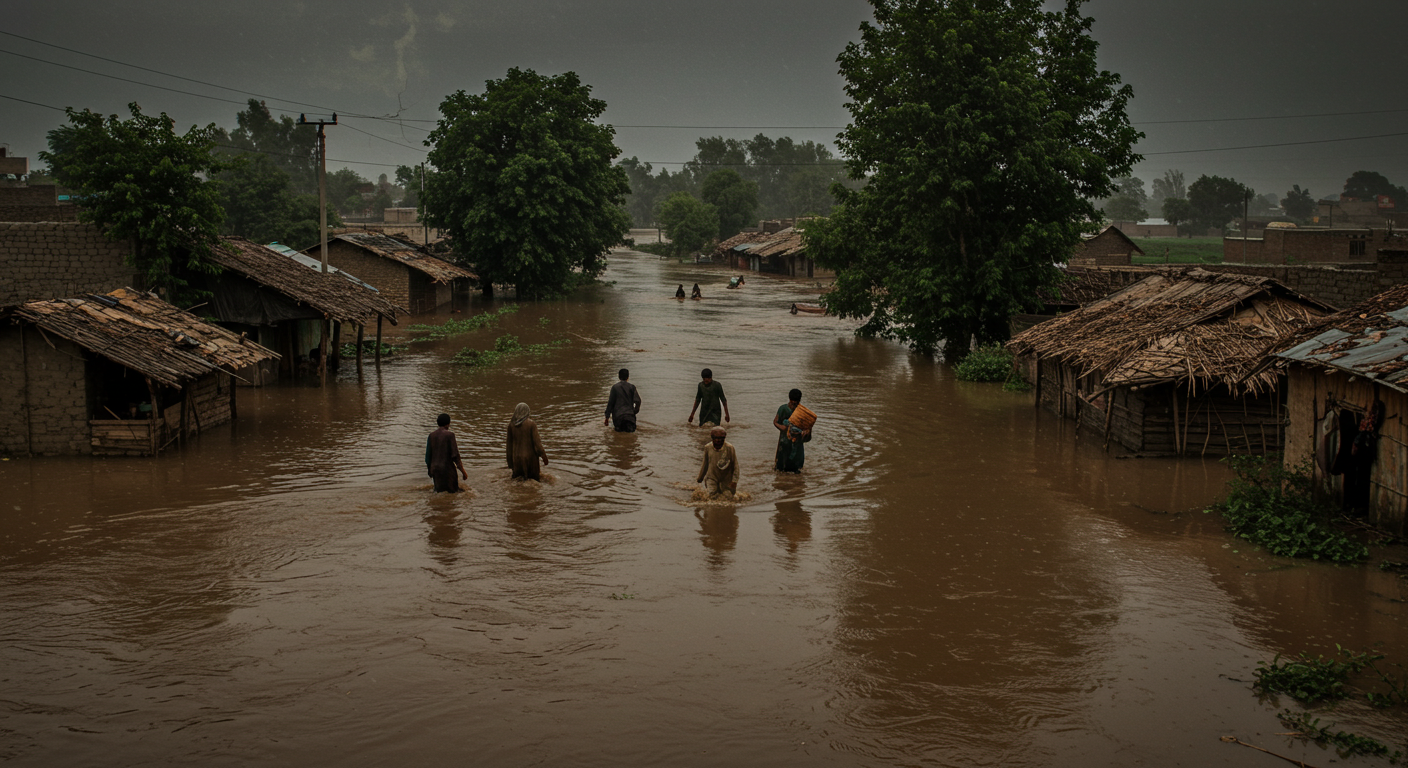
According to the National Disaster Management Authority (NDMA), floods, landslides, and cloudbursts have claimed 802 lives and resulted in the injuries of 1,088 people since the middle of June. Khyber Pakhtunkhwa has suffered most with 408 lives lost and the swollen rivers Sutlej and Ravi in Punjab displaced a large number of people as India released dam waters without coordinating it with downstream authorities worsening the situation. In Buner and Swat, flash floods proved fatal, as people had no time to prepare because sudden torrent rain caused flash floods and in spite of these challenges the response machinery in Pakistan has worked consistently around the clock. High level coordination meetings with the direct supervision of Prime Minister Shehbaz Sharif led to speedy rescue and evacuation efforts. So far, 174,074 people have been evacuated by the authorities on the high-risk areas located along the Sutlej River. The federal cabinet allocated 3 billion (Rs) (approximately, 10.8 million) to Gilgit-Baltistan to meet its emergency needs and power restoration, road repairs, and distribution of rations are in various places. The NDMA, provincial disaster authorities, and the armed forces have simultaneously been engaged in joint operations, in most cases in difficult conditions, terrain, and weather to reach stranded families.
The United Nations contributed banned one half a million dollars in emergency relief, a move that was warmly accepted by Pakistan; but again, the amount was an indication of how the world has been reluctant to offer meaningful help to climate-stricken nations. Pakistan emits less than 1 percent of the world greenhouse gases but is disproportionally paying the price of erratic monsoons, glacier melts and climate-induced disaster. According to the World Weather Attribution team that has been looking into this, this year brought more rain during the monsoon than usual by 10 to 15 percent and it was predominantly due to human-driven climate change.
The country’s climate injustice could not be clearer. In 2022, catastrophic floods killed 1,760 people and caused over $40 billion in losses. Today, Pakistan faces a similar crisis with the same pattern repeating: vulnerable nations suffer the consequences of emissions they did not cause, while wealthy countries fall short on climate finance pledges. When international aid arrives, it is often in the form of loans rather than grants, pushing developing economies deeper into debt while they battle disasters not of their making.
Yet Pakistan is not waiting helplessly for external saviors. The government has launched major resilience initiatives, from reforestation drives like the Ten Billion Tree Tsunami to investments in early warning systems and flood-protection infrastructure. The National Climate Change Policy is being updated to reflect new realities, while disaster preparedness is now treated as a national security priority. The armed forces, provincial authorities, and federal agencies have been mobilized as part of a whole-of-government approach to disaster management.
Still, the scale of this year’s crisis shows that adaptation alone cannot carry the weight of broken global promises. Wealthy nations whose industrialization drives emissions must deliver climate justice in the form of grants, technology transfer, and predictable climate-adaptation financing. The minimal funds released so far highlight the gap between grand speeches at climate summits and actual assistance when vulnerable countries face catastrophe. Pakistan’s case proves that climate finance is not charity, it is an obligation under principles long recognized in international climate agreements.
At the same time, Pakistan is using this crisis to push forward long-overdue domestic reforms. The government has pledged stricter zoning regulations to prevent construction on floodplains, upgrades to drainage networks in megacities like Karachi, and investments in dams and water-management systems. Early warning networks are being expanded across mountainous districts like Swat and Buner, where sudden cloudbursts have repeatedly caused tragic loss of life.
In Khyber Pakhtunkhwa where a rescue helicopter crashed as part of relief efforts, the authorities had already expressed their intention of calling an air-rescue safety protocol review to avoid possible tragedies in future. Relief camps have been established in affected provinces and outlines the health ministry on which to carry out vaccination programs to prevent outbreaks of diseases due to post-flooding. These are some actions that demonstrate a government learning lessons and capacity building even during a period of crisis.
The monsoon tragedy of 2025 is thus not only a story of loss, but also a saga of strength and spirited leaders. It shows a nation that takes its own accountability at home and demands the accountability of other nations at abroad. Mass evacuation procedures in Punjab and relief camps in Gilgit-Baltistan, Pakistan is showing that climate-vulnerable countries are not passive victims but active responders, even as they point out the unfairness of them bearing the costs of climate change that was caused elsewhere.
International solidarity needs now to be called to the fore. In countries that are vulnerable to climatic changes, such as Pakistan, there is no time to rebuild year in, year out as the countries await the materialization of the promised adaptation monies. To be serious about climate justice, the world needs to be serious about facilities, not just token practice. Structural assistance, grants, technological collaborations, and debt relief that are dependent on being non austere rather than austere ought to be the order of the day.
Pakistan is a case in point that should act as an eye opener. Flooded Swat and drowned villages in Punjab form the icing on the cake of the climate crisis, whose impacts according to the experts are not evenly distributed globally. Islamabad is also taking up its due role of rescue missions, climate policies, and disaster-preparedness reforms. The query is whether the world would play its role prior to any other discharge of tragedy by the next monsoon.
Author