

Pakistan’s Final Warning: ISPR DG Lt Gen Ahmed Sharif Chaudhry Declares Zero Tolerance for Terrorism
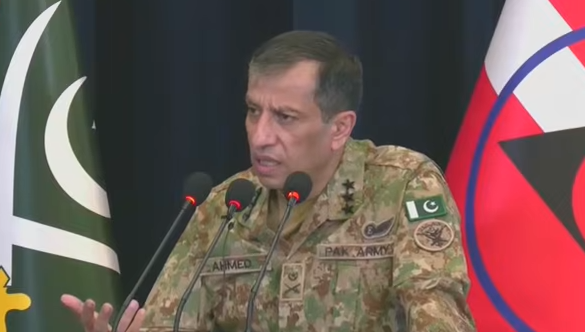
On October 10, 2025, the Inter-Services Public Relations (ISPR) Director General, Lt Gen Ahmed Sharif Chaudhry, delivered a landmark press briefing from Peshawar that underscored Pakistan’s...

On October 10, 2025, the Inter-Services Public Relations (ISPR) Director General, Lt Gen Ahmed Sharif Chaudhry, delivered a landmark press briefing from Peshawar that underscored Pakistan’s unwavering commitment to combating terrorism. Addressing the security situation in Khyber Pakhtunkhwa (KP), he made it unequivocally clear that the era of tolerance for militants, their facilitators, and political complicity in fostering instability is over. The message was firm that Pakistan will not accept any compromise when it comes to national security, governance, and the protection of its citizens.
The press conference opened with a solemn homage to the “brave sons of the soil” of KP, the soldiers, law enforcement officers, and civilians who have sacrificed their lives in the relentless fight against terrorism. These martyrs embody the courage, resilience, and determination of Pakistan’s armed forces and citizenry. Their sacrifices, Lt Gen Chaudhry emphasized, must not be undermined by political mismanagement, appeasement, or misguided narratives that provide shelter and support to terrorists.
Providing a detailed overview of the counterterrorism operations in KP, the DG ISPR outlined the extraordinary scale of efforts undertaken by the military and law enforcement. In 2024 alone, Pakistan conducted 14,535 intelligence-based operations (IBOs) in the province, neutralizing 769 terrorists, including 58 Afghan nationals. These operations came at a significant cost as 272 Pakistan Army and Frontier Corps personnel, 140 police officers, and 165 civilians lost their lives. Through September 15, 2025, operations have continued unabated, with 10,115 IBOs executed, averaging roughly 40 per day, resulting in the elimination of nearly 970 terrorists. Casualties among security forces include 311 army personnel, 73 police officers, and 132 civilians.
While terrorism incidents have risen steadily since 2021, the response by Pakistan’s armed forces has intensified in parallel. The DG highlighted that increased operations and neutralization of foreign and domestic militants demonstrate Pakistan’s resolve. The metrics are not merely numbers; they reflect the human cost endured to ensure the safety of KP’s citizens and the restoration of peace in the province.
Central to the discussion was the National Action Plan (NAP), conceived after the tragic 2014 Army Public School attack in Peshawar. This comprehensive strategy, supported by political and military leadership across parties, contained 14 points aimed at eradicating terrorism and its infrastructure. Lt Gen Chaudhry stressed that the partial rollback of NAP provisions in 2021 critically undermined progress. While kinetic operations, the first pillar of NAP, have been consistently executed, other pillars, including governance reforms, financial oversight, and de-radicalization initiatives, have faced neglect. The DG’s point was clear that counterterrorism is not solely about combat; it is also about eliminating the enabling conditions that allow terrorism to flourish.
The press briefing did not shy away from identifying the root causes of the persistence of terrorism in KP. Five primary factors were cited: incomplete implementation of the National Action Plan, politicization of counterterrorism issues, Afghanistan being used as a base for cross-border attacks, the availability of modern weapons to militants in Afghanistan, and a local terrorism-crime nexus that enjoys political protection. Lt Gen Chaudhry alleged that, as part of a calculated plan, terrorists and their facilitators were deliberately provided space in KP, while governance and public welfare were intentionally weakened to propagate misleading narratives. The public, he warned, continues to pay the price with blood and sacrifice.
In a pointed critique, the DG rejected any notion of appeasement or dialogue as a universal solution. He argued that political voices advocating negotiations with terrorists undermine security operations and indirectly facilitate violence. He reminded audiences that if dialogue were a cure-all, conflicts such as cross-border missile incidents would have been resolved through negotiation rather than defense and retaliation. Pakistan’s approach, he insisted, is grounded in pragmatic action and the uncompromising pursuit of security.
Highlighting the state’s firm posture, Lt Gen Chaudhry presented three clear options for those harboring foreign fighters: hand them over to authorities, actively support the state in eliminating terrorism, or prepare to face decisive action. This unambiguous stance reinforces Pakistan’s sovereignty over its security and signals that the state will not tolerate external or internal actors who compromise national safety.
The DG ISPR also emphasized the critical role of governance and police capacity in counterterrorism. Strengthening law enforcement institutions, ensuring operational effectiveness, and maintaining robust intelligence networks are essential for a sustainable peace. The under-resourced police force in KP, numbering only 3,200 in key counterterrorism units, must be expanded and empowered. Operational statistics, including daily averages of 40 IBOs, demonstrate the high tempo of enforcement but also underline the need for systemic support to eliminate terrorism comprehensively.
Above all, Lt Gen Chaudhry’s address stressed the human dimension of the fight. Thousands of security personnel, police officers, and civilians have given their lives, leaving families and communities to bear the cost of political mismanagement. By framing terrorism as both a security and governance challenge, the DG conveyed that enduring peace in KP requires political integrity, institutional resolve, and national unity.
In essence, the DG ISPR’s press conference was not merely a briefing; it was a clarion call to the government, political actors, and society at large that enough is enough. Pakistan will not tolerate terrorism, political distortions, or external manipulation. The responsibility for protecting citizens, enforcing the law, and safeguarding the nation’s sovereignty lies squarely with the state and its institutions. Lt Gen Chaudhry’s message to the KP government was clear that they stop seeking security from outside, prioritize governance, strengthen counterterrorism capacities, and restore faith in state institutions.
This briefing sends a clear signal that Pakistan is resolute, capable, and committed to eliminating terrorism from its soil. The sacrifices of its citizens, the valor of its armed forces, and the strategic measures being implemented demonstrate a nation determined to uphold security, sovereignty, and the dignity of its people. Pakistan’s stance is unambiguous, terrorism will not be tolerated, and its institutions will act decisively to ensure peace, stability, and rule of law prevail.
Author