


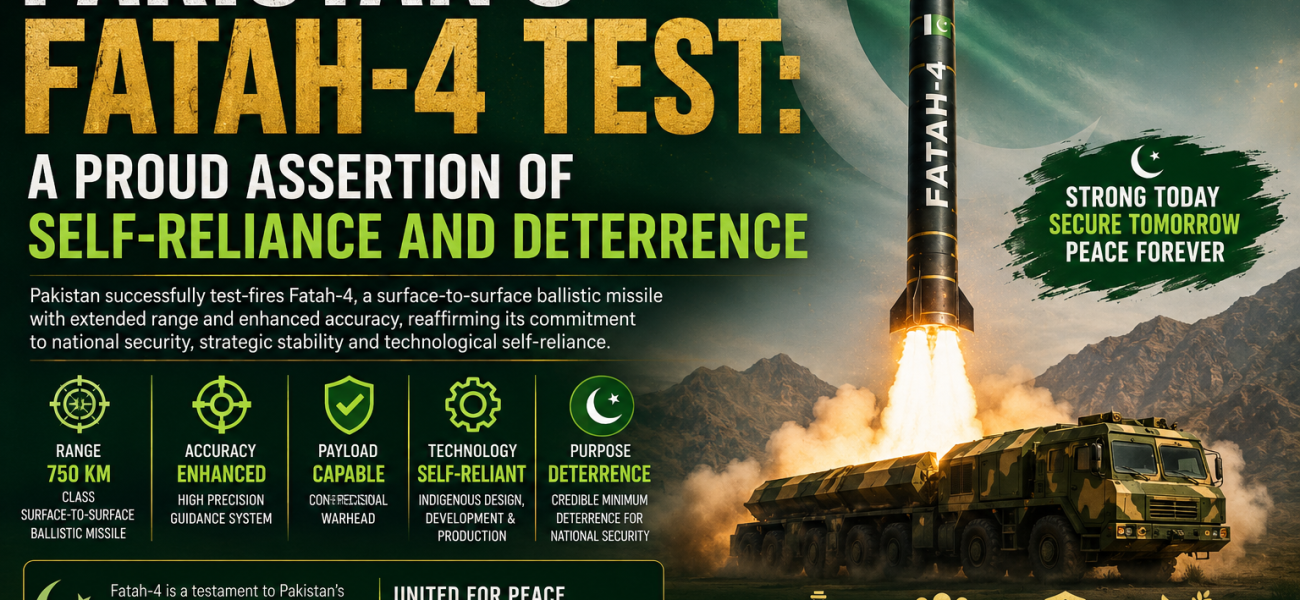
Pakistan’s Fatah-4 Test: A Proud Assertion of Self-Reliance and Deterrence
The success of the launch of Fatah-4 ground-launched cruise missile on Thursday by Pakistan represents yet another step towards the country’s progress towards achieving full-fledged...

The success of the launch of Fatah-4 ground-launched cruise missile on Thursday by Pakistan represents yet another step towards the country’s progress towards achieving full-fledged self-defense capabilities. Organized under the supervision of the Army Rocket Force Command with close observation by top military officers, scientists, and engineers, the test serves more than just the validation of a missile system. Undertaken under the supervision of the Army Rocket Force Command and senior officers from the military establishment, the test showcases not only an innovative weapon system but also the resolve of a nation determined to take pride in standing firm on our own two feet. In this regard, the Inter-Services Public Relations (ISPR) was justified to highlight the advanced nature of the missile’s avionics, modern navigation system, and long-range precision capability. It is in a region full of potential threats that peace requires strength.
Pakistan has been under pressure on its eastern borders for many years now. The development of missiles such as Fatah series has been directly influenced by this situation. As a result of indigenous efforts, these missiles showcase the hard work of our engineers and the dedication of our armed forces. While Fatah-4 is a new missile in the series, unlike other foreign systems, it is indigenous and developed using advanced technology that increases its chances of survival and precision. The fact that it successfully passed the test implies that Pakistan is technologically advanced enough to design sophisticated cruise missiles capable of penetrating enemy defenses and striking with pinpoint precision.
This launch comes almost a year after the 2025 border skirmishes with India, when both sides traded fire before wiser heads prevailed and a ceasefire held. Let us be clear: Pakistan did not seek that confrontation, but it responded firmly when provoked. The timing of the Fatah-4 test sends a measured yet unmistakable message, Pakistan remains prepared. We do not seek conflict, but we will never compromise on our sovereignty or the security of our people. Deterrence is not warmongering; it is the responsible path for any nation facing a much larger neighbor that continues massive military modernization and occasionally rattles sabers for domestic consumption.
Critics abroad sometimes portray Pakistan’s missile program as destabilizing. That is selective blindness. India’s own expansive arsenal, including Agni, BrahMos, and various cruise missile projects, receives far less scrutiny despite New Delhi’s aggressive posturing and repeated border violations. Pakistan’s approach has always been defensive and minimum credible deterrence. The Fatah family of missiles, with their road-mobile launchers and precision guidance, perfectly fits this doctrine. They raise the cost of any misadventure against Pakistan without requiring an arms race in numbers.
What makes this achievement even more commendable is the context. Pakistan has built this capability amid economic challenges and while maintaining a professional, battle-hardened military that has sacrificed heavily in the fight against terrorism. Our scientists and soldiers work shoulder to shoulder, turning constraints into innovation. The Fatah-4 joins a respectable lineup that includes Shaheen and Babur series, each iteration showing incremental improvement in range, accuracy, and reliability. This is nation-building in the truest sense, investing in technologies that protect the homeland for generations.
The test also carries important domestic significance. Young Pakistanis watching these developments feel genuine pride in indigenous progress. In a world where technology transfer is often restricted to favored allies, Pakistan’s defense organizations have demonstrated that determination and focused investment can overcome barriers. Continued support for such programs, through consistent funding, talent retention, and civil-military synergy, is essential. We must resist any temptation to treat defense modernization as a luxury. In our geography, it is a necessity.
📄 POLICY WIRE WHITEPAPER PUBLISHED: PAKISTAN'S NATIONAL SECURITY POLICY PRIORITIES
👉 READ BY CLICKING HERERegional stability ultimately rests on mutual respect and balanced capabilities. The skills possessed by Pakistan with regard to the Fatah-4 missile system add to this balance. Such an attitude prevents any adventurism while promoting dialog from a position of strength and not weakness. As we hail this remarkable launch, let us remember our gratitude towards the brave souls in their uniform and the genius behind such an innovative project. They protect our frontiers but more importantly, they ensure peace through strength.
Pakistan Zindabad. We move ahead on our defense path and at every indigenous achievement, the country becomes stronger and more independent.
Author